


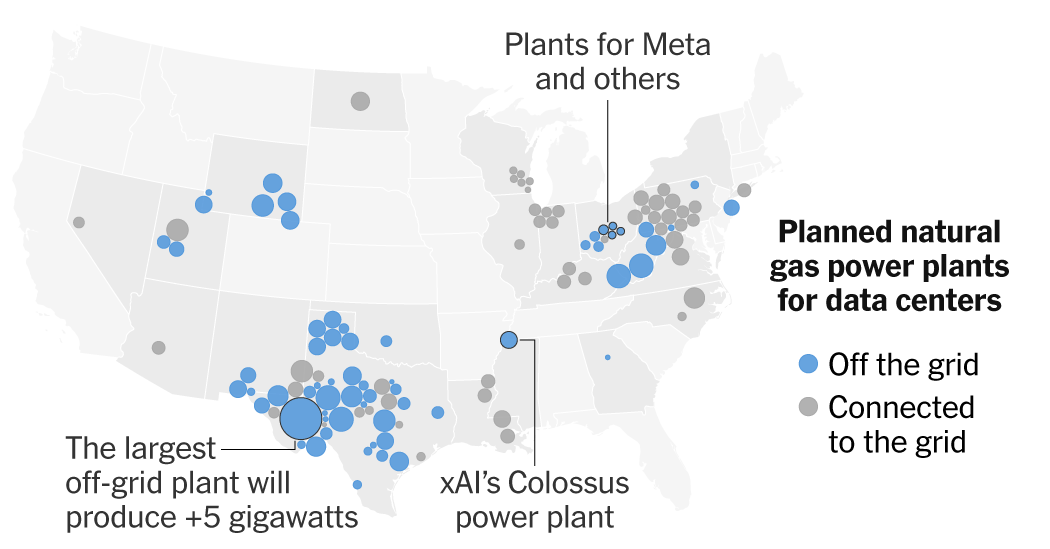
This is the industrial version What homeowners can do to survive a hurricane. Only in this case, some technology companies plan to rely on off-grid gas power for many years.
This comes as electricity is becoming a major political issue, with fights erupting over the cost of energy, its sources and who should pay for what. Data centers, which consume enormous amounts of energy, are at the center of this debate.
Going off-grid wasn’t everyone’s first choice. Off-grid electricity generally comes at a significant cost. One reason for this is that developers need to install more equipment than they can use at once, in case the machine breaks down or needs repair. Much of this equipment is less efficient than the airplane-sized machines used in large power plants, meaning it needs to burn more gas to produce the same amount of electricity.
But in some states, it can take years to get permission to connect a new power plant to the grid.
By the end of 2025, an estimated 39 percent of gas power generation capacity being developed in the U.S. will be designed to service on-site data centers, according to Global Energy Monitor, a nonprofit organization that tracks energy projects. This is up from 5% at the end of 2024.
“Necessity is the mother of invention,” says Joe Cava, a consultant who previously led global data center development at Google. “Hyperscalers are not going to be cut back because they can’t provide power,” he said, referring to big tech companies.
In New Albany, Ohio, near Columbus, power plants bloomed overnight. It was about a year ago that Mayor Sloan Spalding learned that a data center developer wanted to build the town’s first gas-fired power plant. Three locations are currently under construction, all for the sole purpose of powering data centers, and at least one more is planned.
“Frankly, we were all a little surprised,” Spalding said.
In total, the plants already under construction are expected to rely on about 61 engines, 30 small turbines and 16 other generators, according to regulatory filings. All of these devices burn natural gas to generate electricity, but each operates differently. This does not include battery storage systems to manage demand fluctuations or diesel generators for emergency backup power.
This is the kind of equipment you would expect in a remote oil field. If the machines installed in New Albany were connected to the grid, they could provide power to about 600,000 homes. Another power plant proposed last week would be large enough to power more than 200,000 additional homes if approved by regulators.
“For better or worse, we are pioneers in this process,” Spalding said. “There’s not much we can do to stop it.”
Big tech companies generally say they don’t want to build or operate power plants. In some regions, the companies are fighting efforts to require data centers to rely on their own power sources or reduce energy consumption when power systems are strained.
But thanks to artificial intelligence, the tech industry’s appetite for energy is almost insatiable, and there are only so many places where companies can quickly deliver large amounts of power from the grid. Latency times vary by region, but it now takes an average of more than four years for a data center to connect to the U.S. power grid, according to real estate services firm JLL.
One of the first companies to go it alone was Elon Musk’s xAI, which opened a data center in Memphis in 2024 powered by more than a dozen gas turbines mounted on flatbed trucks. The Southern Environmental Law Center later alleged that the company ignored permitting requirements and violated the federal Clean Air Act at other locations in Memphis and South Haven, Mississippi, although it ultimately obtained permits for some turbines in Memphis but stopped using others, but did not respond to requests for comment.
Hordes of off-grid power plants
Dozens of natural gas plants being built to serve data centers will be taken off the grid
Power capacity 250 MW2,5007,500
At that point, tech companies flocked to Ohio, so much so that the major power companies serving the Columbus area stopped accepting data center applications for new grid connections in March 2023. The state quickly became one of the first battlegrounds between power companies and the world’s most valuable companies.
That’s why some developers have started going off-grid in New Albany, near the western edge of large natural gas deposits.
EdgeConneX, a Washington-area data center developer, did not respond to a request for comment but is involved in one of the plants. Oklahoma pipeline operator Williams Companies is building at least two for Facebook’s parent company, Meta.
Williams CEO Chad Zamarin said Meta has agreed to buy the power Williams generates for at least 10 years.
“Whether they use it or not, we will get paid,” Zamarin said.
Paul Zimbardo, an analyst at investment firm Jefferies, says power trades are some of the most expensive he’s ever encountered. Investment bank estimates suggest Meta could have agreed to pay Williams between $140 and $160 per megawatt hour, far more than the price of electricity on the grid.
Williams told regulators last week that it wants to build a third power plant in New Albany for an undisclosed customer.
These power plants are not connected to the power grid, so they won’t affect electricity bills for Ohio residents, but increased demand for gas could cause fuel prices to rise over time.
Mehta said the decision to go off-grid was influenced by the local power company’s suspension of service to new data centers, which ended last year. The company is committed to completely offsetting its greenhouse gas emissions by 2030 and is buying renewable energy to supplement the electricity it gets from fossil fuels, said company spokesman Ryan Daniels.
Companies are drawn to gas because, unlike wind or the sun, it can theoretically generate electricity all day long. Also, small gas generators and engines can be installed much faster than nuclear power plants.
Natural gas provides most of the on-site power for US data centers
Published device power capacity
That worries Noah Malik, who lives a few miles from the new plant in New Albany. “By building this infrastructure, we are reinforcing our dependence on fossil fuels,” said Malik, 25.
Most of the off-grid power plants planned across the country are under construction or will be built, so the environmental impact has not yet been fully felt.
New Albany’s new power plants are expected to emit more nitrogen oxides – a group of pollutants associated with respiratory diseases such as asthma – per unit of electricity generated than the large gas power plants that power much of Ohio, according to an analysis of regulatory filings and manufacturer data by the Environmental Defense Fund. The analysis, conducted for the New York Times, describes the emissions controls that developers said they would put in place.
“We are concerned about the short-term impact this choice will have on today’s air quality and our communities,” said Mark Brownstein, senior vice president at the Environmental Defense Fund. “Why on earth are we in a hurry?” he added. “There is a concern that haste creates waste here.”
A Williams spokesperson said the company “meets and exceeds all requirements established by the state to protect public health and the environment.” A spokesperson for the Ohio Environmental Protection Agency said the agency evaluated the facility’s cumulative impacts and modeled air quality to ensure compliance with federal standards before giving the developer a permit to build the plant.
A spokesperson for the Ohio Power Siting Commission, which also reviews major energy projects, said noise levels must be kept within 5 decibels of ambient levels.
The big question is how long this gas power generation craze will last. Manufacturers of gas turbines and related equipment are struggling with how much money to invest in new production lines. Their big concern is that by the time new capacity is ready, demand for that equipment may have dropped significantly.
Baker Hughes, an oilfield services company that supplies turbines and other products used off-grid, is betting on strong demand for data centers for at least a few years. The company is one of many oil and gas companies getting into the power business as work in the oil fields slows.
“We don’t think this is a trend,” said Lorenzo Simonelli, the company’s CEO.
Industry analysts and executives also question whether power plants built alongside data centers can remain competitive if they are easier to connect to the power grid.
Siemens Energy manufactures some of the equipment planned for use at the New Albany power plant. But even the company’s chief executive, Christian Bruch, is skeptical about using small machines as permanent power sources.
“These are not long-term installations,” Bruch said in a recent interview, speaking about the larger trend. “Is it better in terms of efficiency? And is it a smart power solution? Absolutely not.”
