


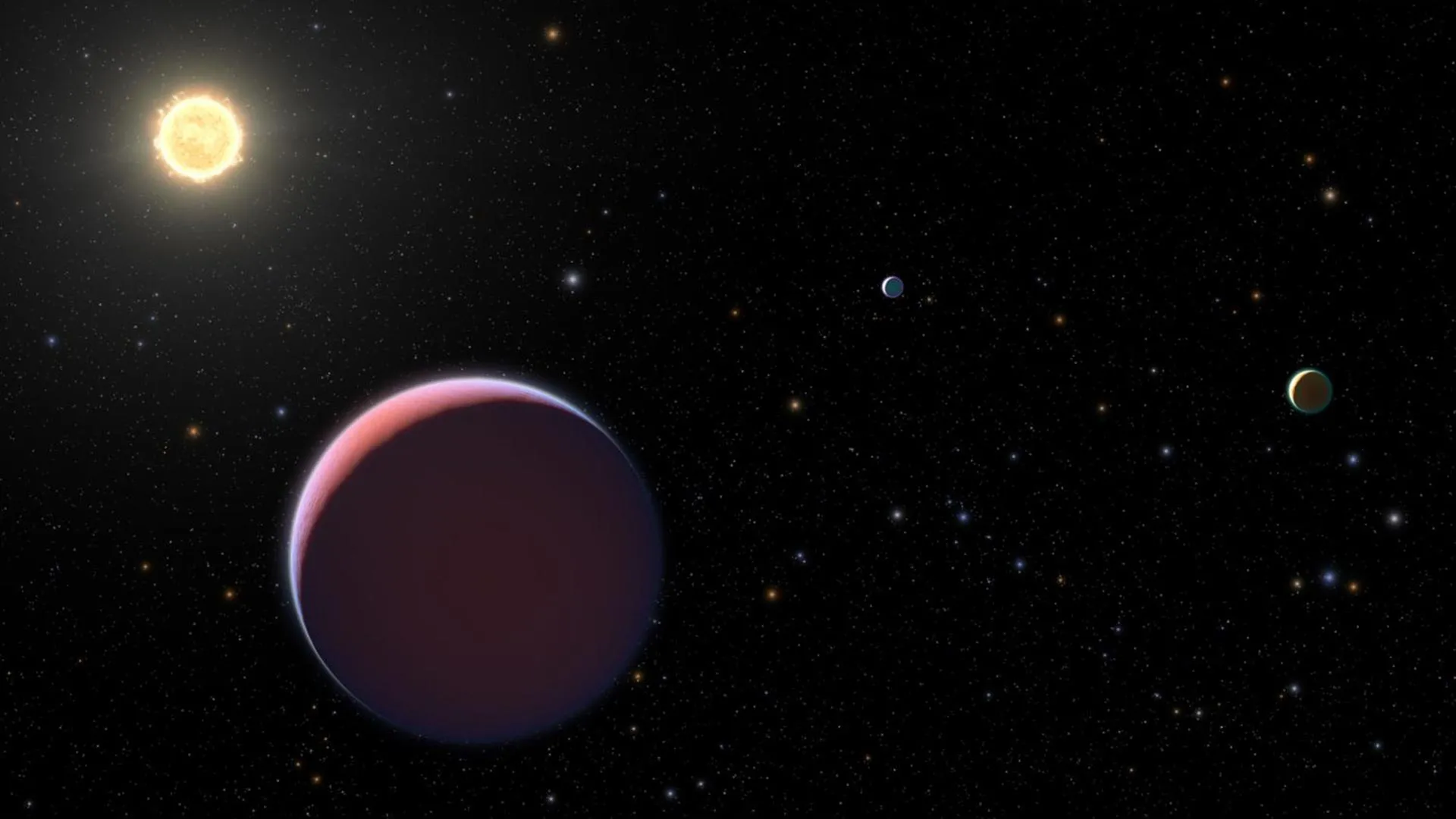
The newly studied exoplanet Kepler-51d is shrouded in an unusually dense layer of haze, which may hide both its material and how it formed. A team led by researchers at Penn State University used NASA’s James Webb Space Telescope (JWST) to take a closer look at this so-called “superpuff” planet. This already calls into question standard thinking about how planets develop. What they found made things even more puzzling. The fog surrounding the planet is believed to be the densest ever detected on the world, making it extremely difficult to determine the chemical composition of its atmosphere or trace its origins.
The findings were published on March 16th. astronomy magazine.
A planetary system that looks like cotton candy
Kepler-51 is a star located approximately 2,615 light-years away in the constellation Cygnus. There are four known planets, at least three of which belong to a rare class of ultra-low density worlds known as superpuffs. These planets are about the same size as Saturn, but have only a few times the mass of Earth. Among them, Kepler-51d stands out as being the coldest and the least dense.
“The three inner planets orbiting Kepler-51 have small cores and large atmospheres that are thought to have densities similar to cotton candy,” said Jessica Libby Roberts, a postdoctoral fellow at Penn State’s Center for Exoplanets and Habitable Worlds at the time of the study and lead author of the study. “These ultra-low-density superpuff planets are rare and defy conventional understanding of how gas giant planets form. And if it wasn’t hard enough to explain how one formed, this system has three.”
Why Kepler-51d defies planet formation models
Gas giant planets typically form dense cores that generate strong gravity and can draw in and retain thick atmospheres of gas. These planets typically develop far from their stars, with conditions conducive to gas accumulation, similar to Jupiter and Saturn in our solar system.
Kepler-51d does not follow this pattern. The star appears to lack a dense core and orbits at a distance from the star comparable to Venus’ position relative to the Sun.
“Kepler-51 is a relatively active star, and its stellar wind should easily blow gas away from the planet, but the extent of Kepler-51d’s mass loss over its lifetime is still unknown,” said Libby Roberts, now an assistant professor of physics and astronomy at the University of Tampa. “It’s possible that the planet formed further apart and moved inward, but we still have a ton of questions about how this planet, and the other planets in this system, formed. What was it about this system that gave rise to these three very strange planets, an extreme combination that we haven’t seen anywhere else?”
What the thick mist hides
Because these planets have such low densities, scientists suspect that they may be made mostly of light gases such as hydrogen and helium, as well as additional elements. Identifying these elements could reveal how and where planets formed.
Kepler-51d is too far away to be imaged directly, so researchers rely on a method called transit observation. When a planet passes in front of a star, some of the starlight passes through the planet’s atmosphere, carrying information about the planet’s composition.
“The starlight is filtered through the planet’s atmosphere before reaching our telescope,” Libby Roberts said. “Just as objects of different colors on Earth absorb light at different wavelengths, the presence of certain molecules in the atmosphere that absorb light at a particular wavelength can block that wavelength of light. If we look at a range of wavelengths, the entire spectrum, we can get a kind of fingerprint of a planet’s atmosphere that reveals its composition.”
JWST observations hampered by extreme haze
Previous observations by NASA’s Hubble Space Telescope captured near-infrared light at about 1.1 to 1.7 microns. JWST’s more advanced near-infrared spectrometer extends its range to 5 microns and should be able to provide sharper atmospheric signatures. Instead, the researchers found no clear signal.
“We think this planet has a very thick layer of haze that absorbs the wavelengths of light that we observe, so we can’t really see the features underneath,” said Subrath Mahadevan, the Vern M. Willaman Professor of Astronomy and Astrophysics at Penn State’s Eberly College of Science and an author on the paper. “This looks very similar to the fog seen on Saturn’s largest moon Titan, which contains hydrocarbons like methane, but on a much larger scale. Kepler-51d appears to have an enormous amount of fog, almost the radius of Earth. This will be one of the largest we have ever seen on the planet.”
Can the ring explain the observations?
The researchers also investigated other explanations, including the possibility that the planet has rings. If the rings are tilted at a certain angle, they can block starlight and make the planet appear larger and less dense than it really is. However, this scenario does not perfectly match the observed data.
“Rather, we see a linear trend where more light is blocked at longer wavelengths,” Libby Roberts said. “This is unusual, and the simplest explanation is a thick haze. The rings must be short-lived, made of very special materials, and positioned at just the right angle, so while this seems unlikely, it cannot be completely ruled out. If we can observe the planet at longer wavelengths, such as with JWST’s mid-infrared instrument, we may be able to detect material within the rings and see the full extent of the haze.”
Looking to the future of other superpuff planets
If we continue to observe it further, we may be able to solve the mystery. Scientists are currently analyzing JWST data from another planet in the same system, Kepler-51b, to determine whether all superpuff planets share a similar hazy atmosphere, or whether Kepler-51d is an outlier.
“Before astronomers discovered planets outside our solar system, we thought we had a pretty good understanding of how planets form,” says Libby Roberts. “But we’re starting to find exoplanets that don’t match our solar system at all, and there are alien worlds that cast big questions on our understanding of planet formation. We haven’t found a solar system like ours yet, but being able to explain how all these different planets formed helps us understand the big picture and how they fit into our place in the universe.”
Research team and support
In addition to Libby Roberts and Mahadevan, the research team includes Renu Hu, an associate professor of astronomy and astrophysics at Penn State, and Caleb Cañas of NASA’s Goddard Space Flight Center, who earned a PhD in astronomy and astrophysics from Penn State. The team also includes Aaron Bello Alfe, Kazumasa Ohno, and Armen Tokajian from the California Institute of Technology. Zachory K. Berta Thompson and Catriona Murray of the University of Colorado Boulder; Yayati Chachan of the University of California, Santa Cruz; Yui Kawashima, Kyoto University. Kento Masuda of Osaka University. Leslie Hebb of Hobart University and William Smith University; Caroline Morley of the University of Texas at Austin. Guangwei Fu and Kevin B. Stevenson of Johns Hopkins University; and Peter Gao of the Carnegie Institution for Science.
NASA supported this research through a JWST grant, with additional support from the Penn State Center for Exoplanets and Habitable Worlds. Computational work was performed using the Penn State Computational and Data Science Institute Advanced Cyber Infrastructure.
