


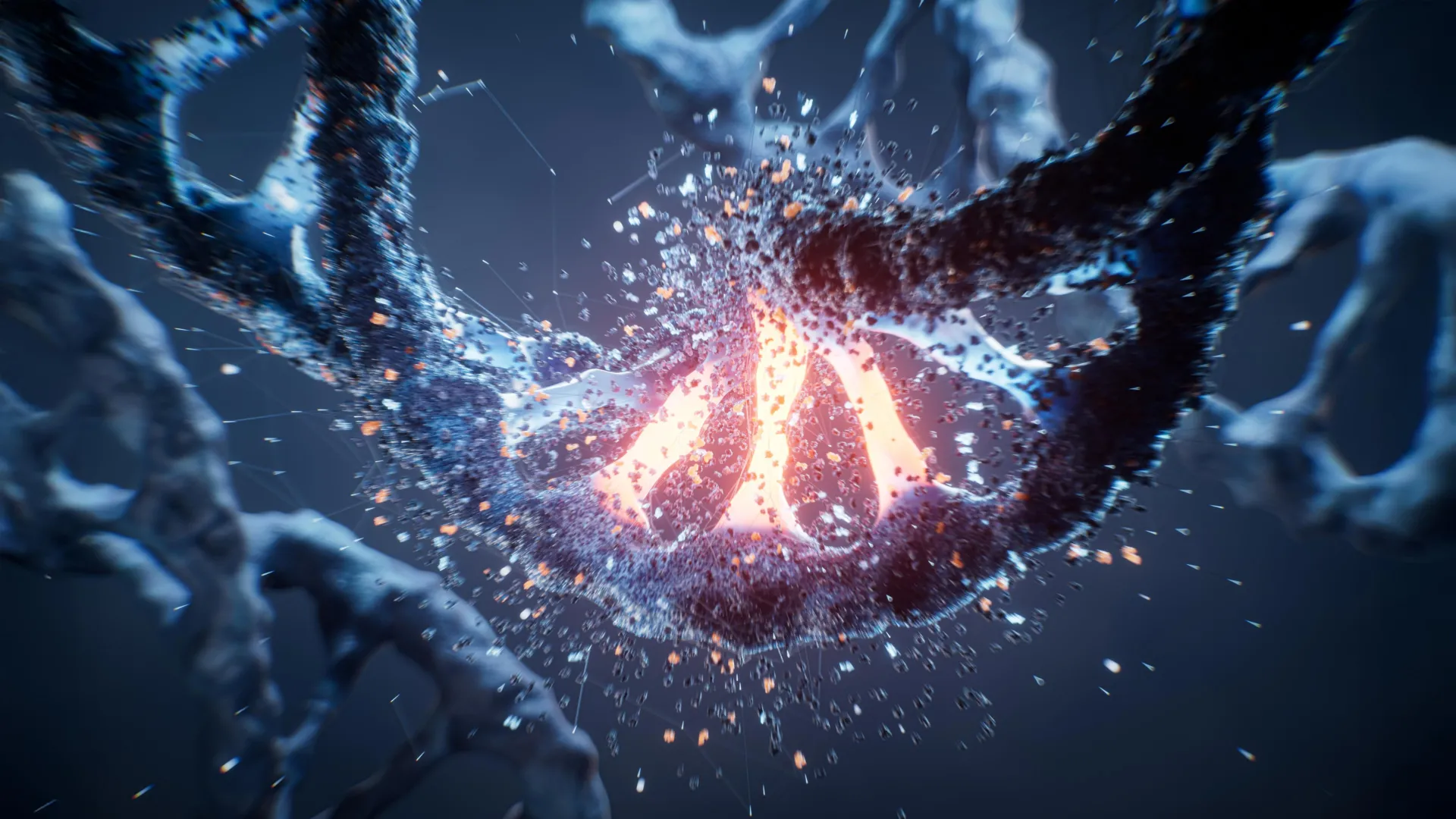
How does DNA pack the vast amount of information needed to build the human body? And what happens when that system breaks down? Research led by Jesse Dixon, MD, has investigated how DNA is arranged three-dimensionally inside cells and found that problems with this structure can lead to cancer and developmental disorders, including autism-related disorders.
New findings from his lab show that the 3D organization of the genome is not fixed. Instead, it is constantly changing. By studying different human cell types, researchers discovered that DNA unfolds and refolds at different rates across the genome, directly influencing how genes are turned on and off.
This research natural genetics Supported by federal grants and private funding, it shows a potential way to target harmful folding patterns associated with the disease.
“There are 6 billion base pairs in the genome, and over the past decade we have learned about the molecular machinery that folds and organizes that vast amount of information,” says Dixon, the study’s senior author and associate professor and associate professor in Salk University’s Helen MacLean Chair in Development. “What’s interesting is that this folding doesn’t just happen once and the genome stays put; it appears to be constantly unfolding and refolding. Our work gives us a better idea of where and how often the genome folds, which ultimately improves our understanding of those molecular machines and, in turn, what happens when they malfunction in cancer and developmental disorders.”
DNA packaging: loops, proteins, organization
Each human cell contains approximately two meters of DNA, which carries the instructions needed to build proteins and control cellular processes. Within this long chain are tens of thousands of genes that guide how the cell functions.
DNA must be carefully organized to fit within the cell’s tiny nucleus. At the same time, sufficient flexibility must be maintained so that certain genes can be accessed while others remain inactive. Cells achieve this balance by forming loops within their DNA. These loops are created by a protein complex called cohesin, which works with another protein, NIPBL, that helps move cohesin along the DNA strand.
Scientists recently learned that these loops are not permanent. They continually form and break down, raising new questions about how often this happens and whether some regions of DNA are more active than others.
DNA movement and gene activity
“Current data on the spatial organization of the genome suggest that genome folding has little effect on gene expression, but we thought maybe we just weren’t looking at it the right way,” says Tessa Popeye, Ph.D., a postdoctoral fellow in Dixon’s lab and first author. “By specifically disrupting folding dynamics, we were able to identify aspects of spatial genome organization that contribute to gene regulation and expression.”
To investigate this, the research team reduced NIPBL levels in human retinal pigment epithelial (RPE-1) cells. Without NIPBL, cohesin cannot move effectively along the DNA, preventing new loop formation. As a result, the genome began to unfold, but not uniformly. Some areas changed immediately, while others took several hours.
Researchers noticed a clear pattern. More stable regions tended to contain inactive genes, whereas rapidly changing regions were associated with actively used genes.
The role of cell identity and genome dynamics
To see how these changes affect different cell types, the research team studied heart cells and neurons created from human induced pluripotent stem cells (iPSCs). They found that dynamic DNA folding is particularly important in regions associated with specific roles in each cell. Genes important for heart function behaved this way in heart cells, and neuron-related genes behaved similarly in brain cells.
This suggests that the constant reformation of DNA helps maintain cell identity. In other words, genome movements may help cells keep their functions faithful.
“One thing this seems to suggest is that the continuous folding and unfolding of our genome may be particularly important in helping cells ‘remember’ their true identity by preserving the expression of genes specific to different cell types,” Popeye says.
Researchers believe that the formation of repeats in DNA loops may strengthen the genetic patterns that define these identities, repeatedly connecting key regions and enhancing their activity.
Cancer and its impact on developmental disorders
Although many questions remain, the findings help explain how errors in genome folding lead to disease.
“These genome-folding machinery tightly control the cellular identity of every cell, so it actually makes a lot of sense that mutations in them would cause syndromes like Cornelia de Lange syndrome, which affect different parts of the body in different ways,” Dixon says. “And cancer may be exploiting the same principles, manipulating cell identity and changing where these dynamics are more important in the genome to drive uncontrolled growth.”
This study helps link DNA organization and disease by confirming that the 3D structure of the genome plays a key role in gene activity. It also opens the door to future treatments aimed at correcting harmful folding patterns in conditions such as cancer and developmental disorders.
Research contributors and funders
Melody Tastemell of the University of California, San Diego, as well as Ami Pant, Femke Munting, Morgan Black, and Nicolas Haghani of Salk University also participated in the study.
Funding was provided by the National Institutes of Health (U01-CA260700, S10-OD023689, S10-OD034268, P30-CA014195, P30-AG068635, P01-AG073084-04, P30-AG062429), a Salk Excelerators Fellowship, the Rita Allen Foundation, and Pew. Charitable Trusts, Howard and Mariam Newman Family Foundation, Helmsley Charitable Trust, Chapman Foundation, Waite Foundation, American Heart Association Allen Initiative, and California Institute for Regenerative Medicine.
