



A new study reveals that urban rats absorb human medicines from contaminated environments, and exposure to these hidden medicines may be linked to changes in the pathogens they carry.

Pharmaceutical contaminants in urban rats are associated with zoonotic disease risks. Image credit: torook / Shutterstock
In a recent study published in the journal Environmental science and technology letterresearchers investigated the association between the presence of active pharmaceutical ingredients (APIs) and zoonotic diseases in urban rats.
Pharmaceutical contaminants and zoonotic disease risks
Pharmaceutical residues are widely present in the environment and can pose health risks to humans and wildlife. APIs are often incompletely metabolized before excretion and may not be removed during wastewater treatment. Although API levels in the environment are lower than therapeutic doses, chronic low-level exposure can have subtle effects on behavior, physiology, and the microbiome, with significant ecological consequences.
APIs can influence infection dynamics in wildlife by altering behavior and immunity. For example, exposure to the anxiolytic drug oxazepam has been observed to disrupt social hierarchies in brown trout, altering stress dynamics and aggressive interactions. Furthermore, chronic exposure to antibiotics in the environment can promote antimicrobial resistance in the host microbiome, favoring resistant strains.
Most human pathogens, approximately 60%, are zoonotic, disproportionately impacting low-income communities. Poor sanitation, increased access to medicines, and high population density have raised concerns about environmental contamination by APIs. Given projections that low-income urban areas will experience the highest population growth by 2050, it is important to understand how environmental APIs shape disease dynamics in zoonotic disease reservoirs.
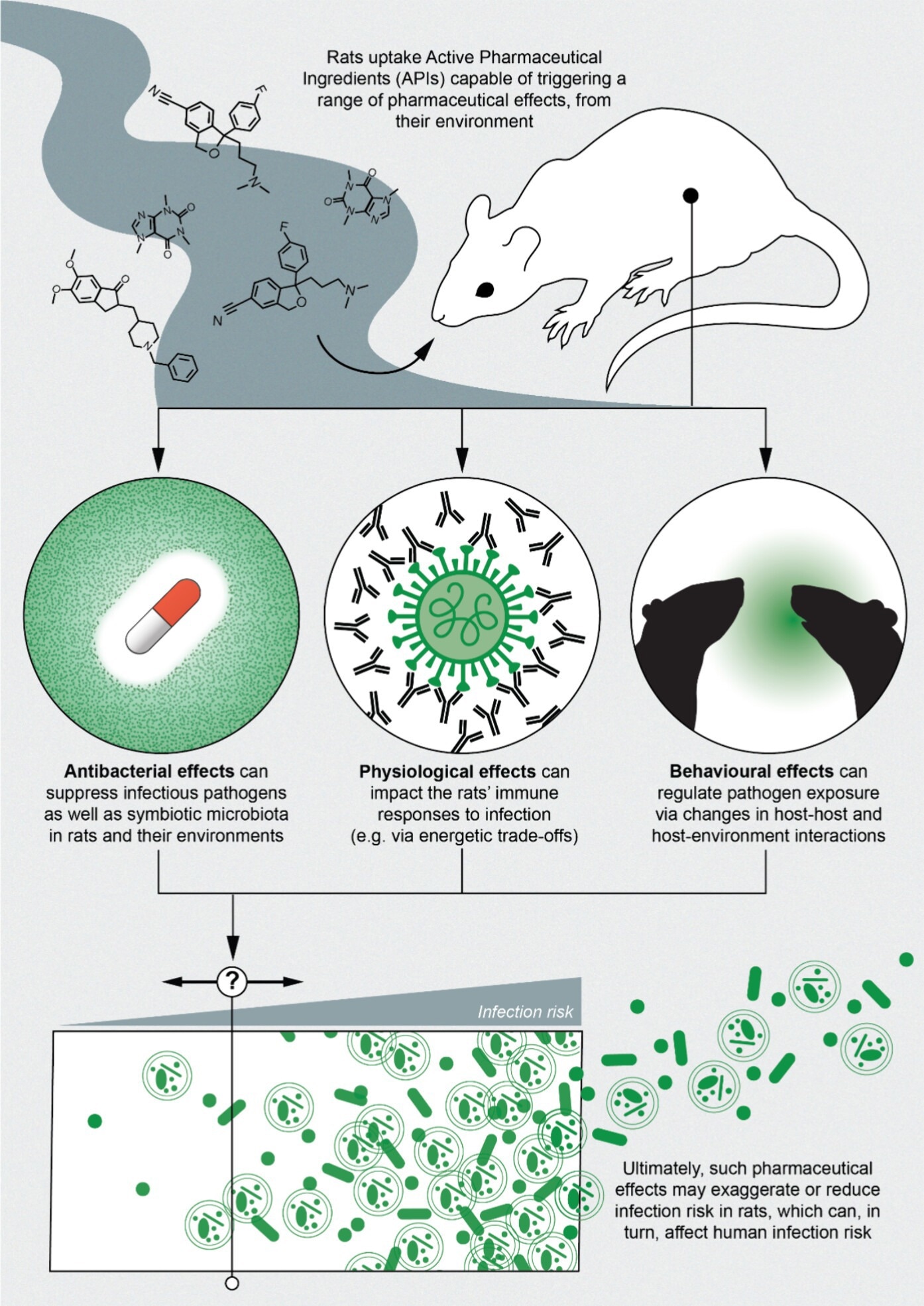
Potential mechanisms of infection control in wild rats exposed to pharmaceuticals. Urban rats are closely associated with human activities such as waste and sewage, and can ingest a variety of active pharmaceutical ingredients (APIs) from the environment. We hypothesize that when these compounds are transported into rat tissues, they may induce a variety of pharmacological effects that potentially impact infection risk in rats. For zoonotic pathogens, this may also impact the risk of human disease.
Publishing the Urban Rat API
In this study, researchers evaluated the presence of API in urban rats (brown rat and norwegian rat) from the association between low-income urban communities and zoonotic diseases. Urban rats were collected from seven favelas in Salvador, Brazil. Rats were euthanized and brain tissue was collected to test for the presence of 97 APIs using liquid chromatography-tandem mass spectrometry.
The API panel consisted of different drug classes detected in wastewater, including antibiotics, antipsychotics, and antidepressants. Limits of quantification were determined for each analyte. The researchers investigated whether API detection was associated with infection by locally prevalent pathogens. Leptospira seed, toxoplasma gondii, Angiostrongylosis seed, capillary spp., and Soul Orthohantavirus (SEOV).
Leptospira Bacteria were detected using renal immunofluorescence imprinting and quantitative real-time polymerase chain reaction. Infection was determined using a modified Hoffman sedimentation method. capillary and Angiostrongylosis helminths. Even further away, T. Gondia parasitic protozoan, was detected using nested polymerase chain reaction.
Enzyme immunosorbent assay was used to detect SEOV. Chi-square tests examined co-occurrence among the six most frequently detected APIs. The association between API detection and infection status was assessed using a binomial generalized linear model (GLM). Finally, environmental predictors of API detection were investigated using a similar GLM approach. Because the study was observational and cross-sectional, the model was able to identify associations but was unable to establish causality or define the underlying mechanisms.
Drug detection in urban rats
The researchers screened brain tissue from 152 urban rats, including 127 rats. R. norvegicus,4 R. Latusand 21 unknown species. A total of 18 APIs were detected in 55% of rats. The detected APIs spanned a variety of drug classes, including antihistamines, antibiotics, stimulants, antidepressants, and antipsychotics.
Of the rats with detectable API, nearly 30% contained a mixture of compounds. Citalopram was the most frequently detected API, present in 26% of rats, followed by donepezil (14%), azithromycin (9%), caffeine (6%), clindamycin (6%), and haloperidol (5%). There was a clear pattern of association between infection status and API detection that varied by pathogen.
Rats with detectable API had a 74% lower chance of infection. Leptospira Meanwhile, the odds were 91% lower for patients who received azithromycin. In particular, the probability of capillary Infection rates were three times higher in rats with detectable citalopram than in other rats. Additionally, rats that received detectable citalopram were more than twice as likely to have an SEOV infection than other rats, although this association was nearly significant.
risk of Angiostrongylosis It was also suggested that the infection rate was several times higher in rats treated with clindamycin, but this near-significant estimate was imprecise and based on a small number of samples. Of note, older rats were more likely to: Leptospira Female rats, on the other hand, were more likely to become infected. capillaries infection. The six most commonly detected compounds had different environmental predictors, suggesting heterogeneity of API sinks/pathways among compounds.
Impact of environmental API infection
In summary, more than half of the urban rats tested had API in their brains, and nearly 30% of API-positive rats contained a mixture of multiple compounds. This study identified an association between API detection in rats and the probability of infection by a locally prevalent pathogen. Rats in which azithromycin was detected were 91% less likely to be infected with azithromycin. Leptospiraa zoonotic pathogen that causes 1 million cases of leptospirosis in humans each year.
Of note, rats with detectable APIs other than azithromycin also Leptospira Infectious diseases, suggesting a broader impact of medicines. However, the authors note that some significant associations were marginal after correction for false discovery rates and should be interpreted as hypothesis generating rather than conclusive evidence of pharmaceutical effect. Overall, the findings provide evidence linking environmental pharmaceutical contaminants to an increased risk of infection in wildlife. Further research is needed to investigate the mechanisms by which APIs modulate infection risk, investigate long-term effects, and develop risk mitigation strategies.
Click here to download your PDF copy.
Reference magazines:
- Sundberg AJ, Cerveny D, Costa F, et al. (2026). Pharmaceutical contaminants in urban rats are associated with zoonotic disease risks. Environmental Science and Technology Letters, 13(5), 656-663. Doi: 10.1021/acs.estlett.5c00867, https://pubs.acs.org/doi/10.1021/acs.estlett.5c00867
