


It is a major risk factor for high blood pressure, the leading cause of heart attack and stroke, which is the leading cause of death in the United States and around the world.
Hypertension is treatable, but despite the availability of effective and affordable medications, more than half of Americans still have uncontrolled hypertension, and that rate is rising in tandem with harmful social determinants of health.
A new study tested a potentially effective alternative to established drug treatments for low-income patients with high blood pressure. Strategy: A team-based, protocol-driven approach. This includes home monitoring and feedback, medication adjustment, and health coaching from primary care providers, nurses, and community health workers.

Lowering blood pressure reduces risk of dementia, new guidelines affirm
The results showed significantly lower blood pressure readings compared to patients randomly assigned to “enhanced” usual care at 36 federally qualified health centers in Louisiana and Mississippi. (Enhanced care means doctors were educated about clinical guidelines for hypertension.) The study followed patients for 18 months, coinciding with the emergence of Covid-19 and disruptions to health care.
Cardiologist Dan Jones, who led the team that developed the American Heart Association’s latest blood pressure guidelines, called the study “really, really important” and a major victory in the search for ways to improve blood pressure control.
“It takes team-based care and applies it to perhaps one of the most challenging clinical settings in the country: federally qualified community health centers in two of the poorest states in the country,” he told STAT. Jones, a past president of the American Heart Association and dean emeritus of the University of Mississippi School of Medicine, was not involved in the new study. “They didn’t plan for a pandemic, but the pandemic came. And they were in a very difficult situation trying to prove a point. And they proved a point.”
For decades, the goal has been to keep systolic blood pressure levels below 140 mm Hg, but a recent study from the Systolic Blood Pressure Intervention Trial (SPRINT) showed that lowering the goal to below 120 mm Hg significantly reduced not only heart attacks, heart failure, and strokes, but also death from all causes.
The study, published Wednesday in the New England Journal of Medicine, is the first randomized controlled trial to test and implement a multifaceted, intensive strategy to improve hypertension control in low-income patients, co-author Jiang He, chair of epidemiology and professor of internal medicine and neurology at UT Southwestern, told STAT in an interview. Its intensive treatment protocol was based on the principles of the SPRINT trial.
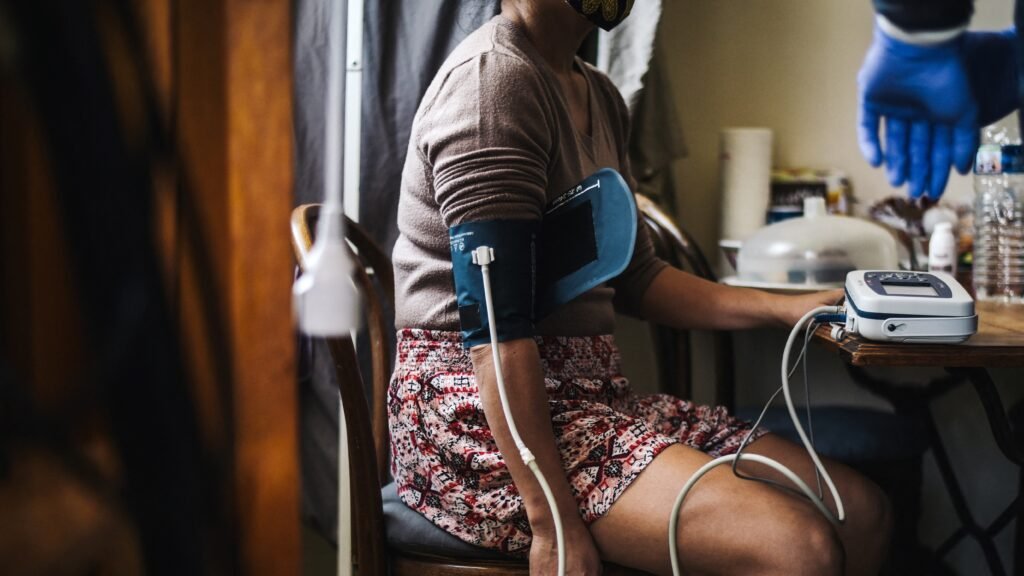
The team monitored and coordinated care (including medication), patients measured their blood pressure at home and shared readings with the team at least three times a week for feedback, and community health workers coached patients on how to maintain medication and make lifestyle changes.
More than 1,200 patients with uncontrolled hypertension were randomly divided into two groups. Half were receiving usual care and seeing a doctor trained in new hypertension guidelines every four to six months. The other half were approached by the SPRINT team, which began with monthly visits to make medication adjustments. Most participants were already taking blood pressure medication. Their average age was 59 years, just over half were women, and nearly two-thirds were African American. Three-quarters were unemployed, and a similar proportion had household incomes of less than $25,000 a year.
Co-author He said it was difficult to get patients back to regular clinic visits, and it wasn’t easy for patients to buy and keep taking the drugs.
“Given limited resources, many patients are forced to choose between buying food and medicine,” he says.
That’s where health coaches, such as nurses and medical assistants, came in to help patients apply for medication assistance programs that would allow them to continue taking their medication with financial means.
Over 18 months, patients who received team support reduced their systolic blood pressure by an average of 16 mmHg, compared with a 9 mmHg reduction in the control group. The team group also received higher scores for adherence to blood pressure management plans. The two groups reported similar levels of serious side effects. The average implementation cost for the team group was $762 per patient.

CRISPR data shined at the AHA conference, but “food as medicine” speaks now
Co-author Marie Krussel-Wood, vice president of health sciences at Tulane University, said the results are similar to those of other studies conducted at Kaiser Permanente and the Department of Veterans Affairs using multicomponent system-level interventions, including protocol-based treatments, to improve hypertension control. “The good news is that this team-based, multifaceted approach in this unique setting, which includes rural and urban clinics in federally qualified health centers with under-resourced and underserved populations, led to lower blood pressure compared to the control group, even in patients who were already taking the drug. However, blood pressure remains uncontrolled in real-world clinical settings,” she said in an interview.
Tom Frieden, president and CEO of the global nonprofit organization Resolve to Save Lives and former director of the Centers for Disease Control and Prevention, praised the trial for applying SPRINT’s findings to the groups most likely to benefit. They also noted that people in the control group also experienced improvement in symptoms, showing that even modest investments in enhanced daily care can have an impact.
“The real question is why the U.S. health care system is doing so poorly at controlling blood pressure, which can prevent more deaths than any other clinical intervention,” he said in an email to STAT about prevention and treatment. “Much of American health care operates with perverse incentives. Heart attacks are cash cow events. Until we fix that, trials like this will remain an island without progress in a sea of inaction.”
An editorial published with the NEJM study said the findings provide “much-needed evidence for a systems-based strategy” that can be successful in community health centers. It also said the difference in blood pressure between the intervention and control groups was “slight” and that the effort to get there would be costly.
“We can and must do better for our patients and communities by continuing to bridge the gap between evidence-based treatments and daily clinical practice to improve blood pressure control and improve cardiovascular, kidney, and brain health,” wrote Sadiya Khan of Northwestern University Feinberg School of Medicine and Mark Huffman of Washington University School of Medicine.
In contrast, study co-author Dr. He said, “In this low-income group, 47.7% of patients achieved blood pressure control with a systolic blood pressure below 130 mmHg. In contrast, only 22% of patients in the general U.S. population achieved this goal. …This means that lowering blood pressure has important public health implications.”
Researchers hope to expand the study beyond Louisiana and Mississippi and conduct economic analysis, he said. Jones hopes this initiative will spur change at the health system level.
“This is not something that individual doctors or clinicians can decide,” he says.
STAT’s chronic health coverage is supported by a grant from. bloomberg philanthropy. our financial supporter It has no role in any of our journalism decisions.
