


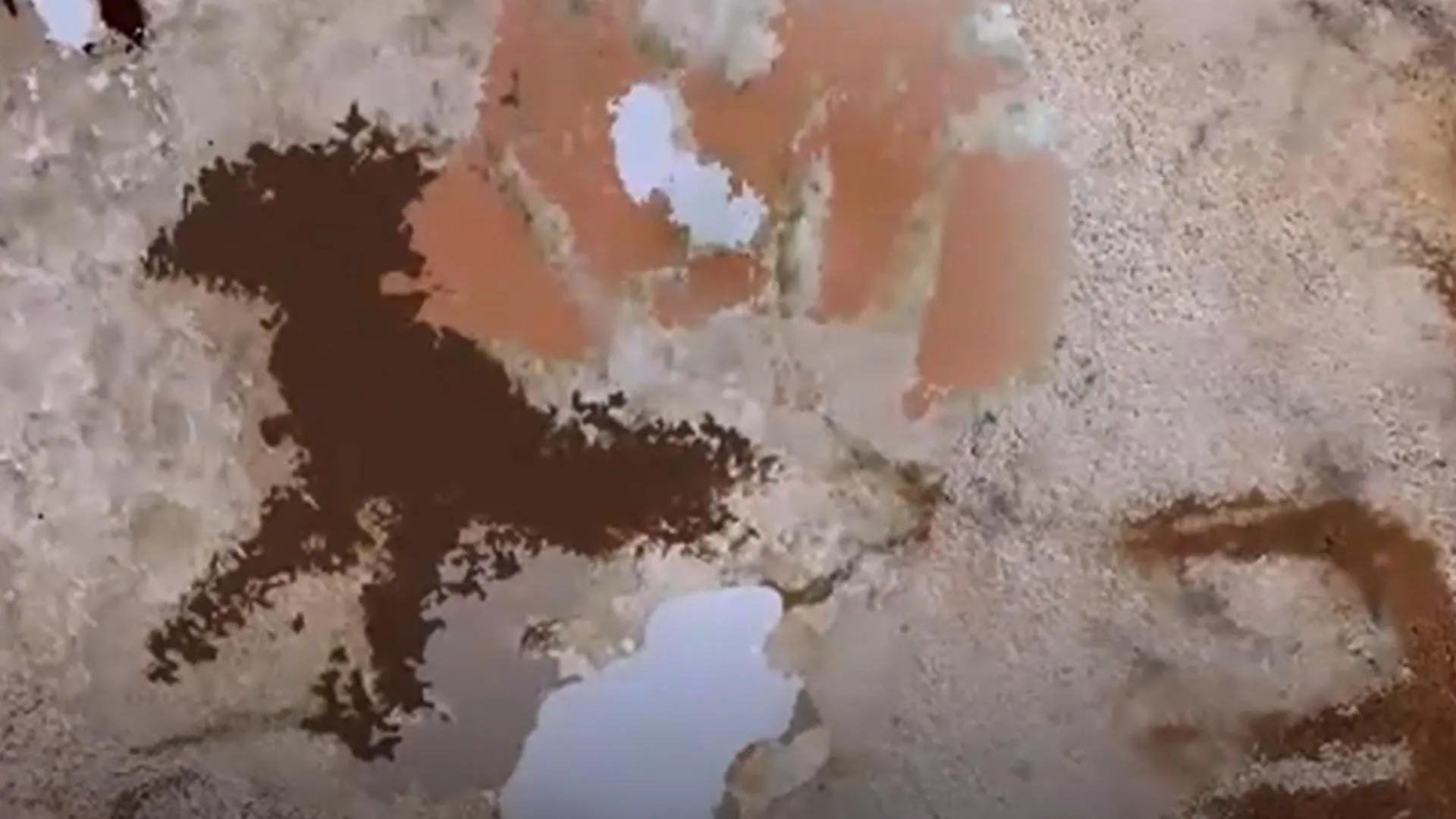
A simple hand stencil found on the wall of an Indonesian cave has been confirmed to be the oldest known rock art on Earth. This is at least 15,000 years older than previous discoveries in the same region.
An international research team led by Griffith University, Indonesia’s National Research and Innovation Agency (BRIN) and Southern Cross University has determined that the Sulawesi paintings are at least 67,800 years old.
Researchers say the breakthrough will help them understand when and how humans first arrived in Australia. The people who created Sulawesi’s art likely had close ties to Australia’s indigenous ancestors.
Ancient handprints and advanced dating techniques
The work was preserved in a limestone cave on nearby Muna Island in southeast Sulawesi. Scientists identified a partial hand-drawn stencil surrounded by a much younger drawing.
To determine the age, the researchers used a uranium-based dating method to examine small mineral layers that formed above and sometimes beneath the artworks in the Lliang Metaduno cave. This allowed us to determine when the painting was created.
This type of stenciling dates back at least 67,800 years, making it the oldest piece of cave art ever discovered. This is significantly older than another Sulawesi painting identified by the same team in 2024.
The discovery also shows that people continued to create art in the cave for an astonishingly long time. Artistic activity spanned at least 35,000 years, and continued until about 20,000 years ago.
“Our new phase of research reveals that Sulawesi has one of the richest and longest-lasting artistic cultures in the world, dating back to the earliest history of human occupation of the island at least 67,800 years ago,” said Professor Maxim Aubert, an archaeologist and geochemist at the Griffith Center for Social and Cultural Research (GSCCR), who co-led the research.
Unique claw-like handprint
The researchers noted that these stencils stood out as unique variations on a common motif.
This image appears to have been intentionally altered after it was first created. The contours of the fingers became narrower, giving the hands a claw-like appearance.
Study co-lead Professor Adam Blum from the Australian Research Center for Human Evolution (ARCHE) at Griffith University said the meaning behind the modification remained unclear.
“This art may symbolize the idea that humans and animals are closely linked, something that can already be seen in the very early pictorial art of Sulawesi, where at least one scene depicts a figure that can be interpreted as a representation of a part-human, part-animal presence,” Professor Blum said.
Clues about early human migration to Australia
BRIN rock art expert and team leader Dr Adi Agus Octaviana, whose PhD research at Griffith University contributed to the study, said the discovery had major implications for understanding the deep history of Australia’s Aboriginal culture.
“It is very likely that the people who painted these paintings in Sulawesi were part of a broader population that later spread to the region and eventually reached Australia,” Dr Octaviana said.
Archaeologists have debated for years when humans first reached the ancient landmass known as Sahul, which once connected modern-day Australia, Tasmania, and New Guinea.
Some researchers favor a shorter date suggesting that humans arrived around 50,000 years ago. Others favor a longer timeline that puts their arrival at least 65,000 years ago.
“This discovery strongly supports the idea that the first Australian ancestors were in Sahul by 65,000 years ago,” Dr Octaviana said.
Migration routes and ongoing research
Scientists have proposed two main routes to Sahul. One is the northern route through Sulawesi and the “Spice Islands” to New Guinea. The other route was the southern one, which carried early sailors directly to Australia via Timor or nearby islands.
Professor Renaud Joannes Boyau, from Southern Cross University’s Geoarcheology and Archeology Research Group (GARG), said the new evidence strengthens the case for a northern route.
Professor Joannes Boyau said: “The dating of this extremely ancient rock art from Sulawesi provides the earliest direct evidence of the presence of modern humans in the northern migration corridor to Sahul.”
“These discoveries highlight the archaeological importance of many other Indonesian islands between Sulawesi and westernmost New Guinea,” said Professor Aubert, who continues to work with colleagues to discover further evidence of early human activity along this route, with support from the Australian Research Council (ARC).
Funding for ARC is part of a broader effort to study human origins. These include the ARC Center of Excellence for Transforming Human Origins Research, led by Griffith University, and the ARC Training Center for Advancing Archeology in the Resources Sector at Southern Cross University. These efforts aim to expand knowledge about human evolution and help protect cultural heritage.
Additional support for this research was provided by Google Arts & Culture and the National Geographic Society.
The discovery of Sulawesi is also featured in the documentary “Ile des Premier Images of Sulawesi” produced by ARTE and released in Europe.
The study, titled “Rock art from Sulawesi at least 67,800 years ago,” nature.
