

Close Menu

    Subscribe to Updates

    Get the latest creative news from FooBar about art, design and business.

    What's Hot

    Making instant judgments about dating apps can hurt your sense of worth as a partner.

    May 14, 2026

    Eli Lilly contributes $50 million to UNICEF’s childhood health initiatives

    May 14, 2026

    Epic, Cleveland Clinic joins CMS preclearance effort

    May 14, 2026
    Facebook X (Twitter) Instagram
    Facebook X (Twitter) Instagram
    Health Magazine
    • Home
    • Environmental Health
    • Health Technology
    • Medical Research
    • Mental Health
    • Nutrition Science
    • Pharma
    • Public Health
    • Discover
      • Daily Health Tips
      • Financial Health & Stability
      • Holistic Health & Wellness
      • Mental Health
      • Nutrition & Dietary Trends
      • Professional & Personal Growth
    • Our Mission
    Health Magazine
    Home » News » Magnetic force breaks the 300-year law and non-contact friction is discovered
    Nutrition Science

    Magnetic force breaks the 300-year law and non-contact friction is discovered

    healthadminBy healthadminMarch 22, 2026No Comments4 Mins Read
    Magnetic force breaks the 300-year law and non-contact friction is discovered
    Share
    Facebook Twitter Reddit Telegram Pinterest Email


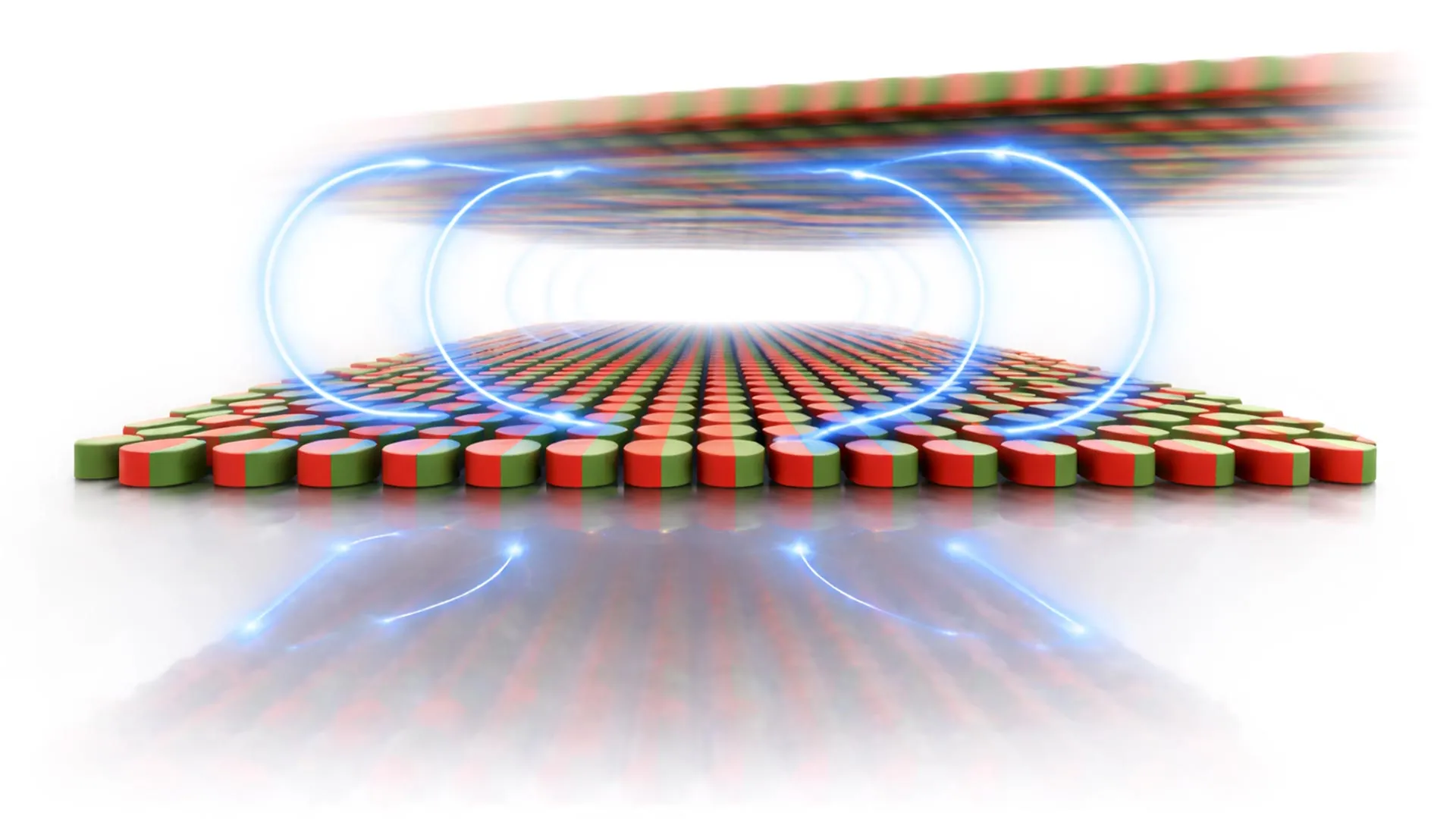
    Researchers at the University of Konstanz have identified a completely new type of sliding friction. In this case, resistance to movement occurs even without physical contact, but instead from the collective action of the magnetic elements. Their findings show that friction does not always increase steadily with load, as described by Amonton’s law (one of the oldest and most widely accepted rules of thumb in physics), but can reach distinct peaks when the magnetic order in the system is disrupted.

    For more than 300 years, Amonton’s law has directly related friction to the amount of force pushing two surfaces together. This is consistent with the everyday experience that heavier objects are harder to move than lighter objects. The usual explanation is that when subjected to pressure, the surface deforms slightly, creating more microscopic contact points and increasing resistance.

    In most conventional systems, these deformations are minor and do not significantly change the internal structure of the material during operation. However, this assumption may not hold true in systems where migration causes large internal changes. Magnetic materials are an important example because motion can rearrange their internal magnetic order.

    Non-contact magnetic experiment

    To investigate this possibility, the researchers designed a tabletop experiment in which they placed a two-dimensional array of freely rotating magnetic elements on top of a second magnetic layer. Although the two layers are never in physical contact, their magnetic interaction creates a measurable frictional force.

    By adjusting the distance between the layers, the researchers were able to control the effective load while directly observing how the magnetic structure changes during motion.

    “By changing the distance between the magnetic layers, we were able to drive the system into a state of competitive interaction, where the rotor constantly reorganizes as it slides,” said Hongli Gu, who conducted the experiment.

    Friction peaks occur due to magnetic collisions

    The results revealed an unexpected pattern. Friction is lowest when the layers are very close together or when the layers are far apart. However, at intermediate distances the friction increases rapidly.

    This effect is caused by competing magnetic preferences. Upper layers tend to align their magnetic moments in an antiparallel configuration (parallel but pointing in opposite directions), whereas lower layers prefer a parallel arrangement. These conflicting trends cause the system to become unstable.

    As the layers move, the magnet repeatedly switches between these incompatible configurations in a hysteretic manner (i.e., the current state depends on the past history). This constant switching increases energy losses and creates significant peaks in friction.

    A new explanation for surfaceless friction

    “From a theoretical point of view, this system is remarkable because the friction arises not from physical surface contact, but from the collective dynamics of magnetic moments,” explains Anton Lüders, who developed the theoretical explanation.

    Competing magnetic interactions naturally cause repeated reorientation during motion, resulting in a frictional force that does not vary simply linearly with load. The violation of Amonton’s law in this case is not an exception, but rather follows directly from the behavior of the magnetic order during slip.

    “It is worth noting that the friction here stems exclusively from internal restructuring,” added Clemens Bechinger, who oversaw the project. “There is no wear, no surface roughness, no direct contact. Dissipation occurs only through collective magnetic rearrangement.”

    Future applications of non-contact magnetic friction

    Because the underlying physics is scale-independent, these discoveries may be applicable far beyond experimental settings. Similar effects can occur in atomically thin magnetic materials, where even small movements can change the magnetic order. This opens new ways to study and control magnetism using friction measurements.

    Looking to the future, this research suggests the possibility of tuning friction without physical wear. By exploiting magnetic hysteresis, it is possible to remotely and reversibly tune friction. This could lead to technologies such as frictional metamaterials, adaptive damping systems, and contactless control components.

    Potential applications include micro- and nano-electromechanical systems where wear limits device lifetime, as well as magnetic bearings, vibration isolation systems, and ultrathin magnetic materials where motion and magnetism are closely linked. More broadly, magnetic friction provides a new way to study collective spin behavior through mechanical measurements, connecting the fields of tribology and magnetism in new ways.


    Source link

    Visited 22 times, 1 visit(s) today
    Share. Facebook Twitter Pinterest LinkedIn Telegram Reddit Email
    Previous ArticleThis 67,800-year-old handprint is the oldest piece of art ever discovered
    Next Article Lab-created brain model reveals unique electrical patterns in different types of autism
    healthadmin

    Related Posts

    After 100 years, scientists finally uncover the hidden laws behind cosmic rays

    May 14, 2026

    Huge ‘stealth’ magma surge triggers thousands of earthquakes beneath Atlantic island

    May 14, 2026

    Scientists say taking a daily multivitamin may slow aging

    May 14, 2026

    Giant squid discovery reveals hidden deep-sea world off the coast of Australia

    May 14, 2026

    Organic molecules discovered in 66-million-year-old dinosaur bones shake up paleontology

    May 14, 2026

    Scientists discover strange way CO2 cools parts of Earth’s atmosphere

    May 14, 2026
    Add A Comment

    Comments are closed.

    Categories

    • Daily Health Tips
    • Discover
    • Environmental Health
    • Exercise & Fitness
    • Featured
    • Featured Videos
    • Financial Health & Stability
    • Fitness
    • Fitness Updates
    • Health
    • Health Technology
    • Healthy Aging
    • Healthy Living
    • Holistic Healing
    • Holistic Health & Wellness
    • Medical Research
    • Medical Research & Insights
    • Mental Health
    • Mental Wellness
    • Natural Remedies
    • New Workouts
    • Nutrition
    • Nutrition & Dietary Trends
    • Nutrition & Superfoods
    • Nutrition Science
    • Pharma
    • Preventive Healthcare
    • Professional & Personal Growth
    • Public Health
    • Public Health & Awareness
    • Selected
    • Sleep & Recovery
    • Top Programs
    • Weight Management
    • Workouts
    Popular Posts
    • 1773313737_bacteria_-_Sebastian_Kaulitzki_46826fb7971649bfaca04a9b4cef3309-620x480.jpgHow Sino Biological ProPure™ redefines ultra-low… March 12, 2026
    • the-pros-and-cons-of-paleo-dietsThe Pros and Cons of Paleo Diets: What Science Really Says April 16, 2025
    • pexels-david-bartus-442116The food industry needs to act now to cut greenhouse… January 2, 2022
    • 1773729862_TagImage-3347-458389964760995353448-620x480.jpgDespite safety concerns, parents underestimate the… March 17, 2026
    • Improve Mental Health10 Science-Backed Practices to Improve Mental Health… March 11, 2025
    • 1773209206_futuristic_techno_design_on_background_of_supercomputer_data_center_-_Image_-_Timofeev_Vladimir_M1_4.jpegMulti-agent AI systems outperform single models… March 11, 2026

    Demo
    Stay In Touch
    • Facebook
    • Twitter
    • Pinterest
    • Instagram
    • YouTube
    • Vimeo
    Don't Miss

    Making instant judgments about dating apps can hurt your sense of worth as a partner.

    By healthadminMay 14, 2026

    Making snap, gut-level judgments about dating apps can leave users feeling worse about themselves than…

    Eli Lilly contributes $50 million to UNICEF’s childhood health initiatives

    May 14, 2026

    Epic, Cleveland Clinic joins CMS preclearance effort

    May 14, 2026

    After 100 years, scientists finally uncover the hidden laws behind cosmic rays

    May 14, 2026

    Subscribe to Updates

    Get the latest creative news from SmartMag about art & design.

    HealthxMagazine
    HealthxMagazine

    At HealthX Magazine, we are dedicated to empowering entrepreneurs, doctors, chiropractors, healthcare professionals, personal trainers, executives, thought leaders, and anyone striving for optimal health.

    Our Picks

    After 100 years, scientists finally uncover the hidden laws behind cosmic rays

    May 14, 2026

    Women score higher than men on fluid intelligence tests when they can express uncertainty.

    May 14, 2026

    Huge ‘stealth’ magma surge triggers thousands of earthquakes beneath Atlantic island

    May 14, 2026
    New Comments
      Facebook X (Twitter) Instagram Pinterest
      • Home
      • Privacy Policy
      • Our Mission
      © 2026 ThemeSphere. Designed by ThemeSphere.

      Type above and press Enter to search. Press Esc to cancel.