


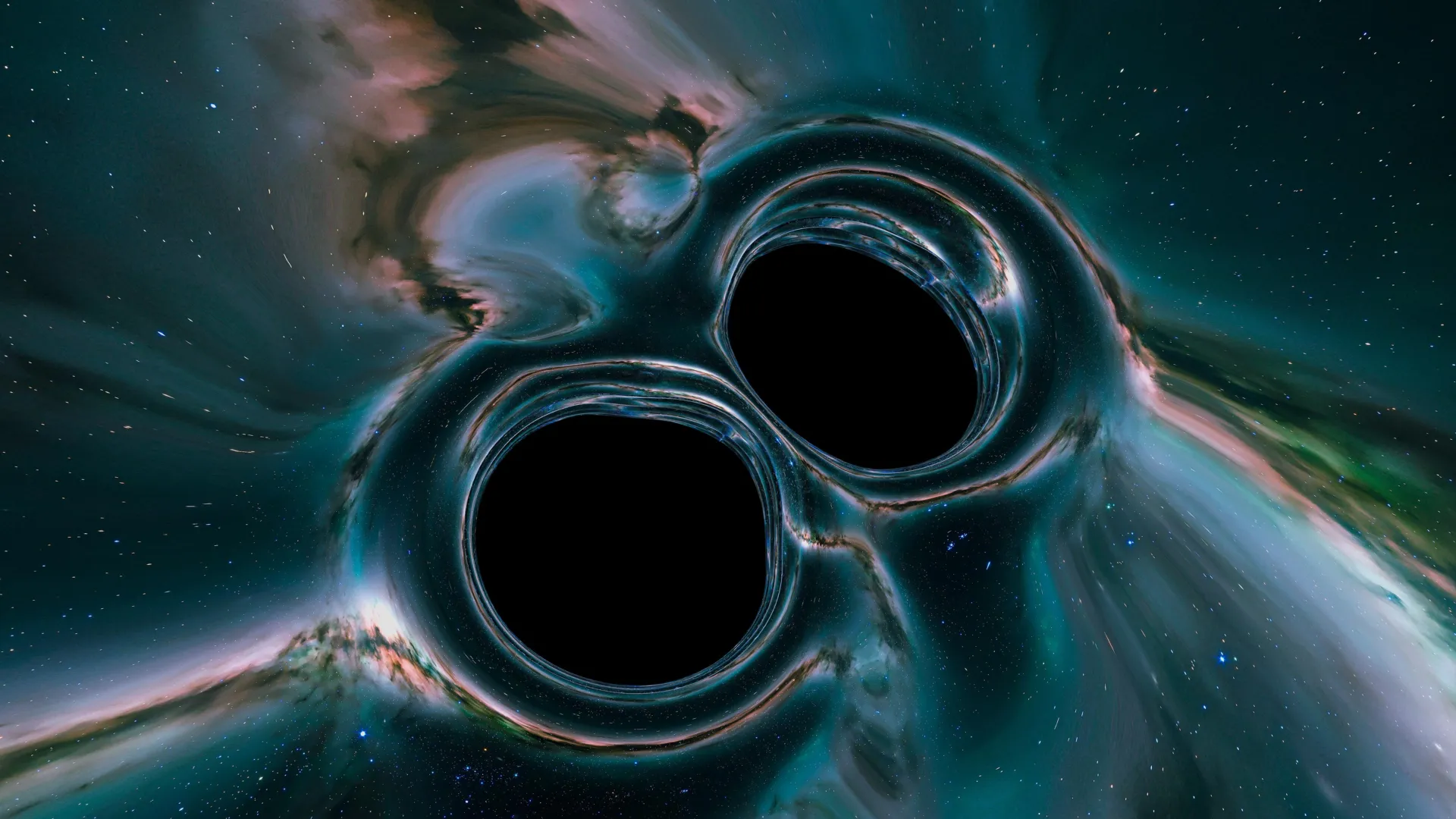
Scientists studying gravitational waves believe they may have discovered how the universe creates its largest black holes. Rather than forming directly from collapsing stars, these massive objects appear to grow through repeated black hole collisions within extremely dense star clusters.
The new study, led by Cardiff University, examined version 4.0 of the LIGO-Virgo-KAGRA Gravitational Wave Transient Catalog (GWTC4). This catalog contains 153 reliable detections of black hole mergers.
The researchers focused on whether the largest black holes in their catalog could be “second generation” objects. In this scenario, black holes formed from dying stars collide with each other and merge again in a dense stellar environment where the stars are packed up to a million times more tightly than around the Sun.
The survey results are natural astronomysuggests that the most massive black holes detected through gravitational waves belong to a separate class with a very different history than smaller black holes.
Gravitational waves reveal two populations of black holes
“Gravitational wave astronomy is now doing more than just counting black hole mergers,” explains lead author Dr Fabio Antonini from Cardiff University’s School of Physics and Astronomy.
“We are beginning to learn how black holes grow, where they grow, and what that tells us about the life and death of massive stars. This is exciting because we can use this information to test our understanding of how stars and star clusters evolve in the Universe.”
By analyzing gravitational wave signals, the team identified two distinct groups.
- Low-mass population consistent with normal stellar collapse
- High-mass clusters whose spins look exactly like those expected from hierarchical mergers of dense star clusters
Researchers say the spin behavior of more massive black holes is particularly clear.
“What struck us most was how clearly the massive black holes stood out as a distinct population,” says co-author Dr Isabel Romero-Shaw, Ernest Rutherford Research Fellow at Cardiff University.
“While the low-mass systems we analyzed generally rotated slowly, the high-mass systems consistently exhibit faster rotation and are oriented in seemingly random directions. This is exactly the signature you would expect if black holes were repeatedly merging in dense star clusters.”
“This makes the origin of the cluster much more plausible than previous catalogs.”
Evidence of a black hole ‘mass gap’
The study also strengthens evidence for a mysterious “mass gap” that has been predicted by astrophysicists for decades. According to this theory, stars over a certain size should explode violently enough to be completely destroyed, rather than collapsing into a black hole.
This would create a forbidden zone where black holes formed directly from stars should not exist.
The researchers confirmed that this change is occurring in a black hole that has about 45 times the mass of the sun.
“In our study, we found evidence for the long-predicted pair-instability mass gap, a mass range in which stars would be expected to leave no black holes at all. Gravitational wave detectors were able to successfully find a black hole that appears to be in or near that gap, confirmed to be around 45 solar masses,” Dr. Antonini said.
“So the key question now is: Are these black holes telling us that our models of stellar evolution are wrong, or are they created in another way?
“The largest black holes in our current sample seem to be telling us not only about stellar evolution, but also about star cluster dynamics.
“Above about 45 solar masses, changes in spin distribution are difficult to explain only by normal stellar binaries, but can be naturally explained if these black holes already experienced early mergers in dense star clusters.”
Black holes could help scientists study nuclear physics
The researchers say the discovery could ultimately help scientists probe deep processes inside massive stars.
The researchers used transitions near the mass gap to study the key nuclear reactions associated with the burning of helium within a star’s core.
“In the future, gravitational wave data may help scientists study nuclear physics, as the mass limit set by the pair instability depends on the nuclear reactions that occur at the center of massive stars,” added co-author Dr Fani Dosopoulou, a research fellow at Cardiff University.
