


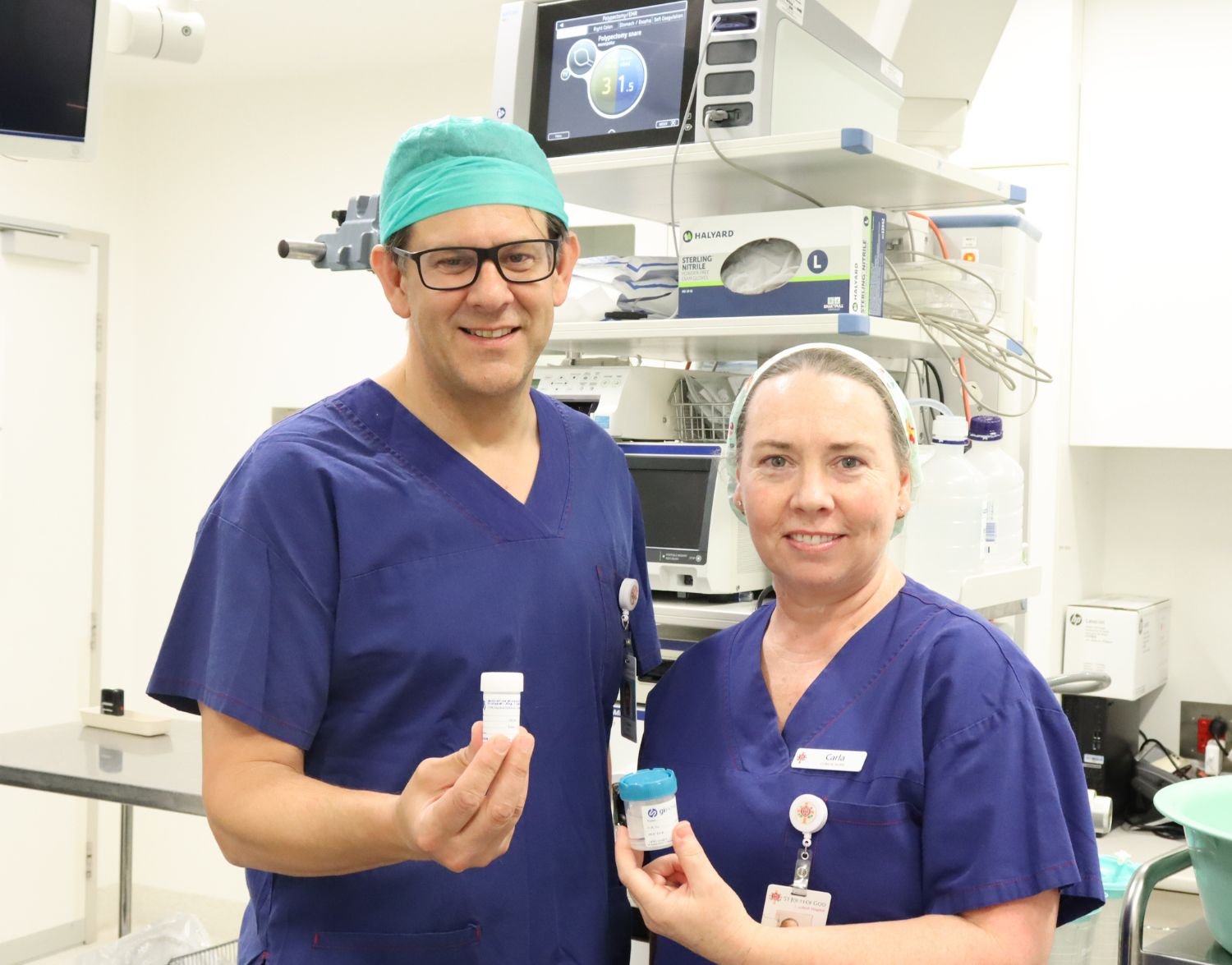
 Dr Oliver Waters and clinical nurse Carla Hazelgrave from St John of God Murdoch Hospital demonstrate the difference between the old histopathological pots used and the new mini pots.
A Perth hospital’s endoscopy team has made small changes that have reduced plastic waste by 25 kilograms a year and reduced use of toxic chemicals by 700 liters.
Plastic waste makes up around a third of general waste from Australian hospitals, and much of it is incinerated due to infection control concerns and complex material combinations.
This includes histopathology pots used to hold samples taken during endoscopy.
Endoscopy staff at St John of God Hospital Murdoch have devised a simple change to help combat unnecessary waste. Dr. Oliver Waters, head of gastroenterology and endoscopy, said most samples during these procedures are only a few millimeters in size.
“Floating a 2mm specimen in a 70ml pot makes no sense; it’s no different than storing and transporting a human-sized sample in an Olympic pool-sized pot,” he says.
However, hospitals have traditionally used 70ml pots.
“That’s what the institute has always done and is available to us,” he said.
“Samples are divided into different pots depending on the patient procedure and the anatomical location of the tissue taken. It is common to have 10 to 30 individual pots at the end of the list.”
Dr. Waters and clinical nurse Carla Hazelgrave led the team in transitioning to smaller 25 mL pots.
The team uses around 41,000 pots each year, and by moving to smaller pots, Murdoch alone has been able to prevent an estimated 26 kilograms of plastic and more than 700 liters of formalin from being incinerated each year.
“These jars are used in huge numbers and eventually they all end up being incinerated,” Dr Waters said.
“Reducing body size reduces waste, reduces exposure to formalin, and proves that sustainability and quality care can go hand in hand.”
This change required both endoscopy nurses and pathology labs to slightly alter their work flow to accommodate smaller pots that are a little more difficult to label and more prone to tipping over on flat surfaces.
Related: Addressing climate change as a “public health issue”
But Waters said nurses and doctors have adapted well to using smaller pots. The smaller pots have been adopted by all pathology providers supplying Murdoch since mid-February.
“There’s a lot of work to be done in the area of environmental sustainability, so it’s great to see everyone working together to make a difference,” he said.
“We hope this is just the start of many initiatives we can take to make a difference, such as reusable scope buttons and reducing the use of sterile bottled water in endoscopy.”
The benefits extend beyond Murdoch, with interest in the histopathology pot initiative spreading to other hospitals such as Peel Hospital and Midland Hospital.
“We are currently using these pots in one department, and the hope is that over time this will become an industry standard, as it can be expanded to other departments, including dermatology, where many biopsies are required as well,” Dr. Waters said.
“It’s great that we’ve been able to make such changes in the private system, and our next goal is to bring about large-scale change across the public sector.
“I encourage all clinicians and carers to look around their work environments and consider what changes they can make to reduce waste and improve care,” he said.
Want more news, clinical, features and guest columns delivered straight to your inbox? Subscribe for free to WA’s only independent magazine for doctors.
Want to submit an article? Email (email protected)
