


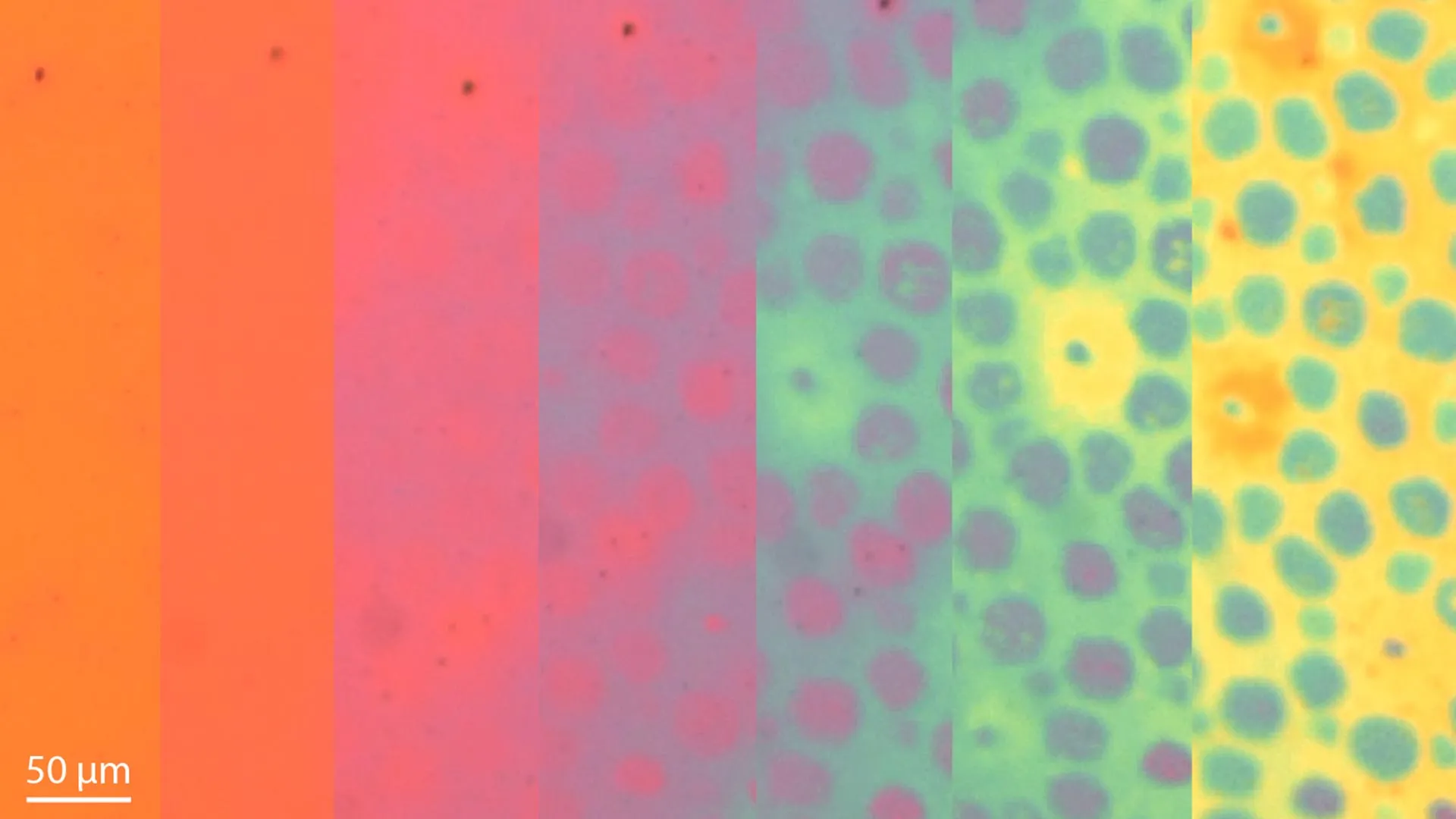
Octopuses and squid are famous for their ability to blend into their surroundings. They can quickly change both the color and texture of their skin, and scientists have long tried to recreate this ability with artificial materials. Now, researchers at Stanford University report a major breakthrough. In a study published in naturethey describe a flexible material that can rapidly change surface patterns and colors to form features smaller than a human hair.
“Texture is critical to how we experience objects, both in appearance and feel,” said Sidharth Doshi, a doctoral student in materials science and engineering at Stanford University and lead author of the paper. “These animals can physically change their bodies at scales approaching the micron scale, and now we can dynamically control the topography of materials and their associated visual properties at the same scale.”
This innovation could lead to improved camouflage systems for both humans and robots, as well as color-changing flexible displays for wearable devices. It also opens new doors for nanophotonics, a field focused on controlling light at very small scales for use in electronics, cryptography and biology.
“No other system is as soft and swellable and can be patterned at the nanoscale,” said Nicolas Meloche, professor of materials science and engineering and senior author of the paper. “You can imagine all sorts of different uses.”
How materials create dynamic patterns
To generate these changing textures, the research team combined water-responsive polymer films with electron beam lithography, a technique widely used in semiconductor manufacturing. When exposed to a focused electron beam, certain areas of the film become more or less absorbing. When the material contains water, those areas swell differently, forming complex patterns that only appear when the film is wet.
The key insight came unexpectedly. In previous experiments, Doshi used scanning electron microscopy to examine nanostructures on polymer films. Instead of discarding the samples afterwards, he reused them. In subsequent tests, areas previously exposed to the electron beam behaved differently and displayed different colors.
“We realized that we could use these electron beams to control the terrain at a very fine scale,” Doshi said. “It was definitely a coincidence.”
From plane to three-dimensional structure
The accuracy of this technique allows for the creation of amazing details. Researchers have also created a miniature version of Yosemite’s El Capitan. When dry, the surface will be completely flat. When water is added, the structure rises from the film and forms a three-dimensional shape.
By carefully adjusting the amount of bulge in the material, the team can also control how light is reflected. This makes it possible to switch between glossy and matte finishes, creating visual effects beyond what current screens can achieve. This process is reversible. Adding an alcohol-based solvent removes the moisture and returns it to a flat state.
The same approach can also be used to generate complex color patterns. By placing thin metal layers on either side of a polymer, the researchers created a structure known as a Fabry-Perot cavity that selects specific wavelengths of light. Different colors appear as the film expands or contracts. The right balance of water and solvent transforms plain surfaces into vibrant patterns.
“By dynamically controlling the thickness and shape of polymer films, we can achieve a huge variety of beautiful colors and textures,” said Mark Bronzersma, professor of materials science and engineering and senior author of the paper. “The introduction of soft materials that can expand, contract, and change shape opens up a whole new toolbox in the world of optics for manipulating how things appear.”
Future applications in camouflage and robotics
By combining multiple layers of these films, researchers can individually adjust both color and texture, allowing the material to blend into its surroundings much like an octopus (although it does require some trial and error).
Currently, water and solvent levels must be manually adjusted to match the background. The team hopes to automate this process by adding computer vision and AI systems that can analyze the environment and adjust materials in real time.
“We want to be able to control this with a neural network, essentially an AI-based system. The neural network can compare the skin to its background and automatically adjust to match in real time, without human intervention,” Doshi said.
Beyond camouflage: new possibilities
Potential uses extend beyond camouflage. Finely controlling the texture of a surface could tune friction, allowing small robots to grip or glide across surfaces. At the nanoscale, structural changes can influence cell behavior, opening up potential applications in bioengineering. The team works with artists to explore creative uses for the materials.
“Small changes in the properties of soft materials over distances in the order of microns will finally be possible, opening up all sorts of possibilities,” Meloche said. “I think a lot of exciting things are going to happen.”
Research team and support
Mr. Brongelsma is a kind professor of applied physics. Member of Stanford Bio-X, Wu Tsai Human Performance Alliance, and Wu Tsai Neurosciences Institute. It is an affiliated company of Precoat Energy Research Institute.
Melosh is a member of Stanford Bio-X and the Wu Tsai Neurosciences Institute. An affiliated company of Precourt Energy Research Institute. Sarafan ChEM-H faculty fellow.
Other Stanford co-authors of the study include Alberto Saleo, Hong Shih, and the Vivian W.M. Lim Professor of Photon Science. Associate Professor Polly Fordyce. postdoctoral researchers Nicholas A. Gusken and Gerwyn Dyck; Jennifer E. Ortiz-Cardenas, director of the Stanford Microfluidics Foundry; and graduate students Johan Karlström, Peter Suzuki, and Bohan Li.
This research was funded by the Stanford Graduate Fellowship, the Meta Doctoral Fellowship, the Wu Tsai Human Performance Alliance at Stanford University, the Joe and Clara Tsai Foundation, the German National Academy of Sciences Leopoldina, the Department of Energy, the Air Force Contract Research Office, and the National Science Foundation.
