


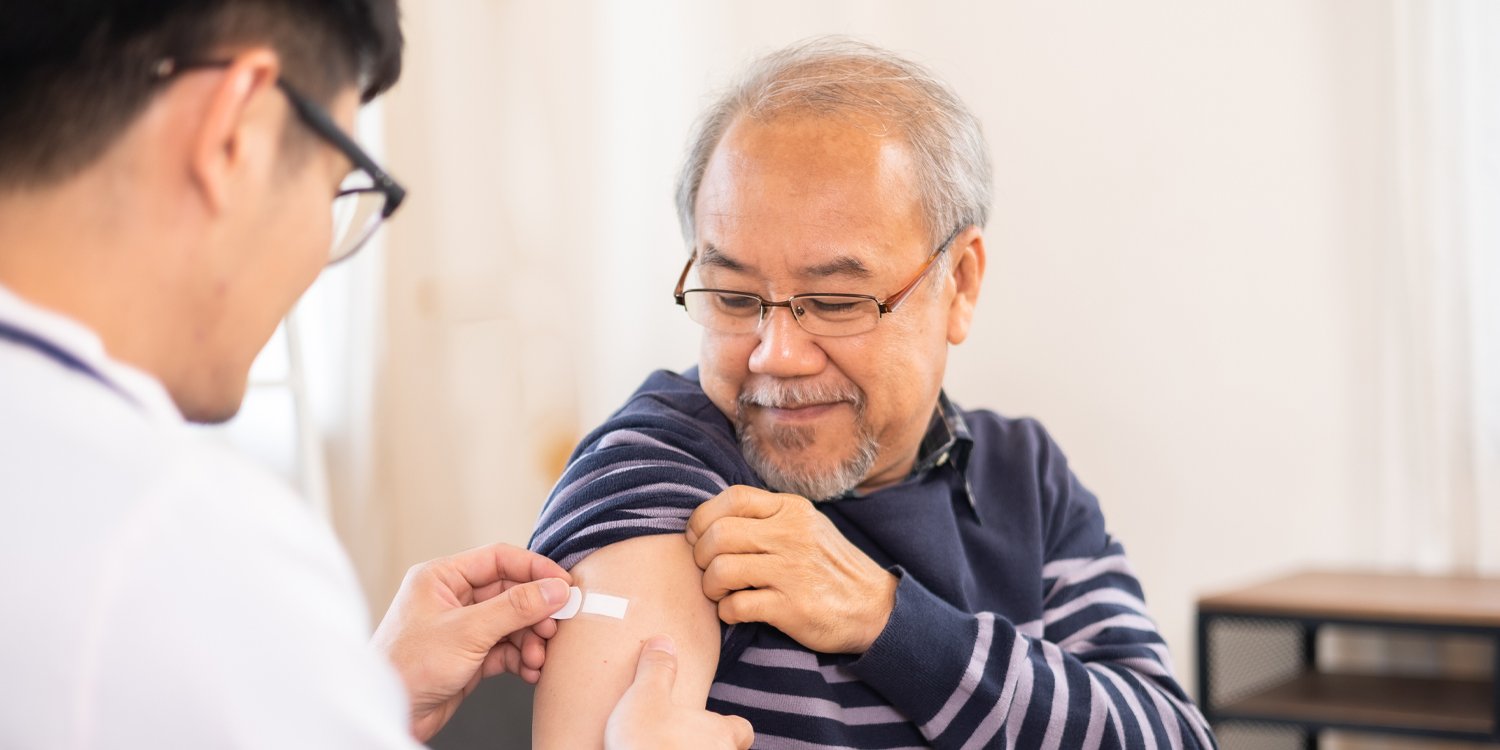
Vaccination with a recombinant shingles vaccine is associated with a reduced risk of developing dementia in older adults who have recently spent time in a skilled nursing facility. The results of this study suggest that this routine immunization may provide protection against cognitive decline over a four-year period. The study was published in the Annals of Internal Medicine.
Shingles is a painful viral infection caused by reactivation of the varicella-zoster virus. This is the exact same virus that causes chickenpox in childhood. The virus remains dormant in the nervous system and tends to reactivate in adults over 50 and people with weakened immune systems.
Previous clinical studies have linked shingles infection to an increased risk of developing dementia later in life. Kayleigh Hayes is an associate professor in the School of Health Services, Policy and Practice and director of the Pharmacoepidemiology and Regulatory Evidence Laboratory. She also serves as Deputy Director of Pharmacoepidemiology at the Center for Gerontology and Healthcare Research.
Hayes explained the biological reasoning that led the research team to investigate this link. “Shingles not only increases the risk of stroke, but also increases the risk of general inflammation in the brain, so we looked at the link between vaccination with Shingrix,” Hayes said, referring to the brand name of the recombinant vaccine.
“Therefore, there is a hypothesis that reducing the activity of the virus that causes shingles (called shingles) may help prevent brain inflammation that can impair brain health in the long term,” Hayes said. Because of this hypothesis, scientists have wondered if preventing viral infections could protect the brain from cognitive decline.
Previous observational studies have shown evidence that older versions of the vaccine reduce the risk of dementia. “Previous studies in different populations that looked at an older vaccine, Zostavax, did find a signal of dementia protection,” Hayes said.
Zostavax is the brand name for an older live attenuated vaccine that contains a weakened, harmless form of the actual virus. That particular live vaccine is no longer available in the United States. In 2017, the U.S. Food and Drug Administration approved a new version known as a recombinant shingles vaccine.
Recombinant vaccines are made by synthetically producing specific virus parts that elicit a strong immune response. This new version is highly effective in preventing shingles in older adults. New vaccines are highly effective against the virus, sparking interest in their potential to protect the brain.
“We wanted to use large-scale, real-world data and a rigorous study design to see if that sign existed in older Americans who received a new, more effective vaccine,” Hayes said. Older adults admitted to skilled nursing facilities are a population at high risk for both shingles and new-onset dementia.
Skilled nursing facilities are inpatient medical centers that provide short-term rehabilitation after hospitalization and long-term care for people who need daily assistance. The authors recognized that admission to these facilities provides a natural window for healthcare professionals to assess vaccine eligibility. They designed the study to see whether receiving a recombinant vaccine during or immediately after a stay in a facility would reduce the rate of new dementia diagnoses.
To investigate this relationship, the scientists used an analytical approach called target trial emulation. In a traditional randomized controlled trial, researchers randomly assign participants to either receive a treatment or a placebo. In some cases, it may be impossible or unethical to conduct such trials in frail populations.
Targeted trial emulation solves this problem by mimicking the design of randomized experiments using existing observational data. Researchers analyzed electronic medical records related to Medicare claims for older adults across the United States. They focused on patients aged 66 and older who were admitted to skilled nursing facilities from January 2017 to December 2022.
The final sample included 509,926 participants. The average age of the participants was 79 years, and approximately 63.6% of them were women. To be included in the analysis, patients had to have no previous diagnosis of dementia and no history of receiving the new recombinant shingles vaccine.
The scientists compared the two treatment strategies using a statistical method that creates duplicate records, or cloning, of each person in the data. One artificial clone is assigned to the vaccinated group and the same clone is assigned to the unvaccinated group. If an individual’s real-world medical data deviates from their assigned group, their artificial clones will be censored or excluded from ongoing analysis.
This complex statistical technique helps balance comparison groups and adjust for biases that plague observational studies. In this study, vaccination strategy was defined as receiving at least one dose of recombinant shingles vaccine within 12 months of nursing home admission. A no-vaccination strategy means no vaccination during the entire study period.
Researchers followed participants for up to four years. They looked for new dementia diagnoses using hospital medical billing codes, routine physician claims, and pharmacy records for common dementia medications. They also tracked characteristics of 57 different participants, including age, previous health conditions, medication use, and previous vaccinations.
Of the more than 500,000 participants, 8,843 received at least one dose of recombinant shingles vaccine within the first year. This represents only 1.73 percent of the study population. Of those vaccinated, 87% received the shot after being discharged from the facility.
Researchers found that the vaccinated group had a lower risk of developing dementia over a four-year follow-up period. Specifically, the four-year risk of dementia for people who received at least one dose of the vaccine was 18.8%. By comparison, the risk was 24.6% for those who did not receive the vaccine.
This translates into an absolute risk reduction of 5.8 percentage points. In relative terms, vaccinated participants had a 24 percent lower risk of being diagnosed with dementia than unvaccinated participants.
“Our study found that 1 in 17 cases of dementia may be prevented by shingles vaccination, but trials are needed to confirm these findings,” Hayes said. The association varies slightly depending on patient characteristics. Men tended to have weaker protective effects than women.
It was also less pronounced in people who had previously received the older live attenuated shingles vaccine. It is important to understand that this study does not prove direct causation, but rather provides evidence of an association. The findings are based on administrative claims data, which may contain coding errors or miss cases of mild cognitive decline.
Overall vaccination rates in this particular population are also very low, which can complicate statistical comparisons. One particular limitation has to do with what scientists call healthy vaccine recipient bias. This concept suggests that people who choose to get vaccinated may also engage in other healthy behaviors or may be in better health in general than those who do not get vaccinated.
The researchers attempted to measure this hidden bias using negative control analysis. Negative control analyzes look for associations between the vaccine and completely unrelated health events. The authors tested whether the vaccine was associated with outcomes such as hip fractures and regular health checkups.
The shingles vaccine does not prevent femoral neck fractures, so finding an association would suggest that the vaccinated group was simply healthier or more cautious overall. Negative control analyzes show signs that vaccinated individuals are healthier overall and point to several residual confounding variables. When the researchers statistically adjusted the primary results to account for this underlying health difference, the protective association weakened.
Even with the most conservative adjustment, the vaccine was still associated with a 12% reduction in relative risk of dementia. The exact biological reasons for this protective connection remain the subject of ongoing scientific research. Vaccines may reduce inflammation in the brain or prevent the varicella-zoster virus from contributing to the buildup of toxic proteins associated with cognitive decline.
It’s also possible that vaccines modulate the immune system in a way that protects the nervous system in general. Future research should aim to confirm these findings through actual randomized controlled trials in nursing homes. By randomly assigning vaccines in a controlled environment, scientists may be able to definitively eliminate bias among healthy vaccine recipients.
Until then, this study suggests that administering a recombinant shingles vaccine may be a practical way to support the cognitive health of older adults recovering from an acute medical event. “The main takeaway is that the shingles vaccine is highly effective in preventing shingles, which is painful and can cause long-term health problems,” Hayes said. “And now there is evidence that something that prevents this physical disease may also help maintain brain health.”
The study, “Dementia risk after recombinant shingles vaccination in older adults with recent stays in skilled nursing facilities: Targeted trial emulation,” was co-authored by Kaleen N. Hayes, Daniel A. Harris, Kevin W. McConeghy, Lexie R. Grove, Richa Joshi, Lisa Han, H. Edward Davidson, Preeti Chachlani, and Thomas A. Bayer, Mriganka Singh, Yasin Abul, Frank Devaughn, and Stephen Gravenstein.
