


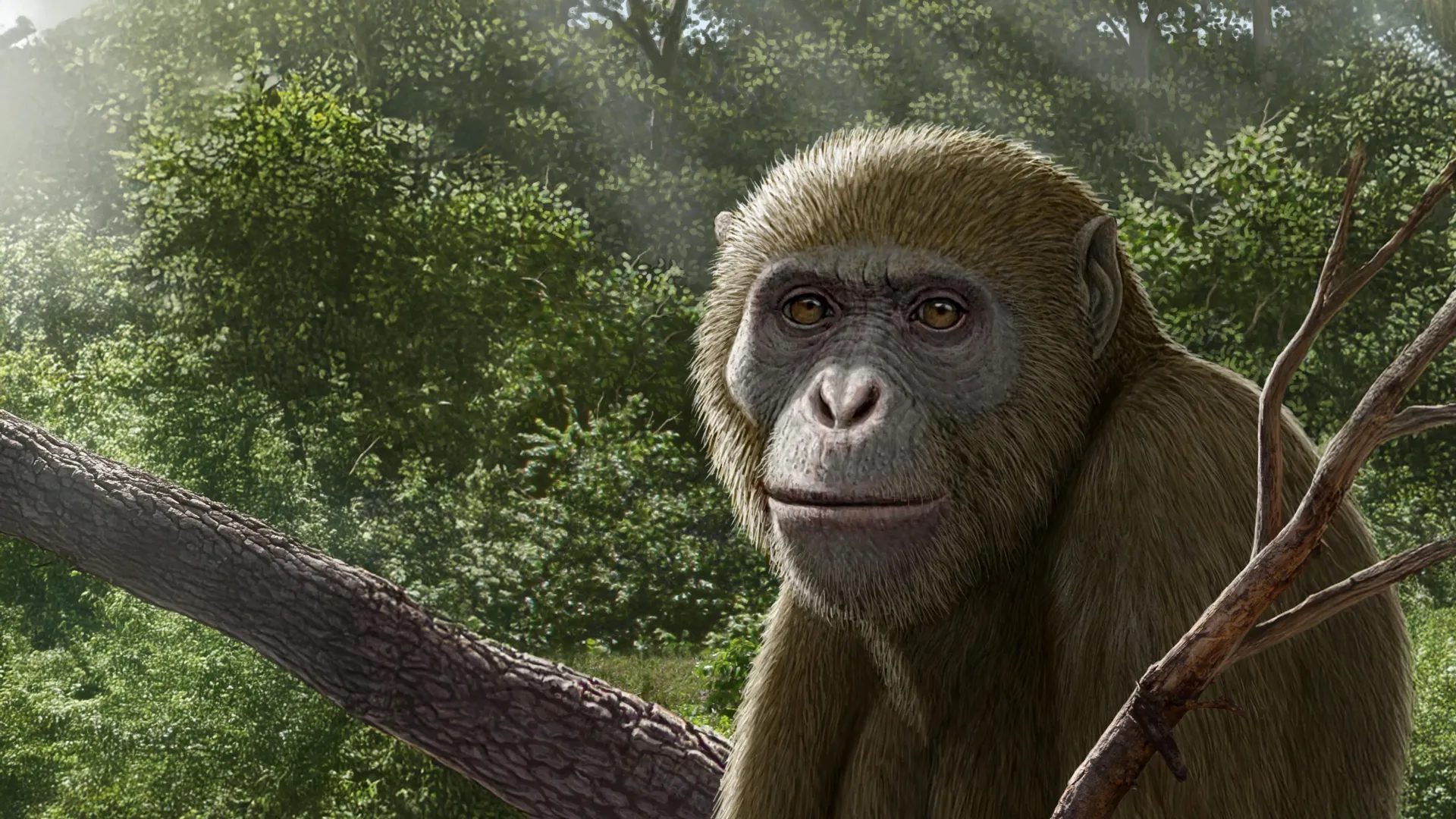
Newly discovered ape fossils in northern Egypt are changing the way scientists view early human evolution, researchers report. The discovery suggests that the closest ancestors of modern apes may have originated in North Africa, rather than East Africa, which has long been the main focus of fossil research. “(The) discovery (…) confirms that paleontologists may have been looking for crown hominin ancestors in the wrong place,” David Alba and Julia Arias-Martorell write in a related Perspective.
The fossil is about 17 to 18 million years old and belongs to a newly identified species called Maslipithecus. It is considered the closest known hominid to the lineage that eventually led to all modern apes, including humans. Scientists generally agree that the earliest great apes (stem hominids) first appeared in Africa-Arabia during the Oligocene epoch more than 25 million years ago. These early apes then spread across Eurasia during the Miocene epoch, about 14 million to 16 million years ago. However, the exact origins of modern apes, including modern apes and their last common ancestor, remain unclear because fossils from this era are rare, scattered, and often difficult to interpret. This challenge is compounded by gaps in Africa’s fossil record, where most discoveries have been made in limited locations, leaving vast areas from this era unexplored.
Maslipithecus mograensis and early ape diversity
Shorouq Al-Ashqar and colleagues say the fossil, discovered in the Wadi Moghra region of northern Egypt, is about 17 to 18 million years old. named species Maslipithecus mograensisprovides new insights into great ape diversity during a critical period when Afro-Arabia began to connect with Eurasia and species were able to spread beyond Africa.
To determine how this species fits into human evolutionary history, the researchers used the Bayesian “hint dating” method. This approach combines anatomical features and fossil ages to estimate evolutionary relationships and divergence times. Their results show that Maslipithecus are stalked hominids closely related to the lineage that ultimately produced all modern apes.
New clues about the origin of modern apes
Based on their findings, the researchers suggest that modern apes may have originated in northern Afro-Arabia, the Levant, or the eastern Mediterranean. This challenges long-held assumptions and highlights how much we still don’t know about the early evolution of great apes and humans.
