


Three years ago, scientists detected an anomaly in the deep waters of the Mediterranean: the most energetic cosmic neutrinos ever observed. The particle has an astonishing energy of about 220 PeV, more than 10 times more energetic than any high-energy neutrino detected so far, and researchers still don’t know exactly where it came from.
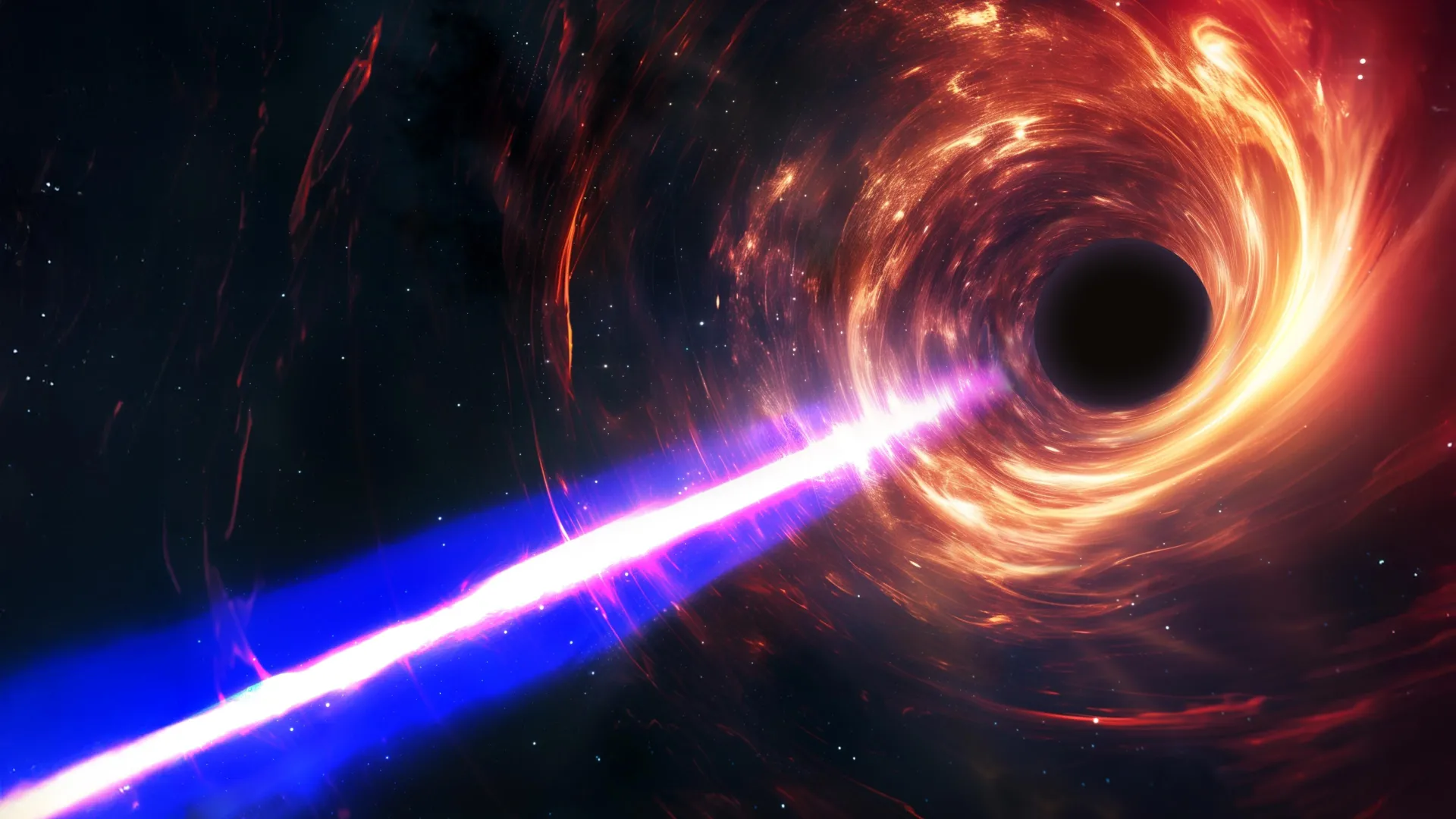
Now, new research Journal of Cosmology and Astroparticle Physics (JCAP) It suggests that the particles may have originated from blazars, some of the most extreme objects in the universe. Blasers are active galactic nuclei powered by supermassive black holes that fire giant jets of plasma directly at Earth.
Scientists search for source of record neutrinos
This neutrino was detected on February 13, 2023 by the giant neutrino observatory KM3NeT/ARCA located off the coast of Sicily. Interestingly, this detector is still under development. At the time of discovery, only 21 detection lines were in operation, approximately 10% of the observatory’s planned final size.
Even in its partial configuration, the detector picked up a signal unlike anything scientists had seen before.
The researchers approached the mystery much like forensic investigators examining clues from a crime scene. Starting with one possible explanation, they created a simulation and compared the results with real-life observations.
One leading idea is that neutrinos originate from a special type of blazar that can accelerate particles to extreme energies.
“There are several possible explanations for the origin of this particle,” explains Meryem Benderman, one of the study’s hundreds of authors, a researcher at INFN Naples, and a member of the KM3NeT collaboration. “Such neutrinos, for example, have been proposed to be produced when very high-energy cosmic rays interact with the Cosmic Microwave Background, the residual light from the early universe. But it is also possible that neutrinos originate from diffuse fluxes produced by ensembles of extreme accelerators, such as blazars.”
Why are the Blazers a prime suspect?
For many cosmic events, astronomers look for electromagnetic counterparts such as radio waves, visible light, X-rays, and gamma rays that arrive from the same region of the sky at the same time as a neutrino is detected.
However, in this case, scientists could not find a matching signal.
“This does not completely exclude the possibility of a point source,” Benderman said. “But this leads us to consider that our neutrinos may come from a diffuse background, a stream of neutrinos that includes contributions from many sources.”
This possibility led researchers toward the idea that this particle could have originated from a large number of blazars, rather than from a single dramatic cosmic event.
To investigate, the team used an open-source simulation tool called AM3 to model a realistic blazer population. Many aspects of the simulation were based on values already measured by other observations, such as the strength of the magnetic field and the size of the emitting region around the black hole.
The researchers mainly adjusted for two important factors. One is the baryonic load, which measures how much energy protons carry compared to electrons, which helps determine how many neutrinos are produced. The second is the proton spectral index, which affects how the proton energy is distributed and whether it can reach extremely high energies.
The researchers calculated both neutrino production and associated gamma-ray emissions for each simulation and compared the results with actual observations.
Comparison of results between IceCube and Fermi
The study combined observations from several major observatories, including KM3NeT/ARCA, the IceCube Neutrino Observatory, and NASA’s Fermi Gamma-ray Space Telescope.
The researchers weren’t just focused on what these instruments observed. They also considered what was not observed.
For example, no other neutrino observatory, including IceCube, has detected similar ultrahigh-energy phenomena. This suggests that such particles are extremely rare, meaning that the proposed explanation must also account for the absence of similar detections.
The blazer model matched that constraint well.
The research team also tested whether the proposed blazar population would produce too many gamma rays compared to the known extragalactic gamma-ray background measured by Fermi. Their results were consistent with existing observations.
In the end, the researchers found that a realistic population of blazars could plausibly explain the unusual neutrino phenomenon.
“We modeled a realistic blazar population using physically motivated parameters, and found that this blazar population can explain the origin of this ultra-high-energy event, while also being consistent with the constraints we have on gamma-ray and neutrino observations,” Benderman says.
KM3Net could reveal even more extreme cosmic events
Scientists warn that more evidence is needed to confirm this explosive explanation.
“We need more observational data,” Benderman explains. “Although KM3NeT is still under construction, this ultra-high-energy neutrino was detected in only a partial configuration. With a complete detector and more data, we will be able to perform more powerful statistical analyzes and open a new window into the ultra-high-energy neutrino universe.”
If future observations support this theory, the discovery could reshape scientists’ understanding of how blazers work and how powerful they can be.
“Such high-energy neutrinos have never been observed before, and if it turns out that they came from cosmic accelerators like blazars, this could provide new insight into how these objects are able to emit particles with more energy than previously expected,” Benderman concludes.
