


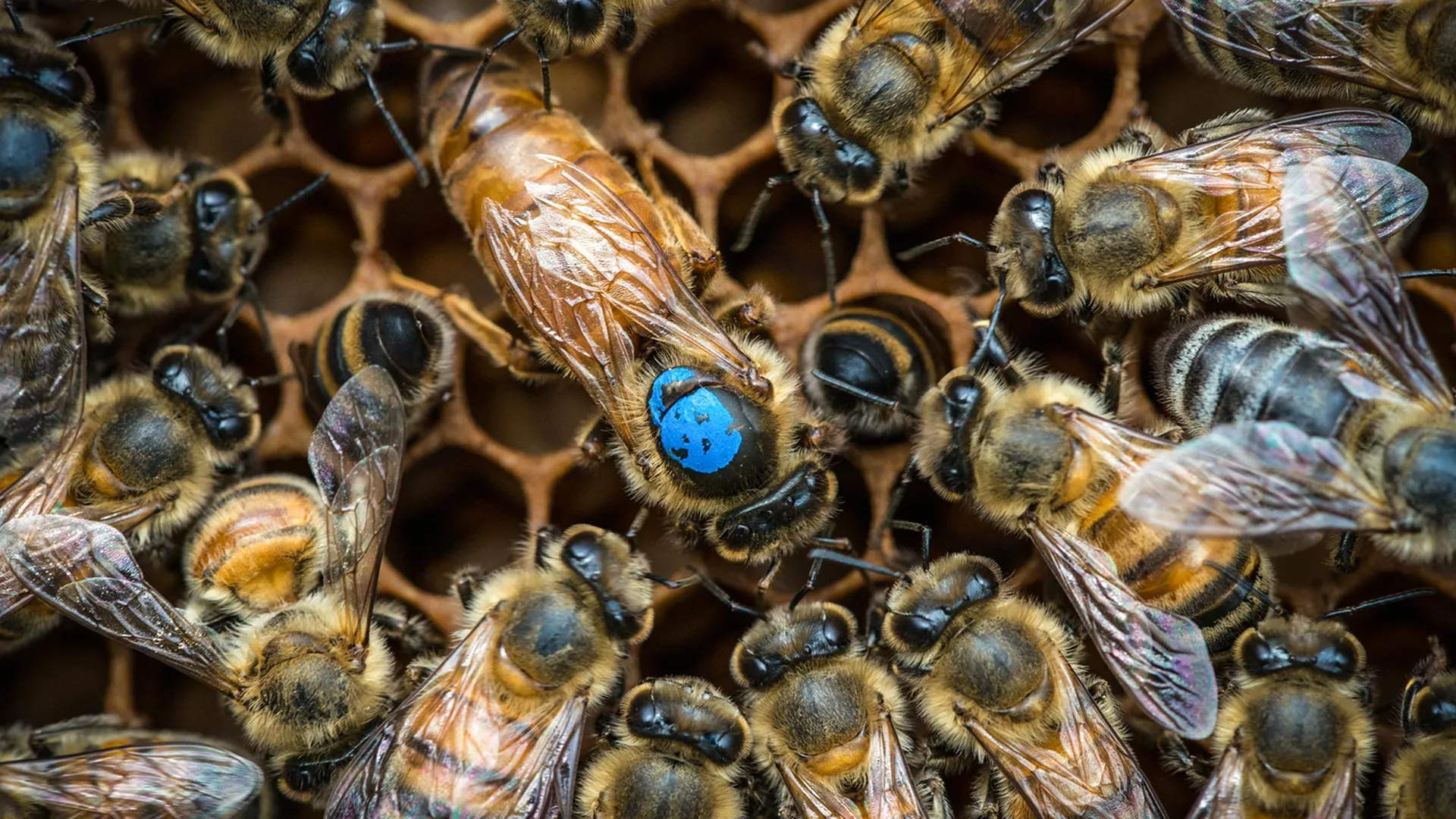
Scientists have identified brain circuits that help worker bees decide what tasks to perform within the colony. Biologists from the Heinrich-Heine University (HHU) in Düsseldorf and the universities in Cologne and Frankfurt/Main have discovered that they can change the behavior of honeybees by manipulating specific genes and selectively reducing the activity of specific neural circuits.
Research results published in scientific journals Proceedings of the National Academy of Sciences (PNAS), provides new insights into how colonies organize their workforces without leaders assigning tasks.
How do bees divide work without a leader?
The success of a community depends on its members completing the right tasks at the right time. Humans can discuss and purposefully allocate responsibilities, but bee colonies have no central planner. Even so, bees (Western honey bee) Divide the work with amazing efficiency.
A worker bee’s responsibilities usually change as it grows. Young worker bees take care of the queen and the developing larvae. They then help build and maintain the nest and protect it from threats. Only in the final stage of life do they leave the colony in search of food.
These behavioral changes are directed by interactions between about 1 million neurons in the honey bee’s brain. But until now, scientists didn’t understand how the nervous system shifts from one task to another as we age.
Genes related to worker bee behavior
Important clues emerged from early research by a team at HHU led by Professor Martin Bay of the Institute of Evolutionary Genetics. Scientists were studying a gene known as double sex when they observed an unusual behavioral change.
Once the genes in the older workers died down, the bees began caring for the queen again. This responsibility is usually reserved for young bees, suggesting that double sex plays an important role in controlling age-related labor behavior.
Because the double-sex gene only functions within specific neural circuits, the discovery gives Bay’s team, along with researchers from the University of Cologne and the University of Frankfurt/Main, a way to investigate how specific parts of the honeybee’s brain influence social behavior.
Scientists switch off specific neural circuits
Researchers selectively silenced neurons associated with double sex. To accomplish this, they used the gene to produce a protein that suppresses neural activity. Next, by feeding bees with a specific substance, they were able to activate the protein and reduce the activity of only the targeted circuit.
When these circuits were disrupted, older workers stopped performing the duties expected of them at their age and returned to caring for the queen.
Dr. Jana Thaler, lead author PNAS The researchers said: “The older workers then resumed caring for the queen, something that would otherwise only be done by young bees. If the circuit was not disturbed, the bees displayed normal age-appropriate behavior. In this way, we were able to control which tasks the workers performed.”
Neural communication may organize nests
This result indicates that there is a neural basis for the working organization within honey bee colonies. When activity in certain areas of the brain decreases, other neural circuits become activated, which can lead to different courses of behavior.
The discovery provides early evidence that communication between neural circuits helps worker bees decide whether to nurse the queen, build or defend a nest, or forage for food.
Professor Bey concludes: “The ability to control social behavior in bees offers us new opportunities to explore the innate behavioral diversity and basis of social cooperation. The solution to the secrets of how bees and other animals successfully cooperate without a blueprint for their work is likely hidden in the brain’s neural circuits.”
