


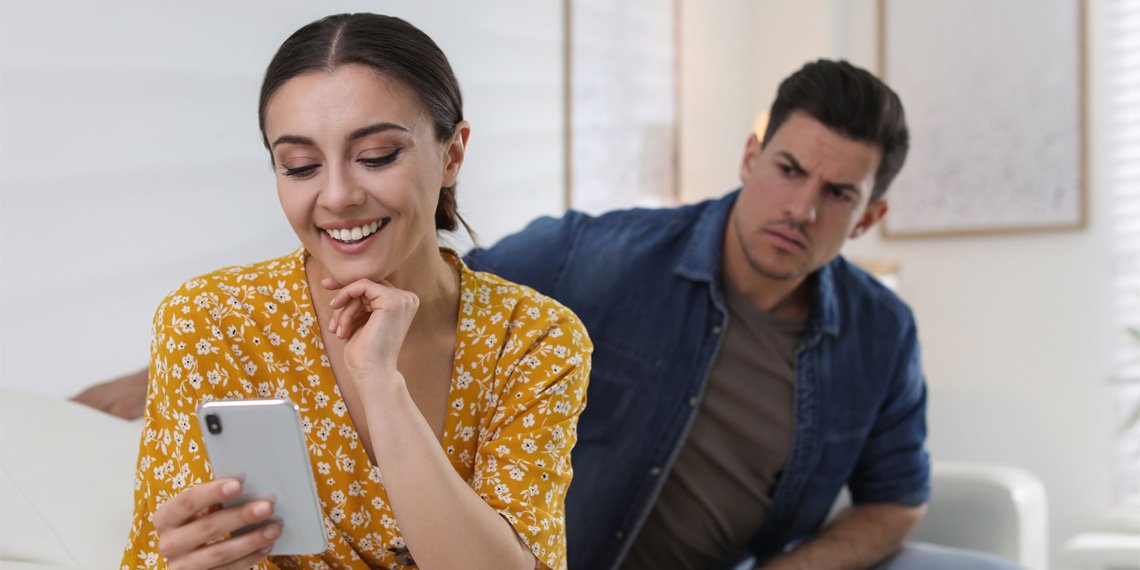
New research published in personal relationship This suggests that the level of jealousy in a person’s relationships is fairly stable over time with a particular partner, but can change significantly when entering a new relationship. This study provides evidence that intrusive doubts about a partner’s fidelity are driven by a combination of individual personality traits and the unique dynamics of each romantic bond. This can help reveal whether people are naturally jealous or just reacting to certain circumstances.
Romantic jealousy is a common emotion rooted in the fear of losing a partner, but in some cases it can develop into an overwhelming obsession. Scientists distinguish between different types of jealousy, noting that some forms are much more harmful to relationships than others. For example, emotional jealousy is a quick reaction to an impending threat, such as seeing your partner flirting at a party.
In contrast, cognitive jealousy involves persistent and intrusive thoughts or suspicions about a partner’s infidelity, often without concrete evidence. Scientists know that this type of jealousy is associated with low self-esteem and relationship distress, but how it works over the life of a partnership is less understood. Researchers designed a new study to determine whether cognitive jealousy functions as an enduring personality trait or a flexible response to different romantic partners.
“As a couples therapist and researcher, I know all too well how painful cognitive jealousy (i.e., persistent thoughts or suspicions of a partner’s infidelity) can be,” said study author Mikila Wildy, associate professor of psychology at Grand Valley State University and owner of Resilient Relationships.
“Much of the existing research has treated jealousy like a stable personality trait that doesn’t change much. I wanted to test that assumption. Is jealousy something that humans simply ‘carry’ from relationship to relationship, or does it depend on the partner and the situation?” Furthermore, does jealousy change over time within a particular relationship? ”
To answer these questions, scientists analyzed data from a large longitudinal study of romantic relationship development. The sample included 891 unmarried young adults aged 18 to 34 years. These participants were followed for five years, completing detailed surveys every four to six months.
Because some participants changed partners during the study, the researchers were able to track a total of 1,507 different romantic relationships. Approximately 42 percent of participants reported having had multiple relationships over a five-year period. This unique data structure allowed scientists to observe how jealousy changes as individuals move from one partner to another.
In these studies, participants answered questions to measure cognitive jealousy. This measure assessed beliefs and suspicions that a partner is interested in or intimate with someone else. The researchers also measured neuroticism, a personality trait characterized by emotional instability and a tendency to experience negative emotions.
Additionally, they assessed attachment anxiety, which refers to a person’s deep-seated fear of abandonment and strong need for security in relationships. Finally, the survey asked whether participants or their partners had ever had a sexual relationship with anyone else since they started dating. This allowed scientists to see how real-life incidents of infidelity affect thoughts of jealousy.
The data revealed that cognitive jealousy does not tend to disappear or escalate as a single relationship progresses. Instead, people’s levels of cognitive jealousy are surprisingly consistent over time in any given relationship.
“We were surprised that cognitive jealousy did not change systematically over time in relationships,” Wildy told SciPost. “Even over five years, people’s baseline levels tended to remain stable. This finding challenges the common belief that jealousy naturally fades or intensifies the longer you’ve been together. That said, our sample consisted of relatively young adults over five years, so it’s possible that different patterns emerge in longer-lasting relationships and later life stages.”
However, Wildy and her colleagues noticed significant variation when looking at multiple relationships more broadly. They found that 28.2 percent of the variation in cognitive jealousy was related to the individual. This means that some people are naturally more jealous, regardless of who they’re dating. At the same time, the largest portion of the variation, accounting for 39.8%, was due to differences between relationships.
“In practice, this means that jealousy is not ‘just your problem,'” Wildy says. “It reflects both your personality and what’s going on in that particular relationship. Therefore, the most effective intervention to address cognitive jealousy will likely need to address both.”
Researchers also identified several specific factors that predict higher levels of cognitive jealousy. Those with higher scores on neuroticism and attachment anxiety tended to report more jealous thoughts. This is consistent with the idea that people who struggle with emotional stability or fear of rejection are more likely to doubt their relationships.
The experience of extramarital affairs also played a major role in forming these suspicions. Participants who knew their partner had cheated early in the relationship reported much higher levels of cognitive jealousy. Learning of a past betrayal seems to make people more wary and maintain their suspicions for a long time.
The data showed that a person’s own past behavior also influenced their thoughts about their partner. Those who admitted to having sexual relations outside the relationship also experienced greater cognitive jealousy. The researchers also noted that men, on average, reported slightly higher initial levels of cognitive jealousy than women.
“Within a given relationship, people’s levels of cognitive jealousy remained fairly stable over time,” Wildy summarized. “The biggest differences in cognitive jealousy emerged across different relationships, meaning some people may experience stronger jealousy toward one partner than another. At the same time, some people consistently reported higher levels of cognitive jealousy than others, regardless of relationship.”
A potential misinterpretation of these findings is the assumption that cognitive jealousy is stable over time and thus a permanent condition.
“Although the average level in a relationship is constant, there were differences in cognitive jealousy between partners, and cognitive jealousy was associated with factors such as attachment anxiety and experience of infidelity,” Wildy told SciPost. “In other words, both personal inclinations and relationship contexts shape jealousy, so that the potential for growth and intervention remains very high.”
This study has some limitations, including the fact that the data was collected between 2007 and 2012. The sample consisted primarily of mixed-sex couples, and dating norms have evolved since the data were collected. For example, modern use of online dating applications may introduce new triggers for cognitive jealousy that were not captured in this older dataset.
“We would like to see whether these patterns hold true in a more diverse sample, such as same-sex couples or consensual non-monogamous relationships,” Wildy said. “We’re also interested in identifying specific relationship dynamics (such as post-infidelity communication and trust repair) that may explain why jealousy differs between partners.”
“This study is the first to track cognitive jealousy across multiple relationships within the same individual over time. It allows us to move beyond the question, ‘Are jealous people just being jealous?'” Instead, ask more nuanced questions like, “How much jealousy is there in the person? And how much jealousy is there in the relationship?” “Does jealousy change over time in a relationship?”
The study, “Leading to Cognitive Jealousy? Revealing Internal Stability and Inter-Relationship Fluctuations,” was authored by Mikila N. Wildy, Kayla Knopp, Scott M. Stanley, and Galina K. Rose.
