


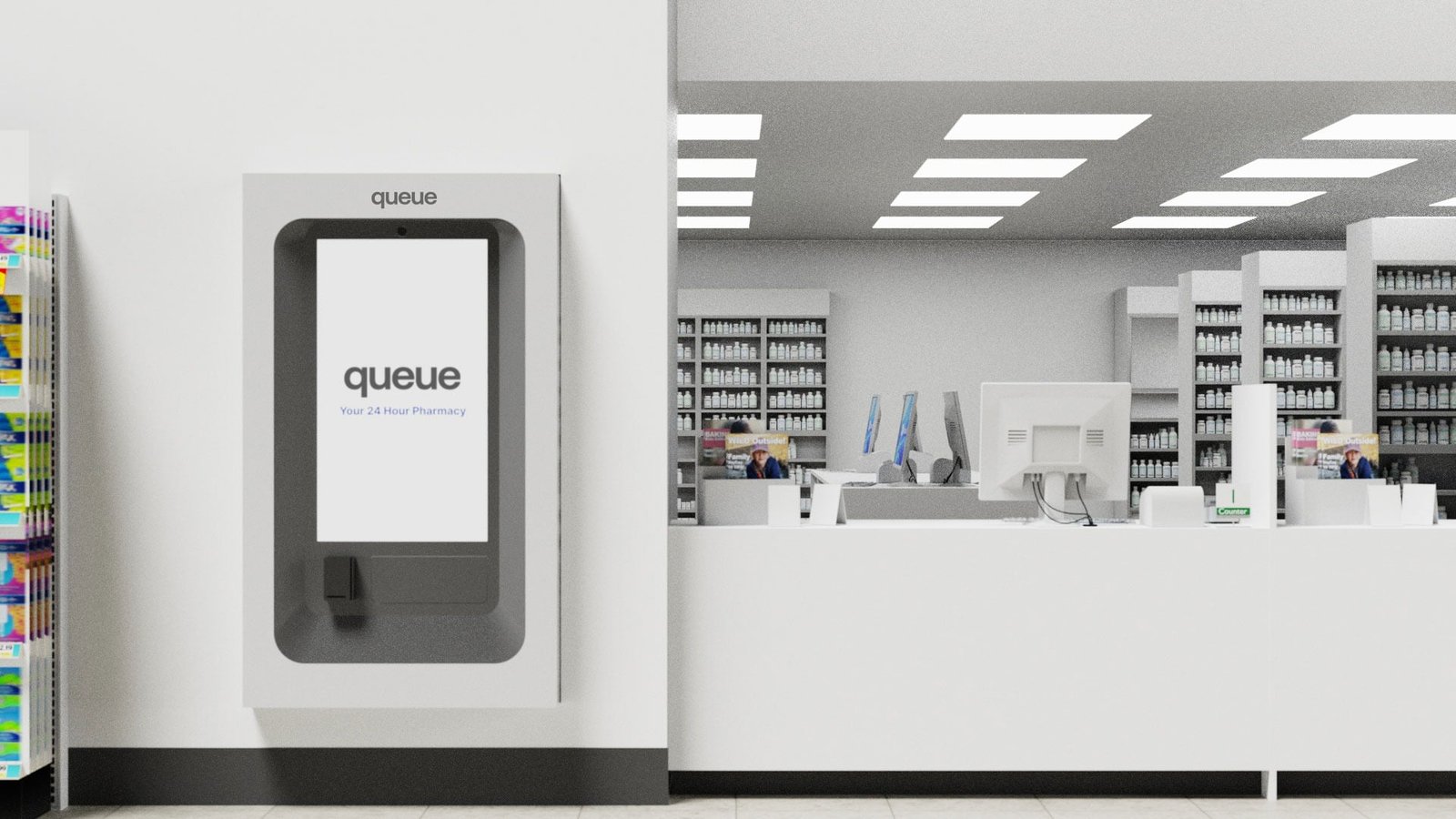
Startup Queue has emerged from stealth to launch what it calls the first fully autonomous robotic pharmacy in the form of a prescription drug kiosk.
The Bay Area company has secured $12.6 million in a seed funding round led by AlleyCorp and previously raised $6 million in pre-seed funding led by Riot Ventures. Additional investors include House Capital, Ubiquity Ventures, Grep Ventures, and Banter Capital.
Queue said it has secured a major national pharmacy chain as a customer and deployed a working prototype to provide the company with early commercial validation.
The startup plans to use the new funding to accelerate product development, expand deployment with pharmacy enterprise customers, and grow its engineering team. Queue currently has a team of 20 engineers in Silicon Valley and is actively hiring across its robotics, hardware, software, and pharmacy operations.
The company was co-founded by healthcare entrepreneur Nick Desai and Josh Liu, who previously worked at Tesla and Zipline. Desai was the co-founder and CEO of Heal, a startup that offered insurance-backed doctor visits and was acquired by Humana in 2023. He also co-founded the AI-powered healthcare app Together by Renee with his wife, Dr. Renee, which was acquired by Cairns Health last year.
Operating autonomously, Queue’s system accepts sealed wholesale medication vials at one end and produces pre-filled, verified prescription drug vials at the other end, eliminating the need for an on-site pharmacist. Executives say the platform currently supports 250 of the most prescribed drugs in the United States.
Consumers use the kiosk to scan a QR code on their phone to verify their prescription, according to the company’s video. The company says the kiosk uses computer vision to identify every pill with high accuracy based on the National Drug Code (NDC) and prescription.
The company says its robotic system can deliver medications at up to 96% lower cost than traditional pharmacy operations and can be deployed throughout retail stores, hospitals, rural areas and other healthcare facilities where access to pharmacies is limited.
“America’s pharmacy is structurally broken,” Liu, Q’s chief technology officer, said in a statement. “Queue is a complete reimagining of how medicines are compounded, validated, and delivered. We’ve built the machinery the industry has needed for decades, and the demand we’re seeing is proof of that.”
U.S. pharmacies are facing staff shortages and economic pressures. More than three-quarters of community pharmacists say they are struggling to fill open positions, according to data from the National Association of Community Pharmacists. Overall, 73% of full-time pharmacists in 2024 rated the workload level at their workplace as “high” or “too high,” compared to 66% in 2014, according to the National Pharmacy Workforce Survey.
According to data compiled by NCPA and the University of Southern California, one in eight regions in the United States is considered a pharmacy desert.
Last year, Amazon Pharmacy introduced kiosks stocked with prescription drugs so patients could get their medications right after their appointment. The kiosks were launched at One Medical locations in Los Angeles beginning in December 2025. The kiosk contains commonly prescribed medications such as antibiotics, inhalers, and blood pressure medications.
Queue positions autonomous prescription fulfillment as a new infrastructure layer for U.S. healthcare, bringing pharmacy services closer to patients and dramatically improving economics, company executives said.
“What the Queue team has accomplished is rare in medical hardware development,” Abe Murray, general partner at AlleyCorp, said in a statement. “We chose to lead this funding round because we believe Queue is building critical infrastructure that can improve accessibility for patients to get the prescriptions they need, while using robotics and automation to significantly improve the workforce constraints that exist across pharmacy.”
