


A prototype smart ring that analyzes sweat in real-time could push wearable health tracking beyond fitness metrics, giving researchers a glimpse at how future devices can continuously monitor key metabolic biomarkers without repeating blood tests.
 Research: A fully integrated smart ring for daily biochemical monitoring. Image credit: PeopleImages/Shutterstock.com
A prototype smart ring that continuously tracks multiple biochemical markers in sweat could bring lab-style metabolic monitoring to your finger. This wearable device measures up to four biomarkers simultaneously, including glucose, ketones, uric acid, lactate, ascorbic acid, and alcohol, providing real-time insights into metabolic health. This study nature communications.
Smart rings extend health tracking beyond vital signs
Wearable smart rings are gaining popularity around the world mainly due to their customizable features, compact design, and comfortable wearing experience. Several large companies manufacture smart rings that can simultaneously monitor various biophysical parameters such as skin temperature, sleep patterns, heart rate variability, calories, and blood oxygen levels.
These smart rings are primarily used as wellness and fitness trackers and can alert users about potential health abnormalities. However, these devices can only provide physiological information and lack the ability to track molecular and metabolic changes that promote physiological health.
Researchers at the University of California, San Diego developed and validated the Compact Continuous Health Analysis Ring Module (CHARM)., A fully integrated wearable smart ring that provides real-time continuous monitoring of multiple biomarkers in sweat.
Continuous measurement of biomarkers is critical for obtaining timely and personalized insights, as episodic measurements often fail to detect rapid biomolecular dynamics that are highly associated with positive or negative health outcomes.
CHARM – Main features
CHARM is an extremely compact smart device with an outer diameter of 3 cm that can be comfortably attached to a ring. The device can measure several biochemical markers from sweat, including glucose, ketones, ascorbic acid, uric acid, lactate, and alcohol. Sweat is collected passively at the skin surface using an osmotic hydrogel that creates a pressure gradient, without the need for movement or electrical stimulation.
This fully integrated device includes all necessary biomarker sensors, low-power electronics, and a flexible battery. The left compartment of the device is designed to passively draw sweat out using osmotic hydrogel, a soft polymer that creates a pressure gradient and painlessly draws fluid from the skin.
The sweat is then analyzed by multiple electrochemical sensor arrays in the same compartment, allowing simultaneous real-time tracking of four biomarkers at once. The researchers established a subject-specific calibration factor through repeated measurements to convert the sensor current measured at the ring site into an estimated blood-equivalent concentration value. These calibration factors enable more personalized insight into biomarker trends. When we repeated the experiment with a freshly prepared sensor patch, this personalized calibration remained stable for up to 2 months.
The right compartment of the device houses a flexible zinc-silver oxide rechargeable battery that powers up to 12 hours of operation between charges. Biomarker information generated through the sensor is wirelessly transferred to a connected Bluetooth-enabled device and displayed in real-time. Prototype experiments used a custom MATLAB interface rather than a consumer smartphone app.
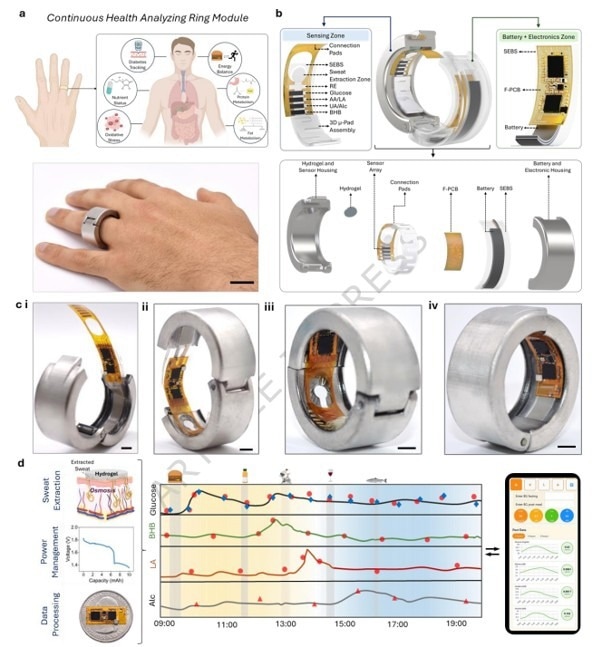
Researchers developed the CHARM prototype smart ring. This wearable device passively collects sweat and continuously measures up to four biochemical markers in real-time using integrated biosensors, flexible electronics, and wireless data transmission. Image credit: Saha et al, 2026.
Functional verification
The effectiveness of CHARM’s biomarker monitoring was verified under various conditions. Study results showed that the device performed well in initial temperature, cytotoxicity, and body compatibility tests. Preliminary studies in healthy participants and patients with type 1 diabetes also demonstrated high analytical accuracy, highlighting the potential for non-invasive metabolic monitoring.
Specifically, the researchers examined the relative changes in sensor current and blood concentration due to specific stimuli; Personalized calibration model for converting measured sensor current over time Based on sweat measurements, it estimates the corresponding blood sugar concentration.
The calculated estimated sweat-based blood glucose concentrations showed a mean absolute relative difference of approximately 13.7% to the corresponding blood concentration values. Other biomarkers also showed strong correlations with their respective blood profiles, underscoring the device’s promising efficacy as a minimally invasive sweat-based monitoring approach, although this study included a limited number of participants and larger clinical studies are still needed.
Prototype accurately tracked multiple biomarkers during testing
This study describes the development and validation of a compact and user-friendly wearable smart ring, CHARM. CHARM exhibits high accuracy in tracking multiple sweat biomarkers simultaneously in real time and provides a promising platform. Future metabolic health, diabetes, disease monitoring and nutrition tracking. Continuous monitoring of glucose and ketones may provide additional information to support future diabetes management decisions. However, this device has not been evaluated for insulin administration or closed-loop therapy.
Of note are the integrated sensors and microfluidic architecture used in the device. We maintained participant-specific calibration factors for approximately 2 months in repeated tests with freshly prepared sensor patches. This suggests that frequent recalibrations may eventually be reduced, although the system still relies on initial reference measurements and requires further validation under a broader range of real-world conditions.
The researchers believe they could further improve the device by making it more waterproof. This can be achieved by changing the hinge lock design to a fully enclosed concentric configuration. In this configuration, all components are sealed within a comfortable rubber-like elastic cover.
The researchers did not take into account the physiological time lag correction between blood and sweat biomarkers. However, they say a delay correction algorithm can be easily implemented in the device’s electronic circuitry, as is commonly used in commercially available continuous blood glucose monitors.
This device requires further validation in diverse clinical settings and across large diabetic cohorts. To enable long-term monitoring over multiple days, hydrogel technology needs to be further improved for sweat drainage over extended periods of time. The authors also note that additional studies are needed to evaluate performance across a broader range of physiological conditions and strengthen the evidence for long-term clinical use.
Researchers plan to develop a multimodal chemical-physical hybrid ring to measure important vital signs. We highlight the need to address commercial issues such as insurance coverage and reimbursement in order to clinically deploy CHARM as a practical and easy-to-use multi-biomarker tracking device.
Download your PDF copy now.
