


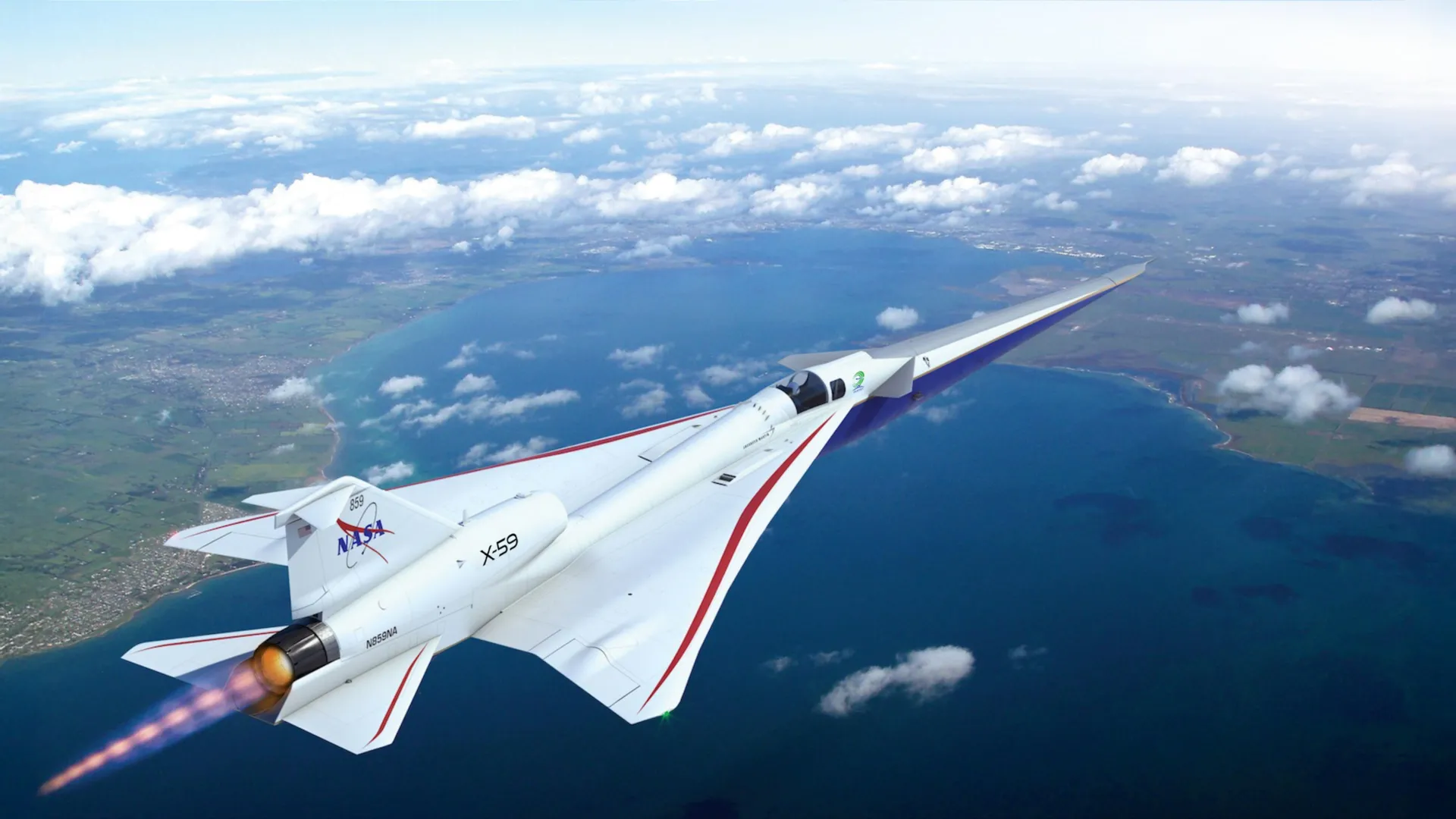
NASA’s silent supersonic research vehicle, the X-59, is nearing one of its most important stages of development. The experimental X-plane is scheduled to begin a new series of test flights, including the first flight above the speed of sound, along with several other key objectives for the mission.
“What’s going to happen next is this unique aircraft will fly at supersonic speeds for the first time,” said Kathy Baum, project manager for NASA’s low-boom flight demonstrator. “We are starting toward a test point for the mission conditions for which the X-59 was designed.”
After months of flight testing, the X-59 team reviewed its progress in late May and is now preparing for a new phase that will push the aircraft to higher altitudes and faster speeds. These flights are intended to demonstrate how the aircraft performs under the operating conditions required for NASA’s Quest mission, which aims to collect data about quiet supersonic flight.
First supersonic flight scheduled
NASA expects the X-59 to exceed the speed of sound for the first time on a test flight scheduled for early June. The aircraft will fly at speeds of more than 1,000 miles per hour at an altitude of about 43,000 feet, marking a major milestone in the program.
The aircraft will then attempt a “mission conditions” flight reaching Mach 1.4 (925 mph) at approximately 55,000 feet. These performance goals are important because they match the conditions NASA plans to use when flying the X-59 over U.S. territory. During future flights, researchers plan to collect public feedback about the aircraft’s quieter “thud” sound and assess how people react to it.
Although the X-59 was designed to minimize the destructive sonic boom typically associated with supersonic aircraft, these early supersonic flights were not intended to demonstrate that capability. A conventional supersonic tracker accompanies the X-59, and the larger sonic boom produced by the tracker masks the quieter sounds produced by the experimental jet.
During this summer’s supersonic tests, the pursuit aircraft will also be equipped with a special shock-sensing probe that will collect the first measurements of the X-59’s shock waves.
What NASA learned from previous flights
The first phase of aircraft testing achieved a number of important goals and provided valuable data for engineers.
After its first flight in October 2025, the X-59 underwent a planned maintenance period before returning to flight testing in March 2026. Since then, the aircraft has completed 14 additional flights and achieved several notable milestones, including:
- Complete the first gear swing, retract the landing gear, and reveal a unique aerodynamic profile in flight.
- It reaches altitudes of up to 43,000 feet and approaches the sound barrier at speeds of Mach 0.95, or approximately 627 miles per hour.
- An initial dual flight will be conducted, followed by multiple flights per day as part of regular testing.
- Move from faster, higher altitude flights to slower, lower altitude tests to evaluate performance over a wider range of operating conditions.
Information collected during these flights helped engineers evaluate key systems such as fuel supply, hydraulics, environmental controls, and the aircraft’s external vision system. This unique camera-based system replaces traditional forward-facing windshields by providing pilots with a live display view of the front of the aircraft.
The team also closely monitored how the X-59 behaved during takeoff, landing, and flight operations. Strain gauges installed throughout the aircraft measured structural loads and recorded how the aircraft responded to the various forces encountered during the test.
Extending the flight envelope
The next series of flights will present new challenges for the aircraft. Pilots will continue working at planned test points while engineers evaluate performance in true supersonic conditions.
“Flight at supersonic speed is a major milestone for the X-59 team,” Baum said. “Each step in envelope expansion brings us closer to demonstrating the silent supersonic capability that is at the heart of the Quest mission. Completing the first mission conditions flight is especially meaningful; it is the moment we begin validating the aircraft in its designed environment.”
In addition to reaching mission conditions, the aircraft is expected to achieve its highest planned performance goals during this testing phase, including a top speed of Mach 1.6 (1,218 miles per hour) and a top altitude of 60,000 feet.
Even so, not all flights occur at supersonic speeds. Engineers will continue to fly a combination of subsonic and low-altitude flights to monitor the aircraft’s behavior under various conditions.
“These flights not only deepen our confidence in the X-59’s performance, but also demonstrate our progress toward future stages of the mission that will ultimately help shape the future of supersonic flight,” Baum said.
Preparing for phase 2 of the quest mission
All flights completed to date are part of Phase 1 of NASA’s Quest mission, along with an upcoming test campaign. This phase focuses on proving the aircraft’s performance and airworthiness.
Some flights will also include early use of specialized equipment, such as a rover aboard NASA’s F-15 research aircraft. This instrument is designed to measure the unique shock wave characteristics of X-59.
Information gathered during these initial measurement flights will help engineers prepare for Quest Phase 2, scheduled to begin later this year. At that stage, the team will directly measure the aircraft’s supersonic flight characteristics and confirm that quiet supersonic shocks are occurring as designed.
“Aviation pioneer Otto Lilienthal said, “Designing a flying machine is nothing. Building it is something, but flying it is everything.” The 15 X-59 flights we have accomplished since March have meant everything to this team and mission,” Baum said. “Every flight has pushed the boundaries of what is possible, steadily expanded its reach and strengthened our faith in aviation.”
However, Baum emphasized that the team remains focused on the work ahead.
“Looking to future flights, we are ready to push the envelope even further and boldly move toward the mission test points this aircraft was created to achieve,” Baum said. “Flying supersonic and reaching these milestones is more than just progress; it is the realization of years of perseverance, innovation, and teamwork. Each step brings us closer to Phase 2 and the future of commercial supersonic flight.”
