


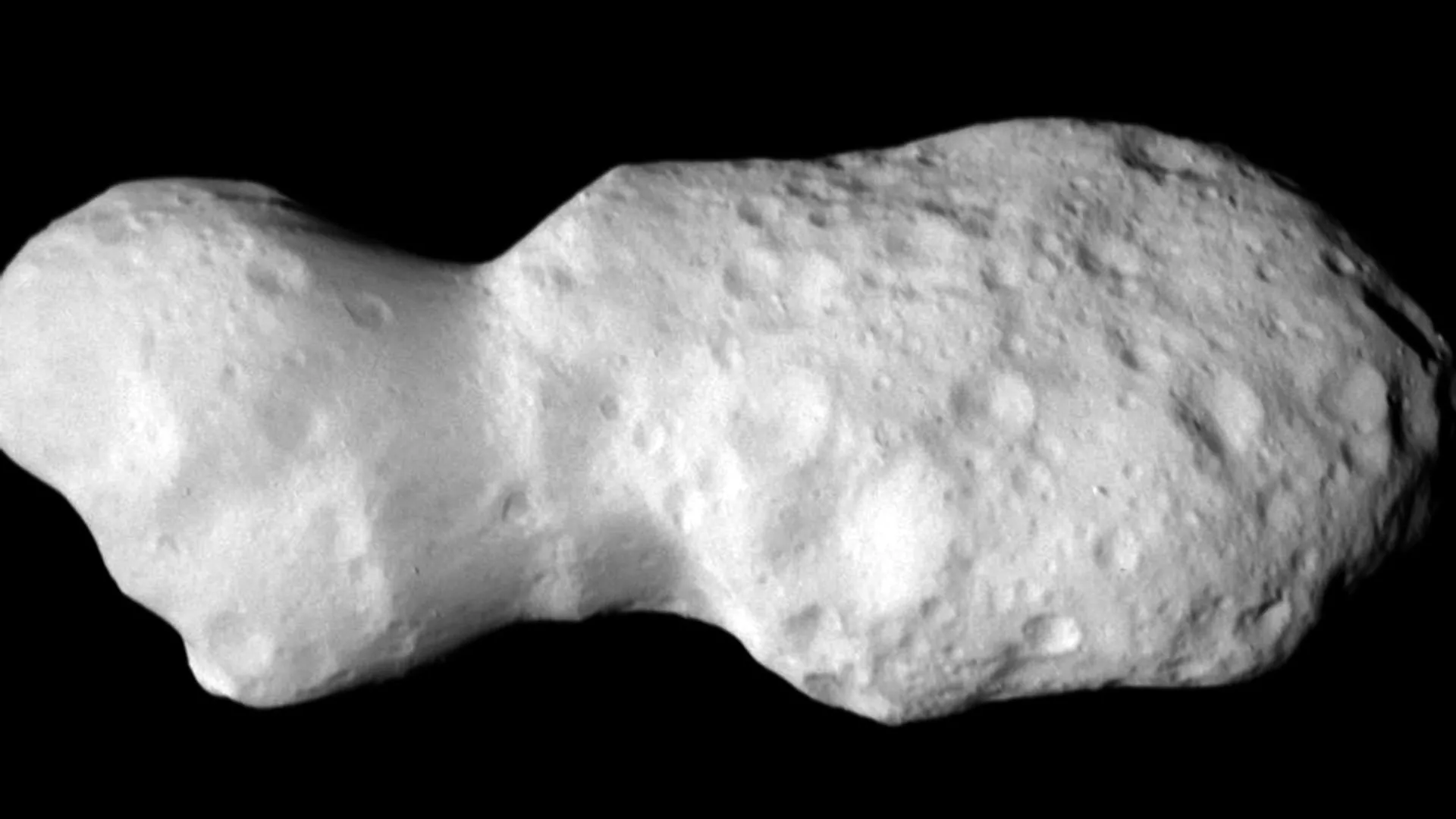
Even relatively small asteroids can have surprisingly checkered histories. NASA’s Lucy spacecraft recently revealed that asteroid Donald Johansson is a wobbly, peanut-shaped object that was shaped by impacts, sunlight, and even a brief encounter with liquid water in the past.
This asteroid was formed about 155 million years ago when debris from a violent collision gradually came together. Since then, subtle but persistent forces generated by sunlight have altered the rotation, leaving traces of ancient water on the rock’s surface.
On April 20, 2025, Lucy passed within 650 miles of Donald Johansson while passing through the main asteroid belt on its way to the Jupiter Trojans. During the flyby, the spacecraft captured the first close-up images and collected detailed scientific measurements. These observations revealed that the asteroid was not rotating in the simple way that scientists expected.
Lucy also provided detailed views of Donald Johansson’s unusual shape and the craters, ridges, and other surface features that help tell the story of its evolution.
Lucy’s asteroid flight reveals abnormal rotation
This encounter served as practice for Lucy’s future visits to Trojan asteroids, starting with Eurybates’ approach on August 12, 2027. While testing the spacecraft’s systems and mission operations, scientists had the unique opportunity to study a previously unexplored asteroid and compare it to Bennu and Ryugu, two asteroids studied up close through sample return missions.
The researchers reported their findings in an academic journal on June 18th. science.
Before Lucy arrived, astronomer Donald Johansson studying from Earth noticed a repeating pattern in the asteroid’s brightness. These observations suggested that it is an elongated object that rotates once every 10.5 Earth days.
The spacecraft’s close-up measurements reveal a more complex reality.
Donald Johansson behaves like a wobbling top, rather than rotating around a single axis like most asteroids and planets. Scientists discovered that the star flips over once every 10.5 days, while simultaneously rocking back and forth around its major axis once every 26.5 days.
Peanut-shaped asteroid formed in an ancient collision
Earth-based observations had already suggested that Donald Johansson is elongated, but Lucy showed that the asteroid is actually composed of two connected lobes connected by a narrow neck.
Scientists describe this type of structure as bilobed. It was probably formed when two pieces from a previous collision drifted together and fused under their own gravity.
Researchers estimate that the asteroid was spinning at least 10 times faster shortly after its formation. But over the past 20 million to 60 million years, that rotation has gradually slowed.
As the spin rate decreased, the balance between centrifugal force and gravity changed. Loose rock and debris moved down the slope, reshaping parts of the surface and contributing to the softer appearance of many of the craters seen in Lucy’s images.
The researchers believe this slowdown was caused by the YORP effect, a subtle process triggered by sunlight.
When sunlight warms an asteroid, its surface emits that energy in the form of infrared radiation. The reaction force generated is very small, but it acts continuously for millions of years. Because Donald Johansson’s shape is non-uniform, these small forces do not cancel out completely, but instead create a twisting effect that gradually alters the asteroid’s rotation.
The same process can slow or speed up an asteroid’s rotation. Bennu, which rotates once every four hours, and Ryugu, which rotates about once every seven hours, may have rotated much more slowly in the distant past, before YORP accelerated.
Evidence of ancient water at Donald Johansson
As Lucy passed by Donald Johansson at about 30,000 miles per hour, its instruments detected iron-rich clay minerals on the asteroid’s surface.
These minerals can only form in the presence of liquid water. However, scientists believe that the exposure to the water was relatively short-lived.
Over time, iron in clay minerals tends to be replaced by other elements such as magnesium due to long-term interaction with water. Because Donald Johansson’s clay remains rich in iron, researchers concluded that liquid water is only present for a limited period of time.
The situation seems to be different between Bennu and Ryugu. Both asteroids contain magnesium-rich clay, suggesting that they were exposed to water for much longer periods, perhaps millions of years, while part of their larger parent bodies.
These differences may indicate that the parent asteroid formed at a different time or in a different region of the solar system before eventually moving into the main asteroid belt.
Comparison of Donald Johansson, Bennu and Ryugu
Scientists believe that Donald Johansson was born from the rocky remains of a larger, carbon- and water-rich asteroid that was shattered by an impact within the main asteroid belt.
Bennu and Ryugu likely formed in the same general area through similar processes. However, important differences distinguish them.
Donald Johansson is only about 155 million years old, making it much younger than Bennu and Ryugu, which are estimated to have formed between 1 and 2 billion years ago.
The history of the orbits is also different. Although Donald Johansson has remained in the asteroid belt since its formation, Bennu and Ryugu will eventually move into orbits closer to Earth and periodically approach our planet. These orbits made ideal destinations for sample return missions.
“It’s useful for scientists to compare Donald Johansson to similar asteroids like Bennu and Ryugu, because every nuance is another clue to our origin story,” said Simone Marchi, Lucy’s deputy principal investigator at the Southwest Research Institute office in Boulder, Colorado, and lead author of the study.
“As we begin to learn more about the Trojans, a very different population of space rocks with very different histories, our understanding of solar system formation is destined to be challenged,” Marchi said.
Lucy, named after a famous human ancestor fossil discovered in Ethiopia in 1974, will be the first mission to explore Jupiter’s Trojan asteroid. These ancient, relatively unaltered objects formed early in the solar system’s history and can help scientists better understand how planets formed and moved before settling in their current positions.
About Lucy Mission
Lucy’s principal investigator is based in the Boulder, Colorado office of Southwest Research Institute, headquartered in San Antonio. NASA’s Goddard Space Flight Center in Greenbelt, Maryland, oversees mission management, systems engineering, safety and mission assurance. Lockheed Martin Space of Littleton, Colorado, built the spacecraft.
Lucy is the 13th mission in NASA’s Discovery program. The program is managed by NASA’s Marshall Space Flight Center in Huntsville, Alabama, for NASA’s Science Mission Directorate in Washington.
