


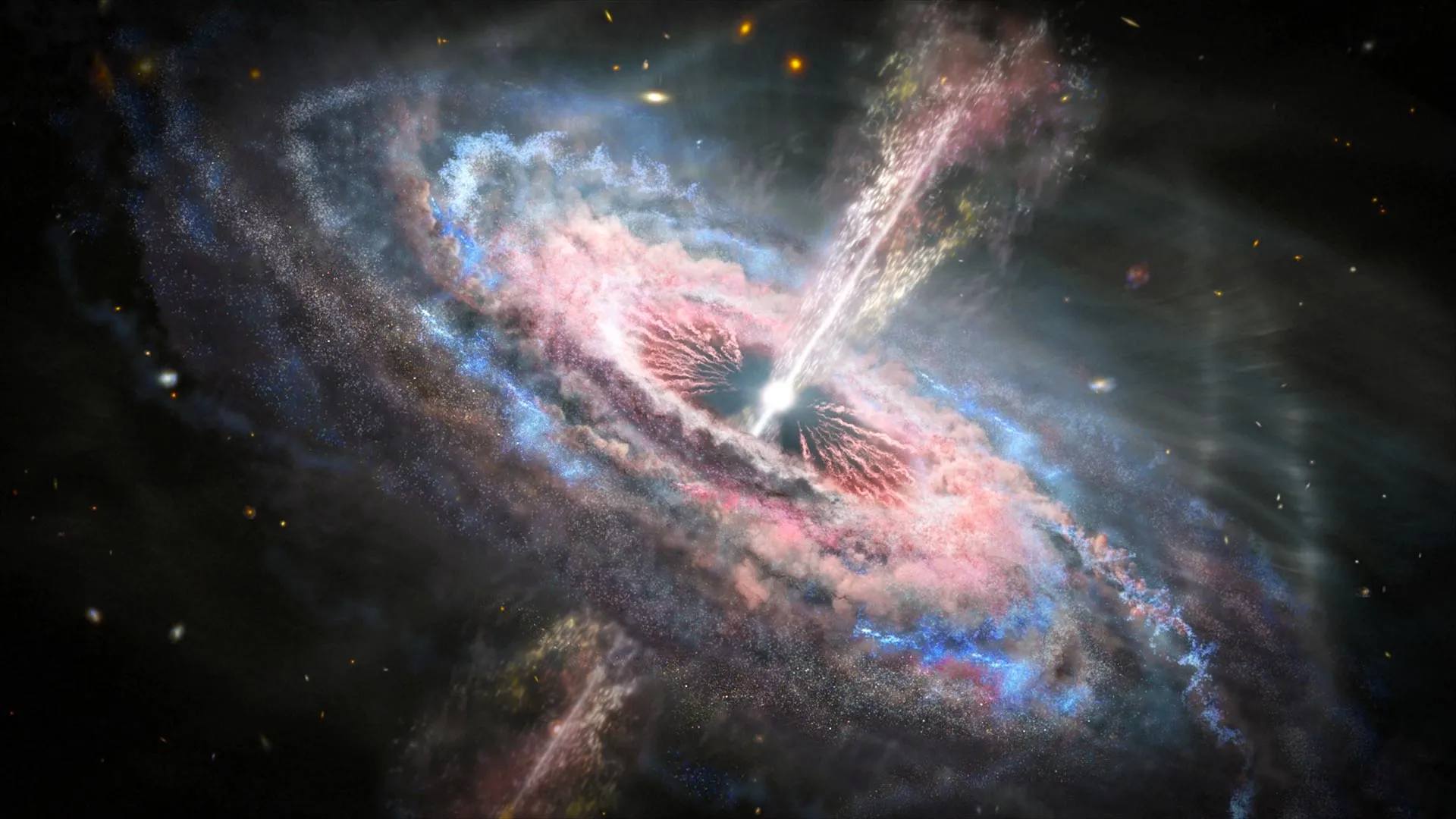
The intense radiation from an active supermassive black hole, thought to be at the center of most galaxies, does more than shape its own surroundings. A new study led by Yongda Zhu at the University of Arizona suggests that these black holes could slow star formation in galaxies millions of light-years away.
“Traditionally, people have been thought to evolve primarily on their own because the galaxies are so far apart,” said Zhu, the study’s lead author. Astrophysics Journal Letter. “But we found that a highly active supermassive black hole in one galaxy can influence other galaxies millions of light-years away, suggesting that galaxy evolution may be a rather collective effort.”
Mr. Zhu likens this concept to the interconnected ecosystems on Earth, describing it as a “galactic ecosystem.” “An active supermassive black hole is like a hungry predator that dominates an ecosystem,” he says. “Simply put, it swallows matter and affects how stars in nearby galaxies grow.”
What makes supermassive black holes so powerful?
Black holes have fascinated scientists and the public ever since they were first proposed in the early 1900s. These objects represent some of the most extreme conditions in the universe, with gravity so strong that they can pull in nearby matter and even light if they get too close.
A special category known as supermassive black holes, which includes the black hole at the center of the Milky Way, can have millions or even billions of times the mass of the Sun. Black holes themselves can’t be seen, but they can become incredibly bright when they actively consume matter around them.
In this active phase, known as a quasar, gas and dust form a rotating disk around the black hole, releasing enormous amounts of energy as the black hole falls inward. These quasars can shine so brightly that they outshine the entire host galaxy.
The mystery of JWST leads to new discoveries
Early data from the James Webb Space Telescope reveals something unexpected. Astronomers have noticed that the regions around some of the brightest quasars in the early universe appear to contain fewer galaxies than expected. This raised questions because large galaxies usually form as dense star clusters.
“We were perplexed,” Zhu said. “Did the expensive JWST break?” he added with a laugh. “We then discovered that galaxies may actually exist, but were difficult to detect because very recent star formation had been suppressed.”
This insight led researchers to consider new possibilities. Perhaps the intense radiation from a quasar not only affected the galaxy itself, but also limited star formation in nearby galaxies.
Evidence that quasars suppress star formation
To explore this idea, the research team focused on J0100+2802, one of the brightest known quasars. This object is powered by a supermassive black hole with a mass approximately 12 billion times that of the Sun. That light has been propagating for more than 13 billion years, giving us a glimpse of the universe less than 1 billion years old.
The researchers used JWST to measure emissions from O III, an ionized form of oxygen that indicates recent star formation. They found that galaxies within about 1 million light-years of a quasar exhibit weak O III radiation compared to ultraviolet light. This pattern indicates that star formation has been recently suppressed in these galaxies.
“Black holes are known to ‘eat’ a lot of things, but in the process of active eating and in the form of bright quasars, they also emit very strong radiation,” Zhu said. “The intense heat and radiation split the hydrogen molecules that make up the vast interstellar gas cloud, eliminating any chance of it accumulating and turning into new stars.”
How radiation disrupts the birth of stars
Stars form under very specific conditions that rely on large amounts of cold molecular hydrogen gas. This gas acts as the raw material for creating new stars. Scientists already knew that quasars can destroy this gas within their own galaxies, effectively halting local star formation.
What remained unclear was whether this effect spread beyond a single galaxy. By observing quasars in the early Universe, researchers have found strong evidence that this influence reaches much farther than previously thought.
“For the first time, we have evidence that this radiation is affecting the universe on an intergalactic scale. Quasars not only suppress stars within their host galaxy, but also affect nearby galaxies within a radius of at least 1 million light-years,” Zhu said.
Why JWST was essential
According to Zhu, this discovery would not have been possible without the James Webb Space Telescope. Light from very distant objects such as J0100+2802 has been stretched to infrared wavelengths by the expansion of the universe. Previous telescopes could not clearly detect this faint infrared light.
JWST’s advanced sensitivity allows astronomers to observe these early cosmic events in unprecedented detail, opening new windows on how galaxies formed and evolved.
What this means for the Milky Way galaxy and beyond
The Milky Way itself is currently inactive, but it may have once gone through a quasar phase. Researchers are now considering how such a step might have influenced the development of our galaxy and its neighbors.
In the future, the research team plans to study additional quasars to determine whether this phenomenon is widespread. They also aim to better understand the mechanisms behind these interactions and whether other factors play a role.
“Understanding how galaxies interacted with each other in the early universe will help us better understand how our galaxy formed,” Zhu said. “We now know that supermassive black holes may have played a much larger role in the evolution of galaxies than once thought. They acted as cosmic predators, influencing the growth of stars in nearby galaxies during the early universe.”
