


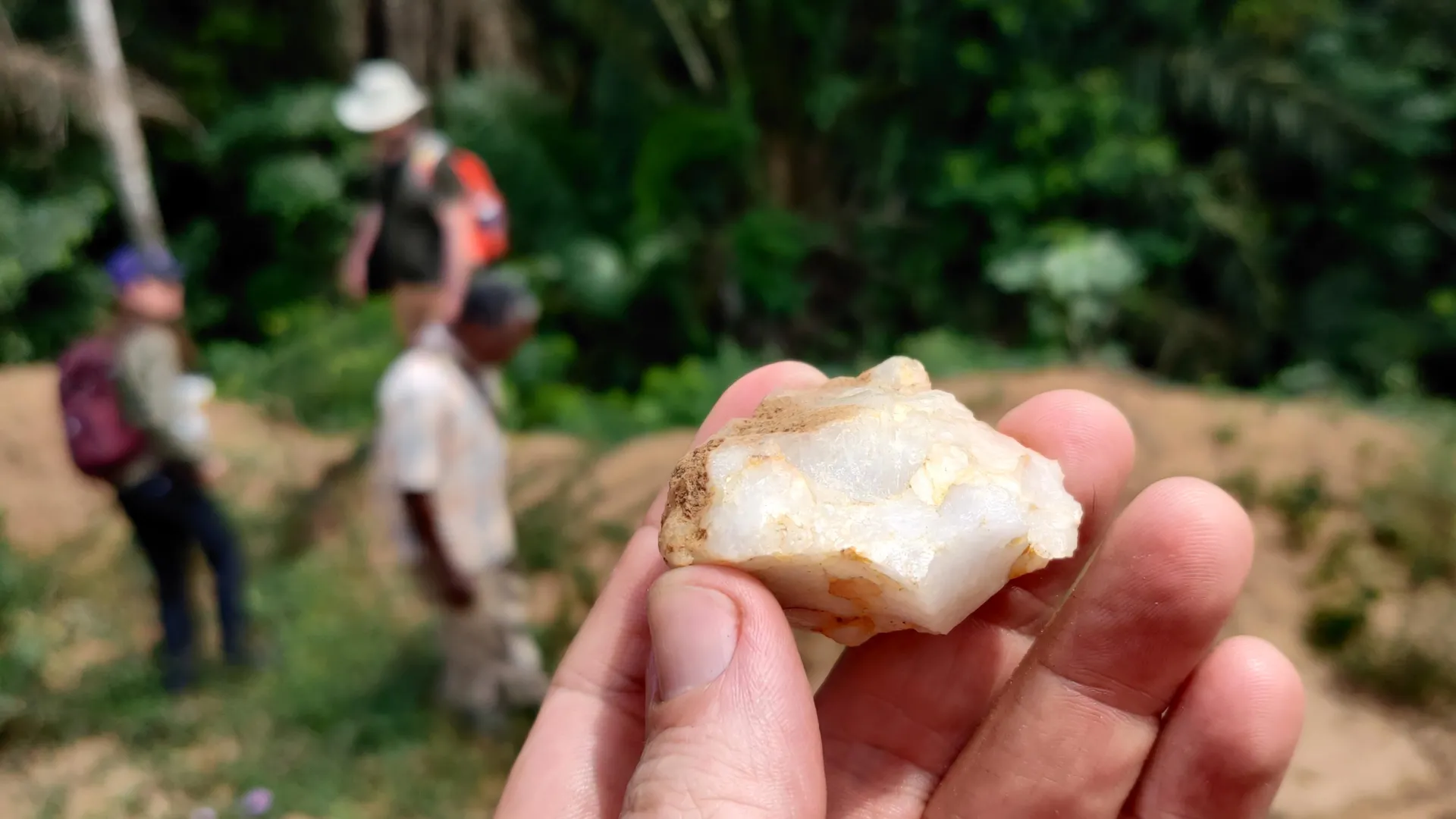
Dense rainforests were long thought to be some of the last places where early humans could survive. For decades, researchers believed that our ancestors stuck primarily to open grasslands and coastal areas, avoiding the dense forests of Africa until much later in history. Evidence from West Africa is now forcing scientists to dramatically reconsider that assumption.
Researchers investigating ruins in what is now Ivory Coast have found evidence that humans lived in humid tropical forests around 150,000 years ago. The discovery pushes back the oldest known evidence of rainforest habitation by more than double previous estimates and suggests that early Homo sapiens were far more adaptable than once believed.
The survey results are naturethere is a growing view that human evolution did not occur in a single environment. Instead, ancient populations appear to have thrived in a surprisingly wide range of ecosystems, from deserts and coastlines to jungles.
Ancient stone tools hidden under the forest
The story began decades ago. In the 1980s, Professor Yodeh Guede of the Félix Houphouët-Boigny University helped investigate the site known as Bete I during a joint research mission between Ivory Coast and the Soviet Union. Excavations have uncovered layers of stone tools buried deep underground in what is now the rainforest.
At the time, researchers were unable to determine exactly how old the tools were or what the environment was like when ancient people lived there. Things changed when an international team returned to the field using cutting-edge technology that was unavailable to scientists 40 years ago.
“With Professor Gede’s help, we were able to relocate the original trench and re-examine it using state-of-the-art techniques that were not available 30 to 40 years ago,” said Dr James Blinkhorn, from the University of Liverpool and the Max Planck Institute for Geoanthropology.
It turns out that timing is very important. Since the new excavation, the site has been destroyed by mining activity, making the recovered data particularly valuable.
Evidence of a true rainforest environment
To determine the age of the ruins, scientists used multiple dating techniques, including optically stimulated luminescence and electron spin resonance. Both methods point to human occupation around 150,000 years ago.
The researchers then analyzed traces of chemicals stored in pollen, phytoliths (tiny silica structures left behind by plants), and sediment. As a result, it was discovered that this area was covered in deep forests when humans lived there.
Although the samples contained pollen and plant waxes associated with humid West African rainforests, grass pollen levels were very low, suggesting the site was surrounded by dense forest rather than thin forest.
Prior to this discovery, the earliest reliable evidence of human habitation in the African rainforests was only about 18,000 years old. The previous world record for rainforest habitat is from Southeast Asia and dates back about 70,000 years.
“Prior to our study, the oldest known evidence of rainforests in Africa was about 18,000 years ago, and the oldest evidence of rainforests was from Southeast Asia about 70,000 years ago,” explained lead author Dr Eslem Ben Allous. “This delays the earliest known evidence of humans in the rainforest by more than twice as much as previously known estimates.”
Rethinking human evolution
The discovery adds to the growing body of evidence that early humans were ecological generalists able to survive in a variety of habitats. Scientists believe this flexibility may have helped. wise person It managed to spread around the world while other human relatives disappeared.
The ensuing debate surrounding the research also highlighted just how difficult rainforest archaeology is. Fossils rarely survive in hot, humid environments, and the dense vegetation makes excavation difficult. Because of this, many scientists suspect that much older rainforests are still waiting to be discovered across Africa.
The study also raises larger questions about how long humans have been impacting tropical ecosystems. Researchers are now investigating whether ancient groups, through hunting, fire use and plant management, may have created rainforest environments much earlier than previously thought.
“Converging evidence shows beyond any doubt that ecological diversity is at the heart of our species,” said the study’s senior author, Professor Eleanor Serri. “This reflects a complex history of population segmentation, with different populations living in different regions and habitat types.”
Scientists believe the Ivory Coast discovery is just the beginning. Several more sites in the region remain largely unexplored, raising the possibility that older evidence of humans living in the rainforest may still be discovered.
This research was funded by the Max Planck Society and the Leakey Foundation.
