


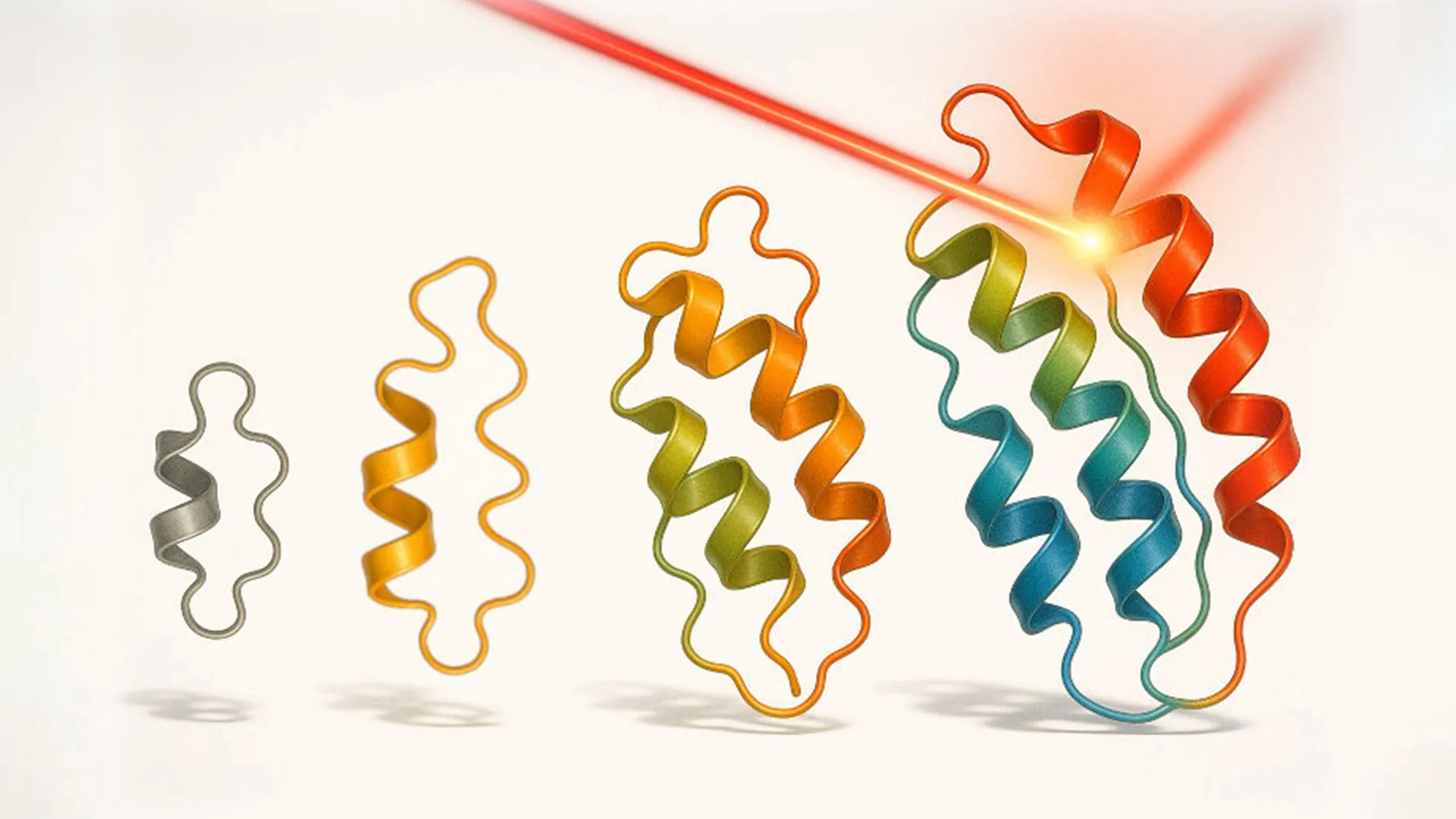
Evolution is nature’s way of designing biological systems. Many variations of DNA, RNA, and proteins occur within cells, and natural selection favors the organisms that function most effectively. Humans began using this process a long time ago. Early farmers influenced evolution by choosing which crops and livestock to reproduce, ensuring that the most productive plants and animals inherited their traits.
Today, scientists apply similar principles in the laboratory through a technique known as directed evolution. Researchers use it to improve proteins such as enzymes and antibodies that play important roles in medicine, industrial manufacturing, and even everyday products such as laundry detergent.
Limits of traditional directional evolution
Despite its success, standard directed evolution techniques have important limitations. Typically, they impose a constant selection pressure favoring proteins that maintain a high degree of activity at all times. However, real biological systems rarely work this way. Many proteins function as signals, molecular switches, or “logic gates” (proteins that combine multiple inputs to make a “yes” or “no” decision). That is, the state must change as conditions change.
For example, a protein can be temporarily activated, then turned off, and then turned on again. If an evolutionary experiment rewards only a single state, other necessary states may be degraded. As a result, the protein may lose its ability to switch properly and may be harmful to the cell (such as killing the cell). Because of this challenge, existing directed evolution approaches have proven difficult to create proteins with complex multistate behavior.
Light-based strategies for protein evolution
Researchers led by Sahand Jamal Rahi from the EPFL Institute for Biosystems Physics have introduced a new approach called “optovolution.” This method uses light to guide the evolution of proteins that can perform dynamic functions and even simple computational tasks that follow “yes” or “no” rules.
This research cellwhich helps bring directed evolution closer to the natural behavior of cells. In living systems, timing and switching between states are as important as signal strength.
Manipulating yeast cells to select optimal proteins
To build the system, the researchers used the budding yeast Saccharomyces cerevisiae, an organism widely used in both brewing and scientific research. They redesigned the yeast cell cycle so that cell division depends on the behavior of evolving proteins. For cells to survive, proteins had to switch cleanly between active and inactive states.
The scientists connected the protein’s output signal to a controller that controls the cell cycle. This regulator is essential at one stage and toxic at another. If the protein is turned on or off for too long, the yeast cell either stops or dies. Only cells containing proteins that switched at the right time continued to divide.
Controlling evolution in real time using light
Light provided a way to precisely control this process. The researchers used optogenetics, a technique that uses light to activate or deactivate genes. By sending out timed pulses of light, they forced the protein to switch states.
Each cell cycle in yeast lasts about 90 minutes, allowing for a quick pass/fail test to see if the protein switched at the correct moment. The proteins that functioned best allowed cells to survive and regenerate, and mutants that switched poorly were eliminated. This allows Optovolution to automatically select proteins with better dynamic behavior without manual screening or iterative adjustments.
New protein variants and expanded color sensitivity
Using optovolution, the team evolved several different types of proteins. They first improved a commonly used light-regulated transcription factor. The researchers generated 19 new mutants that showed greater sensitivity to light, reduced activity in the dark, or the ability to respond to green light rather than only blue light. Designing proteins that respond to warmer colors than blue has long been considered extremely difficult because of the way proteins absorb light.
Scientists also evolved a red-light optogenetic system so that yeast cells do not need additional chemical cofactors. Evolution has produced mutations that disable normal yeast transport proteins. This unexpected change allowed the system to use photosensitive molecules already present within the cells, facilitating the use of the system in experiments.
Proteins that act like tiny computers
This study also demonstrated that optovolution can be extended beyond light-sensing proteins. Researchers have evolved transcription factors that function like single protein computers. It activated the gene only when two different inputs appeared simultaneously: one light signal and one chemical signal.
The dynamic behavior of proteins is essential for many biological processes, such as sensing environmental changes, intracellular decision-making, and controlling cell division. Optovolution opens new possibilities for synthetic biology, biotechnology, and basic research by allowing these behaviors to continuously evolve within living cells.
The technology could help scientists design smarter cellular circuits, create optogenetic tools that respond independently to different colors of light, and better understand how complex protein behavior arises through evolution.
other contributors
- EPFL Protein Cell Engineering Laboratory
- University of Bayreuth
- Lausanne University Hospital (CHUV)
