


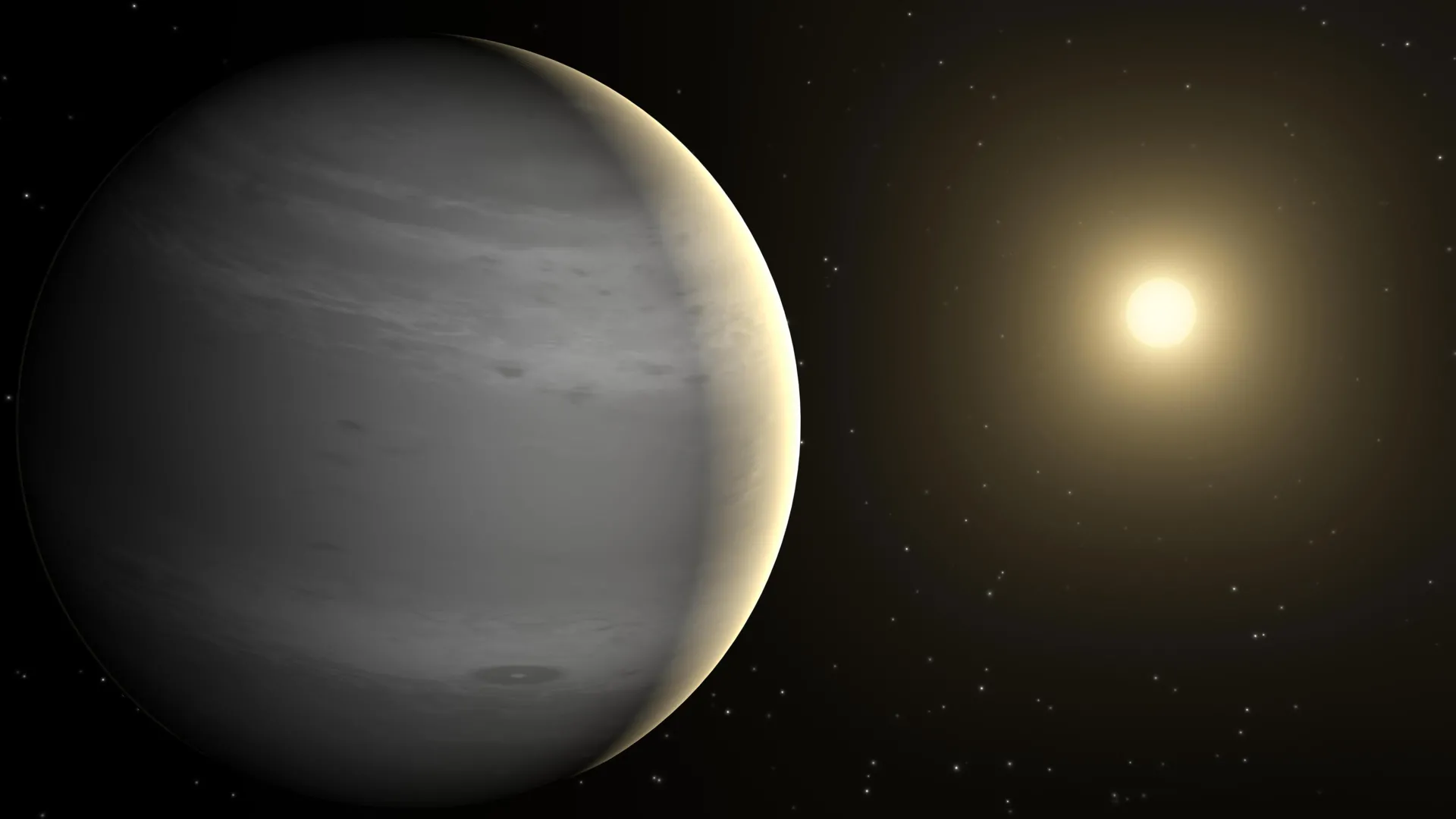
Astronomers using NASA’s James Webb Space Telescope (JWST) have taken a close look at the atmosphere of a rare giant planet with temperatures surprisingly similar to Earth’s. A Saturn-sized world known as TOI-199b has methane in its atmosphere, according to a new study.
The discovery is notable because giant planets are typically found at extreme temperatures. In our solar system, Jupiter and Saturn are very cold because they orbit far from the sun. Many of the giant exoplanets discovered outside our solar system are “hot Jupiters,” worlds that orbit very close to their stars and reach temperatures of several thousand degrees Celsius.
TOI-199b falls somewhere in between. It is one of the few known temperate giant planets, and researchers say this is the first time its atmosphere has been studied in such detail.
The discovery could help scientists refine models of the formation and evolution of planets and atmospheres. The researchers also say the study could ultimately yield new insights into Earth’s own atmosphere.
The study was led by scientists at NASA’s Jet Propulsion Laboratory (JPL) at Pennsylvania State University and the California Institute of Technology and was published May 20 in the journal Science and Technology. astronomy magazine.
“One of the main benefits of studying planets outside our solar system, known as exoplanets, is that we can study many different types of planets, especially those that don’t exist in our solar system, to learn how planetary systems form and evolve,” said Renyu Hu, associate professor of astronomy and astrophysics at Penn State’s Eberly College of Science and leader of the research team. “Astronomers have discovered thousands of exoplanets since the first exoplanet was discovered in 1992 by a team including Alexander Volszczyn at Penn State University. But only a few large temperate exoplanets are known, and this is the first time we’ve been able to study the atmosphere of one of them in detail.”
Huge planet with surprisingly mild temperatures
TOI-199b orbits the star more than 330 light-years from Earth, completing one orbit approximately every 100 days.
The planet’s temperature is estimated to be about 175 degrees Fahrenheit. Although it’s still very hot by everyday standards, it’s much cooler than most giant exoplanets studied so far. For comparison, the temperature inside a parked car exposed to direct sunlight easily rises to the same level as on Earth.
So while TOI-199b is much milder than hot Jupiter, it is dramatically warmer than the frozen gas giants in our solar system, where temperatures can drop to hundreds of degrees below zero.
How JWST studied planetary atmospheres
To study TOI-199b’s atmosphere, researchers used a method called transmission spectroscopy. This technique allows astronomers to study starlight passing through a planet’s atmosphere as it moves across the star’s surface from the perspective of a telescope.
JWST splits starlight into different wavelengths, much like a prism splits white light into a rainbow.
“When a planet passes in front of a star, some of the star’s light passes through the planet’s atmosphere, where it interacts with elements and molecules in the atmosphere,” said Aaron Bello Alfe, a postdoctoral fellow at JPL and lead author of the paper. “Certain elements absorb light at specific wavelengths, creating a fingerprint that reflects the composition of the atmosphere in the spectrum of light that JWST detects.”
The researchers first collected about 20 hours of continuous observations to establish baseline measurements of starlight. The planet’s transit itself lasted about seven hours, much longer than typical transits of hot Jupiter (less than an hour).
The scientists then compared the light spectra recorded during the passage with baseline measurements. This difference revealed which wavelengths were being absorbed by the planet’s atmosphere, allowing the team to identify the gases present.
Methane detected in the atmosphere of TOI-199b
“When we compared the spectra during the transit to the baseline, we found that the atmosphere blocks the wavelengths of starlight that are absorbed by methane,” Beloalfe said. “Compositional models of temperate gas giant exoplanets have predicted that they contain methane, so it’s good to have confirmation that our theory is accurate.”
In addition to methane, this observation also suggested the presence of ammonia and carbon dioxide.
“Further observations of the planet will allow us to establish the relative abundances of different gases in its atmosphere,” Hu said. “A more complete picture of the atmosphere of this temperate gas giant planet can be used to improve our models, potentially leading to a better understanding of how planets and their atmospheres, including Earth, form and evolve.” The success of our first study also gives us the confidence to devote more resources and observation time to studying other similar planets. We will then be able to see if this planet is unique or if there are common features common to planets of this type.”
The research team also included scientists from Arizona State University, Johns Hopkins University, the Carnegie Institution for Science, the California Institute of Technology, and the University of California, Santa Cruz.
NASA funded the research through a grant from the Space Telescope Science Institute.
