



The idea that fruits and vegetables can cause cancer sounds strange. Decades of research has shown that people who eat more plants tend to live longer and healthier lives and have lower rates of heart disease, stroke, and some common cancers.
Lung cancer is no exception. Many large studies have found that higher fruit and vegetable intake is associated with lower risk, especially for smokers.
Against this backdrop, the new suggestion that fruits and vegetables may be contributing to lung cancer in young people is surprising.
The story behind this latest wave of unrest does not emerge from a definitive and landmark trial. This is based on a short presentation at a scientific conference based on 187 young-onset lung cancer patients.
Most had never smoked. When researchers asked about their diets, many said they ate lots of fruits, vegetables, and whole grains. This is the kind of pattern most of us would call “healthy.”
Instead of measuring pesticides in their food or blood, the research team used average residue levels from other sources to estimate potential exposure to pesticides. The researchers hypothesized that pesticides in health foods may explain why some young non-smokers develop lung cancer.
There is a very long way to go to prove that fruits and vegetables themselves are harmful. Such studies aim to raise the question: “Could pesticides be part of the cause of young lung cancer?” – Don’t rewrite dietary advice yourself.
Importantly, this particular study looked retrospectively at people who already had cancer, rather than following healthy people over time, so we can’t know whether their diet played any role in causing their disease. Nor has it been shown that these patients had more exposure to pesticides than comparable people without cancer. It just shows that on average they ate food that could carry residue.
big picture
When we zoom out from this single, small study to the broader evidence, the situation changes from alarming to reassuringly familiar. Large studies followed tens or hundreds of thousands of people over many years, asked them what they ate, and observed who developed lung cancer. Many times, people who eat more fruits and vegetables perform better, or worse, do no better than those who eat less.
A meta-analysis that combined data from multiple studies found that increasing fruit intake reduced the risk of lung cancer, and vegetables also provided benefits. These are studies that influence official guidelines. They’re not perfect – nutrition studies aren’t perfect – but they’re far more informative than a single unpublished study of 187 patients.
So why do small studies like this latest study sometimes seem to say different things? One reason is simple statistical noise.
When the numbers are small, chance plays a big role. If, for some reason, a particular group of young people attending the clinic happened to be unusually health-conscious, it would appear that fruit and vegetable intake was higher among lung cancer patients, even if diet was unrelated to the disease.
Another problem is what scientists call “confounding.” People who eat more plants often differ in many other ways. They may be more proactive about exercising more, drinking less alcohol, getting a different job, living in a different area, or seeking medical help.
Starting from the patient and looking back, it is very difficult to disentangle these overlapping elements. That’s why we place more emphasis on large prospective studies that follow people over time and can better explain these differences.
Pesticides
Next, there is the issue of pesticides. It’s no surprise that this story makes people nervous. It’s true that many conventionally grown fruits and vegetables contain measurable pesticide residues, and people who eat a lot of produce tend to have higher concentrations of some pesticide breakdown products in their urine.
Farmworkers who regularly handle high doses of pesticides also have higher rates of certain cancers, including some lung cancers. This shows that pesticides are not harmless. But what this paper doesn’t tell us is that eating sprayed apples and lettuce at normal dietary levels causes lung cancer in the general population.
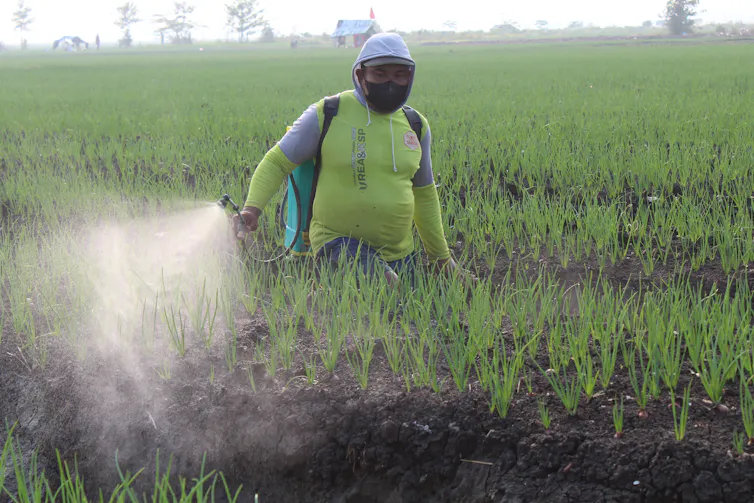
Farm workers exposed to high doses of pesticides have higher rates of certain cancers.
kuro1982/Shutterstock.com
That doesn’t mean we should be satisfied. There is ongoing debate about the mixture of different chemicals, vulnerable populations such as children and pregnant women, and long-term hormonal and brain effects that may not show up in gross cancer rates. But these are arguments for improving the way we farm and how pesticides are regulated, not for abandoning fruits and vegetables.
If you’re still concerned about pesticides, there are practical and sensible ways to do so without swapping oranges for packets of crisps. Washing produce under running water will help remove surface residue and dirt. Also, changing the types of fruits and vegetables you eat means you don’t have to rely so heavily on certain items that tend to have a lot of residue.
If your budget allows, it makes sense to choose organic versions of some “high residue” foods. But the important point is that these are just small tweaks. They do not change the core message that diets rich in plant foods are overwhelmingly associated with improved health outcomes.
Perhaps the most important lesson from this episode is about how to read nutrition headlines. Every time you see “X food causes cancer” or “Ingredient Y is the next miracle cure,” it helps to ask a few simple questions. How large was the study? Were healthy people followed over time, or were patients studied after the fact? Did the researchers actually measure what they were claiming (such as pesticide levels)? And how do the new findings stack up against decades of existing research?
In the case of early-onset lung cancer research, the answer is grim. The study was small, retrospective, and used indirect exposure estimates, and its suggestion that fruits and vegetables may be harmful puts it in an awkward position with a much larger body of research pointing in the opposite direction.
This does not mean that we should ignore the possibility that pesticides may somehow contribute to cancer in nonsmokers, or that diet may be unrelated to lung health. But we must be careful not to let one provocative conference talk turn into a reason to fear the very foods that are consistently shown to be indicators of improved health.
