


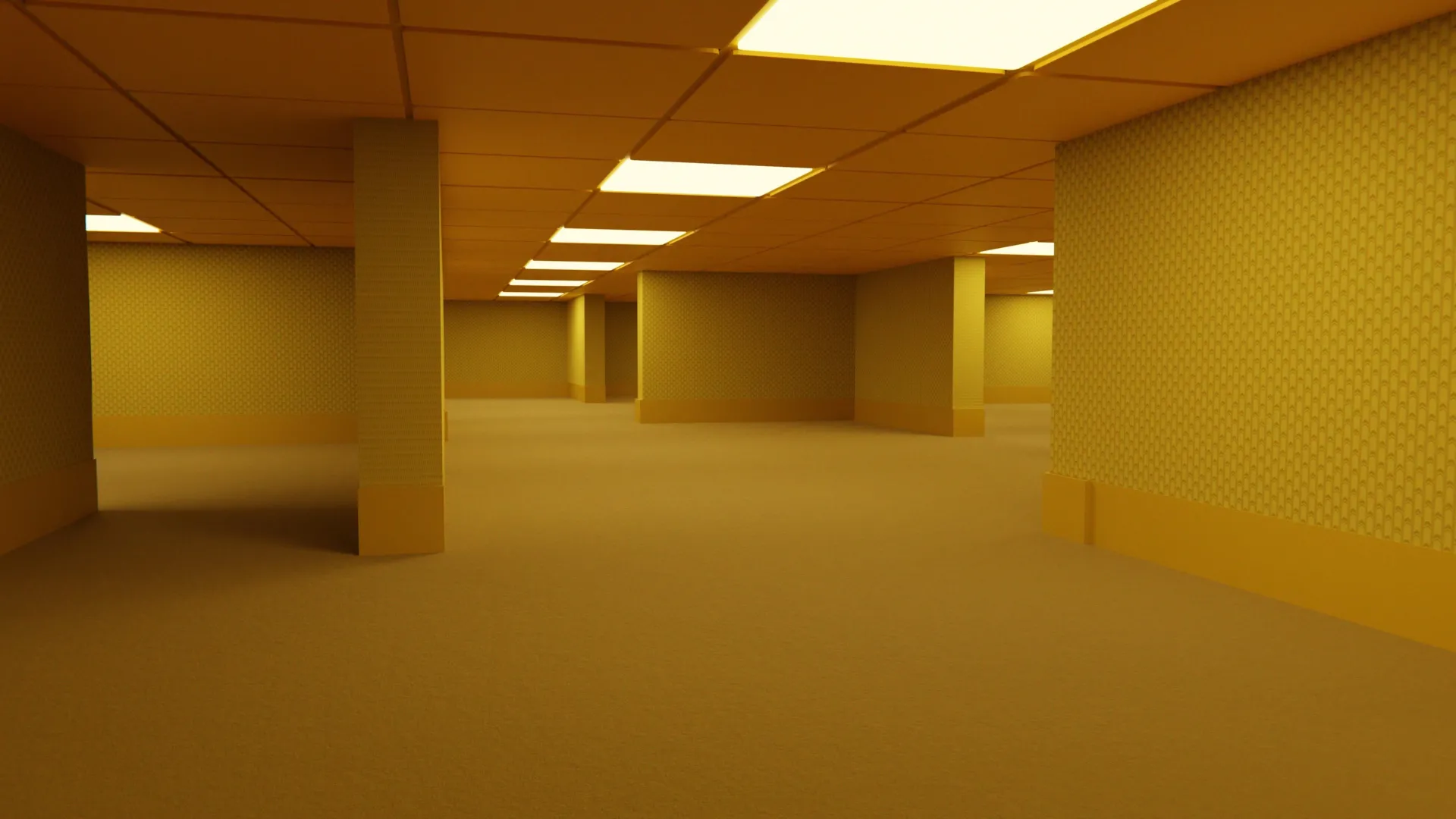
What if you could visit a place that doesn’t exist on maps? A place that’s whispered about online as if it were on the edge of the world we know. A place known simply as the “back room”.
The Back Room is a fictional setting created by the Internet, imagined as an endless network of empty rooms lit by fluorescent lights. The concept centers around the idea of accidentally breaking out of normal reality and becoming trapped in this monotonous, labyrinthine environment with no clear exit.
Since first emerging on the online bulletin board 4chan in 2019, the backroom phenomenon has spread across Reddit, TikTok, YouTube, and gaming platforms, with users collectively mapping, telling, and expanding its myths. Common to much of the user-generated content are eerie images and haunting stories of spaces that exist outside or beyond reality itself, such as mysterious yellow-wallpapered hallways or empty offices.
Much of the internet’s interest has revolved around filmmaker Kane Parsons’ viral “found footage” video on YouTube. Parsons took this phenomenon from low-resolution still images to immersive cinematic explorations and helped establish Backroom as one of social media’s most recognizable horror environments. With Parsons’ adaptation of The Backrooms into a full-length horror thriller, the strange fictional world is rapidly entering mainstream discourse.
At first glance, Backroom may resemble an accelerated urban legend (also known as “creepypasta”), such as Slender Man or the Russian sleep experiment. However, our research suggests that something more important is happening in terms of a shift in consumer interest in spaces related to horror and trauma, their mediation, and new ways of experiencing them.
The other side of the yellow wallpaper
Back Room began with a single disturbing image posted anonymously online. It’s a claustrophobic cluster of cheap, yellow, windowless rooms with old carpeting and harsh overhead fluorescent lights.
Intrigued by the ambiguous mix of menace and nostalgia that the image evoked, internet users began sharing stories and speculating that the backroom was a hidden dimension that people might accidentally enter.
Because of commercial tourism, social media, and video blogs, much of today’s world feels overexposed and overexplained, and it seems like every destination is photographed, every experience reviewed, and every hidden gem incorporated into content. The mystery of the back room felt different.
The r/backrooms subreddit now includes hundreds of thousands of members, and backroom content on TikTok and Instagram continues to garner massive engagement. With more than 500,000 posts of content tagged #backrooms on TikTok and hundreds of thousands of followers, Instagram fan pages like @xbackroom expand on the myth through imagery, editing, and reflective storytelling. Users create maps, fictional diary entries, survival guides, found footage, and first-person explorations that collectively expand the world.
This is one of the reasons why Backroom feels different from traditional horror movies and ghost stories. Rather than passively consuming a completed story, the audience actively participates in the construction and manipulation of the environment itself.
Folklorist Michael Kinsella describes this type of online activity as a form of “online legend trip” in which viewers become contributors, collaborators, and world-builders rather than mere spectators.
fear of familiar places
Studies of dark tourism have revealed that people are drawn to places associated with death, disaster, tragedy, and the macabre, such as former prisons, ruins, or places associated with disturbing historical events. Emotional, symbolic or existential atmospheres are often encountered in these places.
Backroom extends this logic into new participatory realms. Unlike virtual dark tourism, which allows for “armchair trips” to the dark heritage of the real world, there is no physical location to anchor the backroom, no historical tragedy to commemorate. Instead, the backroom offers an online environment that collectively imagines anxiety, abandonment, and liminality.
Interest in backrooms persists precisely because they lack a fixed myth, geographical reality, or narrative history, allowing users to construct meaning around a location that is nonetheless eerily familiar. With its dated décor, hotel-like hallways, overhead ceiling tiles, and abandoned office spaces, the back room resembles an overlooked non-place in modern life: a space that many are aware of but rarely notice.
In this sense, Backroom reveals how digital culture has begun to reshape the experiences traditionally associated with tourism, allowing the mundane to become threatening.
Backroom functions more like a world that people enter than a story that they receive. Across YouTube videos, video games, VR experiences, and TikTok compilations, viewers are located within the environment itself, blurring the boundaries between storytelling, role-playing, tourism, and online participation.
This boundary crossing may help explain why this phenomenon resonates so strongly at this cultural moment. The Internet is no longer just a network of information or communication platforms. It is gradually evolving into a landscape that people can emotionally navigate and fully inhabit.
Backrooms points to a future in which a collectively imagined digital world functions as a meaningful cultural environment in its own right. That is, a place where people travel, explore, emotionally invest, and return to again and again, even though they don’t physically exist at all.
