


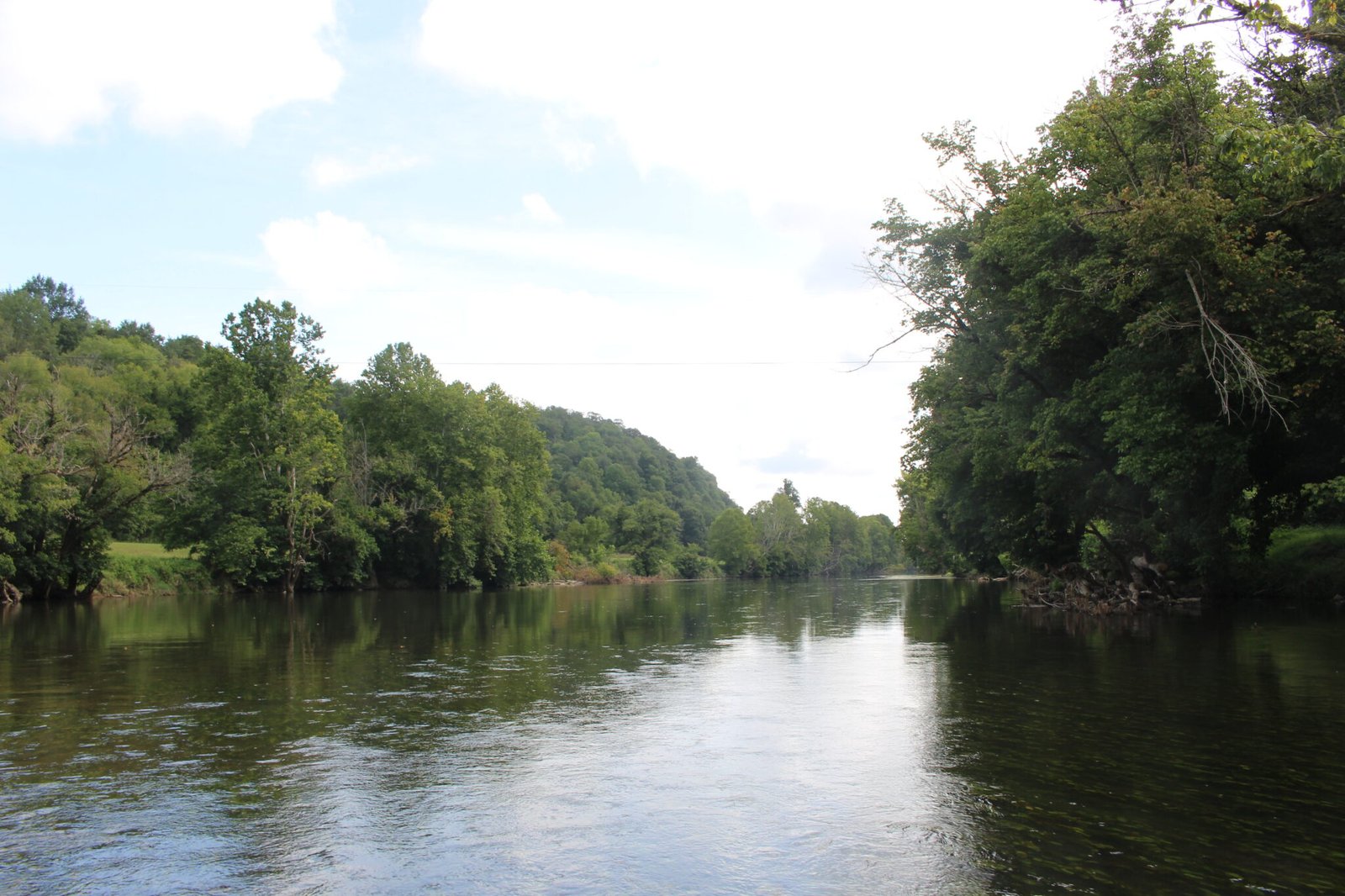
Clinch River, Scott County, Virginia. (Photo by Sarah Fogelson/Virginia Mercury)
As 10-year-old Andrik Williams of Fort Blackmore, Virginia, prepares for his next round of cancer treatment at St. Jude Children’s Research Hospital, he keeps in mind the people his mother calls “the military.”
“He has the military behind him and he knows it,” Andrik’s mother, Kelsey Williams, 33, said in a phone interview from St. Jude in Memphis. “He will win the military battle.”
Andrik was diagnosed with Ewing’s sarcoma, a rare and aggressive form of bone cancer, in 2025. The diagnosis was made after severe lower back pain brought him to Niswonger Children’s Hospital in nearby Johnson City, Tenn., but the family was told it was rhinovirus or possibly nerve compression and sent home. His illness was finally discovered after the pain increased and he went to the emergency room.
 Andrik Williams, 10, of Fort Blackmore, Virginia, was diagnosed with Ewing’s sarcoma, a rare and aggressive form of bone cancer, in 2025. He is hospitalized with his service dog at St. Jude Children’s Research Hospital in Memphis, Tennessee, where he is receiving chemotherapy and treatment. His mother, Kelsey Williams, is urging state health leaders to learn more about why several children in the area have experienced childhood cancer in the past two years. (Photo by Kelsey Williams)
“He has a very high pain tolerance,” Kelsey Williams said. “He has bilateral clubfoot. He’s been through a lot already. So for him to be in constant pain, obviously something was wrong.”
Andrik is not alone. Parents and community members say childhood cancer diagnoses are no longer rare in this county in the southwestern corner of the state, just minutes from the Tennessee border.
 Andrik Williams, a pediatric bone cancer patient, stands behind his brother Kyler. (Photo by Kelsey Williams)
Megan Smith, 35, is a local oncology nurse who has been collecting data on recent childhood cancer cases in Scott County and leading the search for more information. Since 2023, 14 children in Scott County have been diagnosed with some form of cancer, Smith said. Two children were diagnosed in 2023, five in 2024, and seven in 2025.
The rising number of cases in Scott County, and the advocacy of concerned parents there, led Smith to seek research from the Virginia Department of Health and the Virginia Cancer Registry.
“I knew the numbers based on annual pediatric caseloads,” Smith said. “I knew something was wrong.”
Smith created a Facebook group, “Scott County Strong,” where he posts updates and updates from his family. She also posted signs and symptoms of cancer. This helped Kelsey Williams discover her son’s cancer.
“If it wasn’t for Megan’s post about being aware of the signs and symptoms in your child and getting tested right away if you have symptoms, I may never have made the connection between my son and his cancer symptoms,” Williams said. “I saw that post and thought about how Andrik had this terrible hip pain, especially at night, and he kept having low-grade fevers randomly.”
The Virginia Department of Health held a town hall meeting Thursday, Jan. 8, at Gate City High School to report on the findings. Childhood cancer cluster suspicion investigation report analysis. This study consists of data on childhood cancer diagnoses from 0 to 19 years of age in Scott County from 2014 to 2023.
The day before the meeting, VDH announced that Scott County’s cancer incidence does not meet the Centers for Disease Control and Prevention (CDC) cluster definition, based on eight cases included in the report.
However, the study did not include information from the past two years of confirmed childhood cancer diagnoses in Scott County.
Smith and parents across Scott County are struggling with data lags.
“If everything is electronic in 2026, why is there a two-year lag in data?” asked Kelsey Williams.
“We want to know what steps we can take,” Smith said. “How do we eliminate this data lag? Children in Scott County can’t wait two years. How many children will we need?”
VDH says the delay is due to the time it takes to report and verify cancer data.
“The national cancer registry has been delayed for two years due to the time it takes to finalize cancer data,” VDH communications director Cheryl Rodriguez said in a Feb. 27 statement. “Virginia regulations, like other states, allow facilities and health care providers to report diagnoses within up to six months. The registrar may receive multiple reports for the same person. We combine information to create a complete case. These steps are part of the quality assurance process of our work.”
Rodriguez added that preliminary data for 2024 and 2025 will be reviewed once VDH receives 90% of the expected number of cancer cases in Virginia that year.
“VDH is committed to being transparent about the steps we are taking to address community concerns,” Rodriguez said. “We want parents to know that we understand your concern and concerns about the health of your children. VDH will continue to investigate cases in 2024 and 2025 as the data becomes more complete. We will notify the community as soon as the next analysis is complete.”
Eivin Culbertson, 6, of Fort Blackmore, was diagnosed with B-cell leukemia in 2024 after experiencing several days of fever and leg pain. Her mother, Ashley Culbertson, 40, attended the Jan. 8 meeting and believes it failed to address the current increase in diagnoses.
 Avin Culbertson, 9, is growing out his hair after being diagnosed with B-cell leukemia in 2024. She is one of the children in Scott County, Virginia, whose parents are pressing the state to learn more about childhood cancer cases in the area. (Photo by Ashley Culbertson)
“We’re seeing an uptick in childhood cancer in our region,” Ashley Culbertson said. “And it seems like it keeps going. It’s not enough to get it done by 2024. Why do the research if we can’t extract what we need right now? I think that’s how we all feel.”
Ashley Culbertson said she witnessed the growing fear of local families during her daughter’s treatment and after a VDH community meeting as the community searched for answers.
“I feel so terrible for the new mothers and all the families in this county who are having this kind of worry, this deep worry in the pit of their stomachs, for their children right now,” she said. “New mothers have told me how scared they are and just trying to do everything they can to protect their children.”
 Sitting Avin Culbertson is one of several children in Scott County, Virginia, who have been diagnosed with cancer in recent years. (Photo by Ashley Culbertson)
Culbertson said there is now a “deep-seated fear” among her neighbors, even those whose children have not been diagnosed with cancer. Concerns about water quality are widespread in the region, and many are questioning whether it is linked to illnesses among children.
Smith founded the Southwest Virginia Mountain Valley Coalition, a nonprofit organization dedicated to independent testing of water, air quality, soil and local waterways. The coalition is currently accepting donations to further its work.
“We want to go out and spread the word about the coalition so we can do more testing,” Smith said. “Testing for volatile components in water is not cheap. Depending on the test, it can cost up to $1,000 or more. And that’s the next step we need to take.”
Many local residents do their own water and radon testing. A variety of factors, such as the health of local mussels in the nearby Clinch River, could also provide further information, Smith said. The community also discussed investigating local well water, the impact local cave systems may have on local water sources, and even pesticides that may impact local families, among many other potential factors, she added.
Smith said other children in the area are experiencing symptoms similar to those diagnosed with some form of cancer. According to information she gathered in the community, three patients had leukemia-like symptoms, and one patient went to St. Jude, but was instead diagnosed with an autoimmune disease. She says some people lose weight or show other symptoms without being diagnosed with cancer.
“My thinking is that whatever they are exposed to, it doesn’t just cause cancer,” Smith said. “It works just like cancer. Regardless of what these kids are exposed to, it also causes autoimmune disease.”
For families like the Culbertsons, their lives revolve around ending their cancer journey.
Avin will receive weekly treatment through October, and hopes to be able to ring the final bell at St. Jude in October.
“It’s surreal,” Culbertson said. “There has been so much pain and sadness, but to be honest, there has also been so much joy. God has opened so many doors in Avin’s journey for people we have never met before. It has been an amazing journey. But Lord, I can’t wait for her to ring that bell.”
Avin started Battle Bandages, a nonprofit organization that donates bandages to children undergoing medical treatment, using his home’s workshop, which was built with help from Make-A-Wish and Home Depot. The idea came from Avin’s own experience of having blood drawn and a finger pricked, and a bandage brightening the experience.
“Right now, we are using her craft room to help others,” Culbertson said. “And to help other families going through this situation.”
 Eivin Culbertson, a 9-year-old from Virginia who is battling B-cell leukemia, started the nonprofit organization Battle Bandages with his mother, Ashley Culbertson. We hope to bring smiles to the faces of the children who were able to use the bandages to make their treatment a little more enjoyable. (Photo by Ashley Culbertson)
The journey continues for others, including the Williams family.
Williams said Andrik will undergo chemotherapy for the next four to five months. Meanwhile, she and Andrik remain at St. Jude, and Andrik’s younger brother, Kyler, remains in Scott County with Williams’ mother. St. Jude families receive no bills for treatment, transportation, housing, or food, but it is difficult for them to return to their hometowns and continue their lives.
“I’m the only adult here. I’m the only income. I can’t work and pay my bills here,” she said.
The family set up gofundme This is to help cover the costs and help Andrik buy food.
“Especially when he’s in the hospital, he doesn’t want to eat until after chemotherapy, which usually happens late at night after the cafeteria closes,” she says. “So I have to get restaurant food to him via DoorDash so he can eat.”
At home, Smith and others are still looking for answers.
“I want the public to know that we are not standing still,” she said. “Because no matter what, we as a community see this every day. We see the impact it has on our community and our children.”
In the midst of cancer diagnoses and immediate challenges, both families find hope in St. Jude and the military-like community that stands ready to support them and their children.
“There’s a lot of fight inside this kid,” Williams said of Andrik. “There’s no question he’ll win. He’s too stubborn, too hard-hitting and too much of a fighter.”
 From left: Andrik, Kelsey and Kyler Williams during a visit to St. Jude Children’s Research Hospital in Memphis. Andrik is in the hospital undergoing treatment for bone cancer. (Photo by Kelsey Williams)
You make our work possible.
support
Our stories may be republished online or in print under the Creative Commons license CC BY-NC-ND 4.0. Please edit only to change the style or shorten it, and provide proper attribution and a link to our website. AP and Getty images may not be republished. For information on using other photos and graphics, please see our republishing guidelines.
