


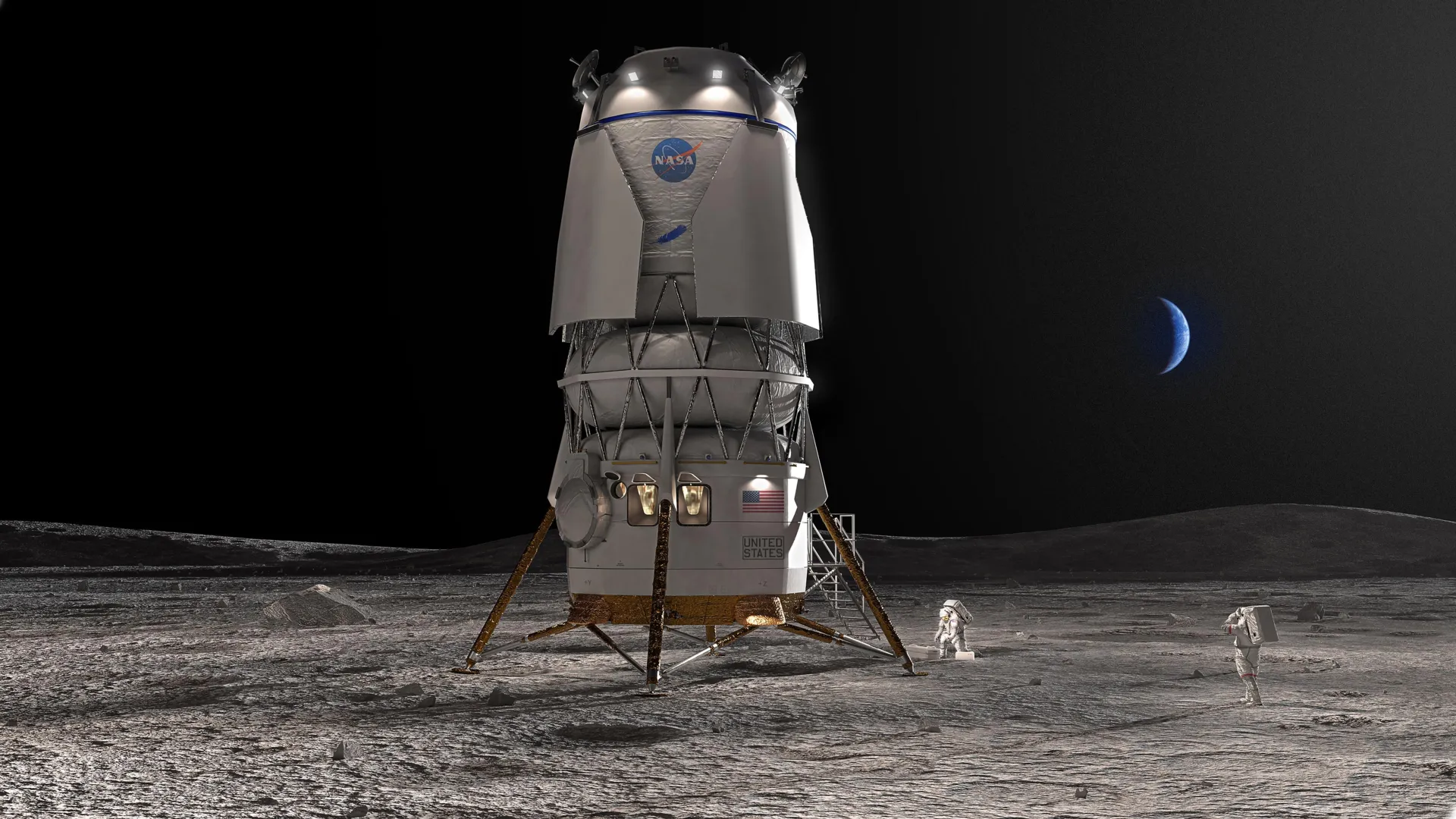
As scientists prepare for a new era of lunar exploration, new research suggests they may leave more than just footprints with each landing. Researchers have found that methane emitted by spacecraft exhaust gases can spread across the moon surprisingly quickly, contaminating areas that may hold ancient chemical clues about how life began on Earth.
The results of the study suggest that even if a astronaut lands near the moon’s south pole, methane molecules could be sent “hopping” across the moon’s surface to the north pole in less than two lunar days. As more governments, private companies and NGOs plan missions to the moon, it becomes increasingly important to understand how the exploration itself may impact future scientific discoveries, researchers say.
This study Geophysical Research Journal: Planetsan AGU journal focused on planetary science.
“We are trying to protect science and investments in space,” said Silvio Sinibaldi, planetary protection officer at the European Space Agency and lead author of the study. He said the moon offers a rare opportunity to study the early history of the solar system, but paradoxically “our activities may actually impede scientific exploration.”
Ancient moon ice may hold clues to life
Near the moon’s poles, there are craters that never receive sunlight (called permanent shadow regions). These frozen environments contain ice that may have trapped material carried by comets and asteroids billions of years ago.
Scientists believe these deposits may contain “prebiotic organic molecules,” chemical components that may have eventually combined to form the first building blocks of life, such as DNA. If researchers can study these molecules in their original state, they may gain new insights into how life first arose on Earth.
“We know that there are organic molecules in our solar system, for example in asteroids,” Sinibaldi said. “But how they came to perform specific functions in the same way as biological materials is a gap we need to fill.”
Because the Earth’s surface is constantly changing, much of this ancient evidence may have been erased. In contrast, parts of the moon have remained largely unchanged for billions of years, making them an ideal archive for recording the history of the early solar system. Permanently shaded areas are particularly valuable because the very low temperatures help capture and preserve molecules. But those same cold traps could also collect organic compounds released by visiting spacecraft, potentially obscuring primordial materials that scientists hope to study.
Computer simulations track methane on spacecraft
To investigate this question, Sinibaldi and lead author Francisca Paiva, a physicist at the Institute of High Technology, developed a detailed computer model using the European Space Agency’s Argonaut mission as a case study.
The researchers simulated how methane, the main organic compound produced during the combustion of Argonaut’s propellant, would diffuse after landing near the moon’s south pole. Previous research has investigated the movement of water molecules on the lunar surface, but this study is the first to model the movement of organic molecules such as methane. The simulation also incorporates the effects of solar wind and ultraviolet light.
“We were trying to model thousands of molecules, how they move, how they collide with each other, how they interact with surfaces,” said Paiva, a master’s student at the University of Leuven and an intern at the European Space Agency during the research period. “It required a lot of computing power. Each simulation had to run for days or weeks.”
Methane could spread across the moon in a few days
Simulations showed that methane would reach the North Pole in less than two lunar days. Within seven lunar days (almost seven Earth months), more than half of the emitted methane was “cold-trapped” in the permanently cold polar regions, with 42% accumulating in the South Pole and 12% in the North Pole.
“That deadline was the biggest surprise,” Sinibaldi said. “Within a week, molecules could be distributed from the South Pole to the North Pole.”
The moon has little atmosphere, allowing for rapid dispersion. Without air molecules to slow down the methane molecules, they move freely under the influence of gravity, bouncing off surfaces when energized by sunlight or slowed down by cooler temperatures.
“Their trajectory is essentially ballistic,” Paiva said. “They’re just hopping from one point to another.”
Paiva said this means there may not be a perfectly safe landing place. “We showed that molecules can travel all over the moon. Eventually, no matter where you land, there will be contamination everywhere.”
Protecting the future of lunar science
Researchers stress that contamination is not necessarily inevitable. Paiva said if the landing site is cold, exhaust molecules may stay more localized than in warmer areas. Sinibaldi also plans to investigate whether the exhaust molecules remain only on the surface of the ice, leaving material deep inside untouched and suitable for scientific research.
Both researchers emphasized that future lunar missions will need to confirm their computer simulations through additional modeling and direct measurements.
“I want to bring this discussion to the mission team. At the end of the day, this is not a theoretical thing, this is the reality of us going there,” Sinibaldi said. “If you don’t have the equipment on board to validate these models, you’re missing an opportunity.”
Paiva also wants to investigate whether substances other than methane, such as compounds emitted by spacecraft parts such as paint or rubber, could contaminate the scientifically important surface of the moon.
“We have laws that regulate pollution of the global environment, including Antarctica and national parks,” she said. I think the moon is an equally precious environment.
This study Geophysical Research Journal: Planetspublished in AGU Journal.
