


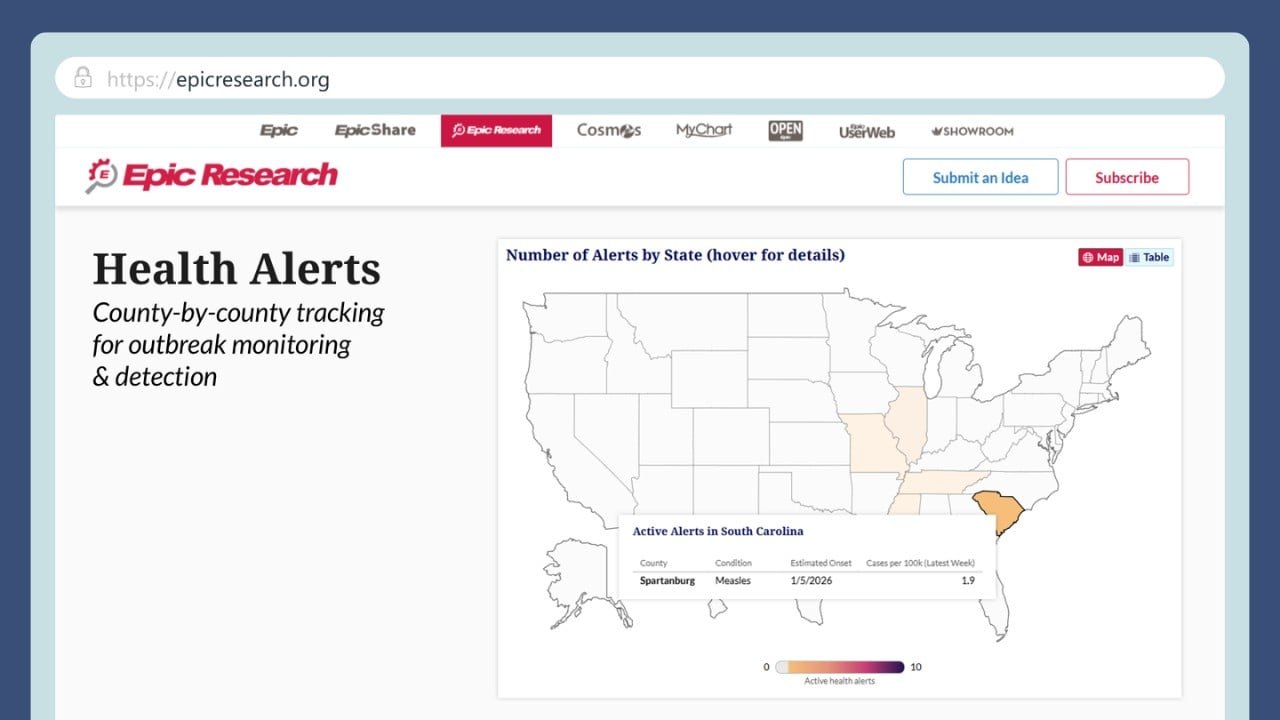
Electronic health records giant Epic has debuted a new feature that monitors county-level health trends and issues alerts when an increase in disease rates is detected.
Developed by Epic Research, Health Alerts uses statistical models applied to actual medical records to detect when rates of health conditions in a county are higher than expected. Each alert is reviewed by the Epic research team, which includes clinicians and data scientists, before being published, Epic said in a blog post. This manual review step assesses whether the alert is clinically meaningful and appropriate for public reporting, the company said.
Active health alerts can be viewed from this Epic dashboard, and users can sign up to receive health alerts via email.
The Health Alerts tool has so far warned of increased rates of acute bronchiolitis, acute tonsillitis, measles, streptococcal pharyngitis, and viral gastroenteritis in some areas of Illinois, Missouri, Tennessee, Arkansas, and South Carolina.
The alert is based on data from Epic’s Cosmos platform, which includes records from 300 million patients from 2,067 hospitals and 47,000 clinics.
The company says Health Alerts is based on data from Epic Cosmos participating organizations, and that the data does not reflect the complete number of cases of a condition, but rather assesses trends in disease activity at a population level.
The Epic Research team’s detection process uses ICD-10-CM diagnosis codes to monitor diagnosis rates at the county level. In its description of the Health Alerts feature, Epic states that the purpose of the Health Alerts tool is to highlight conditions that are increasing and accelerating from historical rates.
Alerts are most likely to appear for acute diseases, epidemics, and rare or unexpected spikes, rather than chronic diseases or predictable seasonal patterns.
Conditions are flagged for review if they meet a number of criteria, including a year-over-year increase in diagnosis rates that takes into account normal seasonal fluctuations, and an acceleration of growth in diagnosis rates. Conditions that meet the first two criteria will be assessed using the Farrington Improved Algorithm, a well-established method in public health surveillance, Epic Research said.
“The model uses three years of historical data to establish expected baseline rates, further adjusting for seasonality and long-term trends, and confirming that the observed increases are statistically significant and unlikely to be due to random fluctuations,” Epic Research said in its methodology description.
