


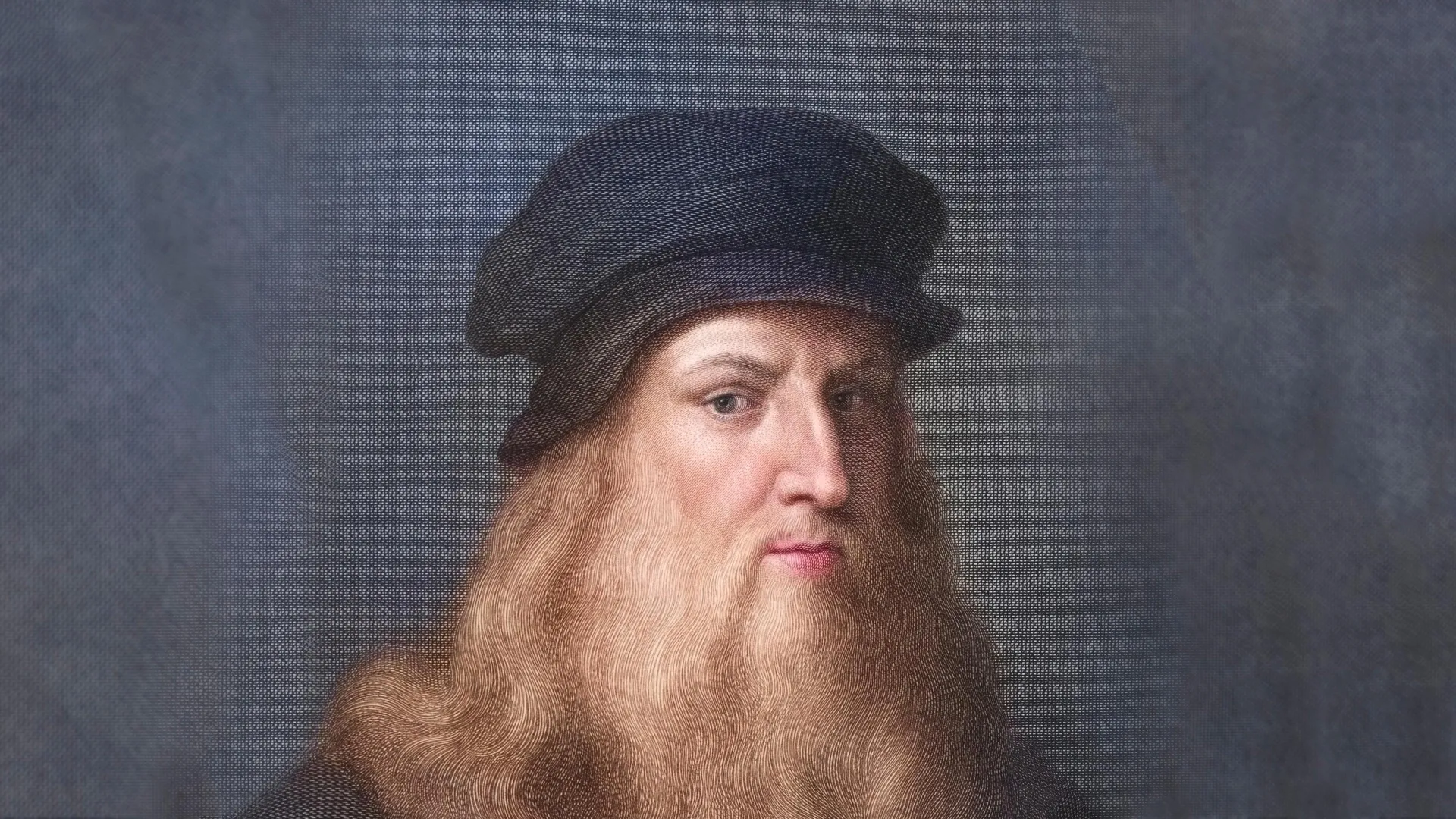
For more than 500 years, Leonardo da Vinci has been celebrated as a great artist, inventor, and thinker whose talents were likely far ahead of his time. Now, an ambitious international effort known as the Leonardo DNA Project is bringing scientists closer than ever to uncovering the biological roots of his genius.
The newly published book “Genia da Vinci. Genealogy and genetics of Leonardo’s DNA” summarizes 30 years of research led by Alessandro Vezzosi and Agnese Sabato of the Leonardo da Vinci Heritage Society in Vinci. With the support of the Municipality of Vinci, this research is reconstructing an extensive family tree dating back to 1331. This spanned 21 generations and included more than 400 individuals, and laid the foundation for an unprecedented attempt to reconstruct Leonardo’s genetic profile.
By carefully studying archival records and historical documents, researchers were able to uncover a previously unknown lineage of Leonardo’s family. In the process, they identified 15 living male descendants who are directly related through paternal lineage to Leonardo’s father and half-brother Domenico Benedetto.
DNA testing is associated with living descendants
This discovery opened the door to genetic analysis. David Carameli, who coordinates the anthropological and molecular aspects of the Leonardo DNA project and heads the biology department at the University of Florence, worked with forensic anthropologist Elena Pirri to analyze the DNA of six of these descendants.
The results showed that the segments of the Y chromosome were consistent between participants. Because this chromosome is passed from father to son with little change, the discovery confirms a continuous male lineage within the da Vinci family, going back at least 15 generations.
Ancient tombs may hold important evidence
Researchers have also identified the tombs of the da Vinci family in the church of Santa Croce in Vinci. Archaeological excavations are currently underway in collaboration with the University of Florence. The ruins are thought to contain the remains of Leonardo’s grandfather Antonio, uncle Francesco, several half-brothers, Antonio, Pandolfo, and Giovanni.
Anthropologists Alessandro Riga and Luca Bacechi recovered bone fragments from the site, some of which have been radiocarbon dated. One specimen, age-matched to Leonardo’s relatives, has already undergone paleogenome testing. Initial analysis suggests the person was male.
“Further detailed analysis is needed to determine whether the extracted DNA is well preserved,” said Carameli, who is also president of the University Museum System. “Based on the results, we can proceed with the analysis of Y chromosome fragments for comparison with current descendants.”
If the Y chromosomes of these remains matched those of their living descendants, historical records and genealogical reconstructions would be strengthened. It will also be possible to analyze biological traces associated with Leonardo himself, including substances left behind in manuscripts and works of art, potentially allowing scientists to reconstruct Leonardo’s DNA.
global scientific effort
The Leonardo da Vinci DNA Project began in 2016 and is coordinated by Rockefeller University in New York. It brings together institutions such as California’s J. Craig Venter Institute and the University of Florence, with support from foundations such as the Akelis Bodman Foundation (New York) and the Richard Lounsbury Foundation (Washington, DC).
The project focuses on tracking the Y chromosome, which is passed down largely unchanged through male generations.
“Our goal is to reconstruct the genealogy of da Vinci’s family to this day, while preserving and cherishing sites associated with Leonardo and allowing scientific research into his DNA,” says Vezzosi. “Through the recovery of Leonardo’s DNA, we hope to understand the biological roots of his extraordinary eyesight, creativity, and perhaps his health and cause of death.”
“Even a tiny fingerprint on a page could contain cells that need to be sequenced,” says Jesse H. Ausubel of Rockefeller University. “21st century biology is moving the boundaries between the unknowable and the unknown. We may soon have information about Leonardo and other historical figures believed lost forever.”
Beyond DNA: new insights into Leonardo’s life
This book goes far beyond genetics and explores Leonardo’s world in detail. Over 21 chapters, we examine historical, geographical, and genealogical evidence to better understand the environment in which he lived.
Researchers have identified seven da Vinci family homes in the village and castle of Vinci, as well as two properties that once belonged to Leonardo himself. These properties were inherited from his uncle Francesco and were the subject of a long dispute with his half-brothers.
The study also reconsiders the key figures in Leonardo’s life. It is revealed that his grandfather Antonio was not just a farmer, but a traveling merchant who operated between Catalonia in Spain and Morocco. Meanwhile, new archival analysis has provided a clearer picture of Leonardo’s mother Katerina. Evidence suggests that she may have been a slave working for the wealthy banker Vanni di Niccolo di Ser Vanni. Historical documents, including wills and donation records dating back to 1449, reveal the banker’s relationship with Ser Piero, Leonardo’s father.
A mysterious picture appears
Particularly interesting finds include charcoal drawings found on the fireplace mantle of Vinci’s old building, once known as the Bracci House. The artwork depicts a fantastical creature that combines several striking features, including spiral horns, an elongated snout, hooked teeth, wings, and a serpentine tail.
Vezzosi and Sabato named this image “Unicorn Dragon.” Some elements seem to anticipate Leonardo’s later flight research. Comparisons with known drawings from the 1470s suggest it may be an early work by Leonardo, but further scientific analysis and restoration are planned.
This hypothesis is supported by Roberta Barsanti, director of the Leonardo Museum and Library, and Daniele Vanni, the mayor of Vinci. The city is preparing a detailed survey of the large drawing (approximately 80 x 70 centimeters) under the supervision of cultural heritage authorities.
Leonardo and his early thoughts on genetics
The book also explores Leonardo’s own ideas about heredity. His book suggests that he may have anticipated ideas now associated with epigenetics, considering how diet, blood, and parental behavior affect offspring.
“Leonardo questioned the origin of human life not only biologically. His work on generations made conception a complex act in which nature, emotion and fate intertwine, anticipating themes that are now central to the debate in genetics and epigenetics,” explains Agnese Sabato.
Toward reconstructing Leonardo’s DNA
The final section of the study considers whether modern descendants share physical similarities with Leonardo’s famous self-portrait. This is still speculative, but the main goal is scientific.
Once enough genetic material can be recovered and sequenced, researchers hope to learn more about Leonardo’s biological characteristics, including his appearance, health, and even his potential predispositions.
“This is not just a story about the creator of the world’s most famous painting,” Ausubel concluded. “Redefining the limits of historical knowledge and cultural heritage is a challenge.”
Reconstructing Leonardo’s genetic profile would be a major milestone in both scientific and cultural history. For the small Tuscan town of Vinci, where Leonardo was born, the possibility of hearing his “genetic voice” centuries later is a source of powerful pride.
This research will also contribute to future documentaries and international film projects. And despite all that has been revealed so far, one conclusion stands out. That said, Leonardo da Vinci’s story is still unfolding.
Important points
- Leonardo da Vinci DNA Project: The first scientific project aimed at reconstructing Leonardo’s genome through indirect and comparative biological materials
- Art meets genetics: DNA found in manuscripts and drawings could confirm the authenticity of works of art, and the technology developed through the project could revolutionize the way disputed works are verified.
- Forensic analysis: Leonardo’s genetic profile may reveal biological traits such as left-handedness, vision, diet, health predispositions, and physical appearance
- 21 generations documented: The reconstructed family tree is updated from 1331 to the present and includes records of extinct families.
- Heritage rediscovered: More than 400 individuals were analyzed, including 219 da Vinci/Vinci (119 males and 100 females).
- 15 male descendants identified Belongs to the paternal line and is essential for Y chromosome research
- Y chromosome: Six direct male descendants successfully underwent comparative DNA analysis
- “Unicorn Dragon”: The hypothesis that a large painting in Leonardo’s hometown may be his
- Archaeological excavations in Vinci: First efforts to identify the remains of the da Vinci family tomb recorded in the church of Santa Croce
- Digital archive “Genìa Da Vinci”: Genealogy and document database for scholars, genealogists, and hobbyists based on traceability and historical verification standards
- Leonardo’s family residence: New map of Da Vinci’s homes in Vinci village and countryside (including two of Leonardo’s own properties)
- The mystery of motherhood: Historically updated reconstruction of the hypothesis regarding the identity of Leonardo’s mother
