


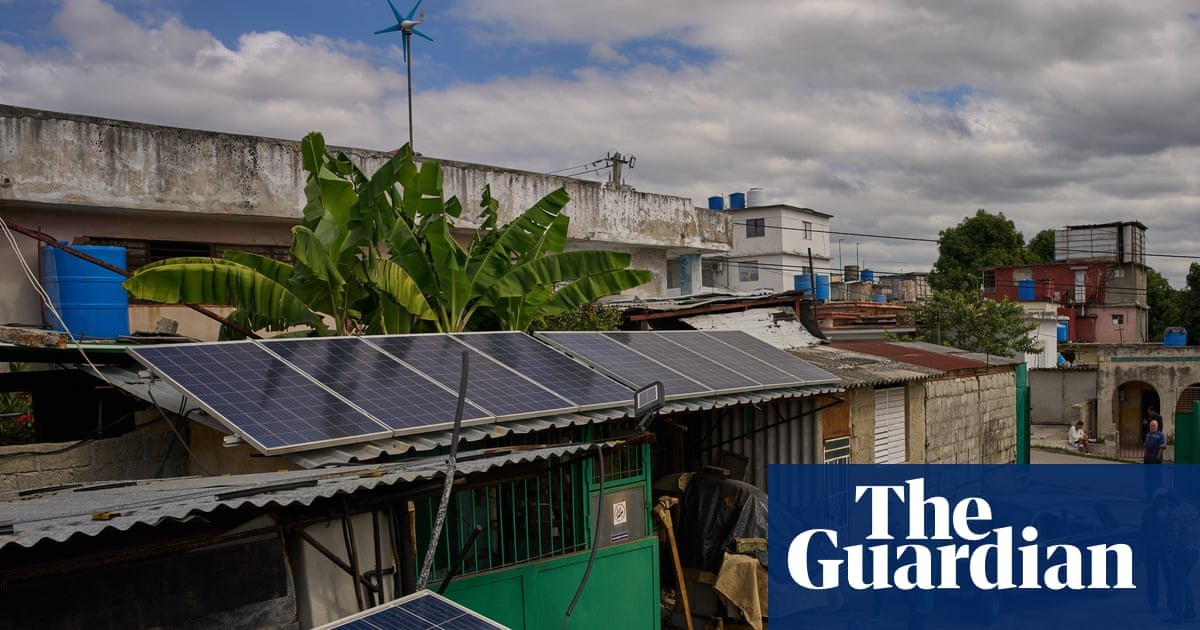
Cuba could break America’s devastating energy blockade forever with just $8 billion in renewable energy investments. And the rest of the world will have to pay the price.
These are the bold claims of a think tank’s analysis of the beleaguered socialist republic’s energy policy, which argues that Cuba can show its Caribbean neighbors a path to a green energy future.
Just $8bn (£5.9bn) could fund the build-out of enough renewable energy to meet 93.4% of Cuba’s electricity generation needs, the report claims. For less than $20 billion, Cuba could become the first Caribbean country to have an entirely renewable energy grid.
The proposal comes as Cuba endures a weeks-long energy blockade imposed by the United States on the island and its communist-run government, which Washington claims is having an “adverse impact” on the region.
Cuba has received oil from Russia only once since January, after President Donald Trump signed an executive order threatening to impose trade tariffs on countries that sold oil to Cuba.
By March, the country’s power grid had collapsed, and 10 million people endured repeated power outages. Hospital intensive care units lost power, transportation and industry halted, and President Trump boasted, “I am confident that we will have the honor of occupying…Cuba.”
An analysis by Commonwealth think tank Transition Security Project (TSP) outlines how Cuba could gain full energy independence from its unstable neighbor by converting its electricity grid to run on renewable energy. This would not only reduce Cuba’s vulnerability but also serve as a model for the region.
“America’s energy dominance strategy seeks to lock in dependence on fossil fuels, slow the green transition, and strengthen America’s power,” said TSP researcher Kevin Cashman, who wrote the analysis. But increasingly cheap and scalable solar power and battery storage are undermining such strategies.
“For a country like Cuba, which has vast renewable energy potential but suffers from power outages and widespread suffering due to America’s brutal and illegal energy blockade, a transition to green power will reduce America’s influence and set a shining example for the world.”
A TSP analysis that modeled four different scenarios found that Cuba’s fully renewable electricity grid would cost $19.2 billion, but that an $8 billion investment would be enough to end dependence on imported fossil fuels. Even with the introduction of $5 billion, Cuba’s dependence on fossil fuels would be reduced to just one-fifth of its electricity generation.
The most ambitious proposal calls for three-quarters of electricity to come from solar PV, one-fifth from wind, and the rest from hydropower and bioenergy. Cheaper scenarios involve greater reliance on bioenergy and wind power.
“Electricity is cheaper in all renewable energy investment scenarios than in business as usual. The cost per unit of energy falls from 14.3 cents per kWh in the baseline scenario to 12.1 cents for a $1 billion investment, 7.3 cents for a $5 billion investment, 6.5 cents for an $8 billion investment, and 9.9 cents for the fully renewable case,” the report states.
This transition requires whole-of-society change, and Cuba has done it before. After the collapse of the Soviet Union in the 1990s, the country rapidly transformed its agricultural system towards agroecology and self-sufficiency.
The Cuban government has already installed more than 1,000 MW of solar power last year with Chinese funding and assistance.
The question then remains: who will pay? “Financing this transition…should be understood as climate remediation financing,” the report argues. Not only will Cubans be able to repay their investment through cheaper energy savings, but this transformation “will serve as an important example of rapid energy transition under conditions of external constraints.”
