


Many people instinctively close their eyes when trying to concentrate on a faint sound. A common belief is that removing visual distractions allows the brain to focus more fully on hearing, increasing sensitivity. However, this approach does not always work, especially in environments full of background noise.
Research published in serviceAIP Publishing, on behalf of the Acoustical Society of America, set out to test whether truly closing your eyes in noise improves your hearing. Researchers from Shanghai Jiao Tong University investigated how visual input affects sound detection ability.
Experimental experiment on hearing in noise
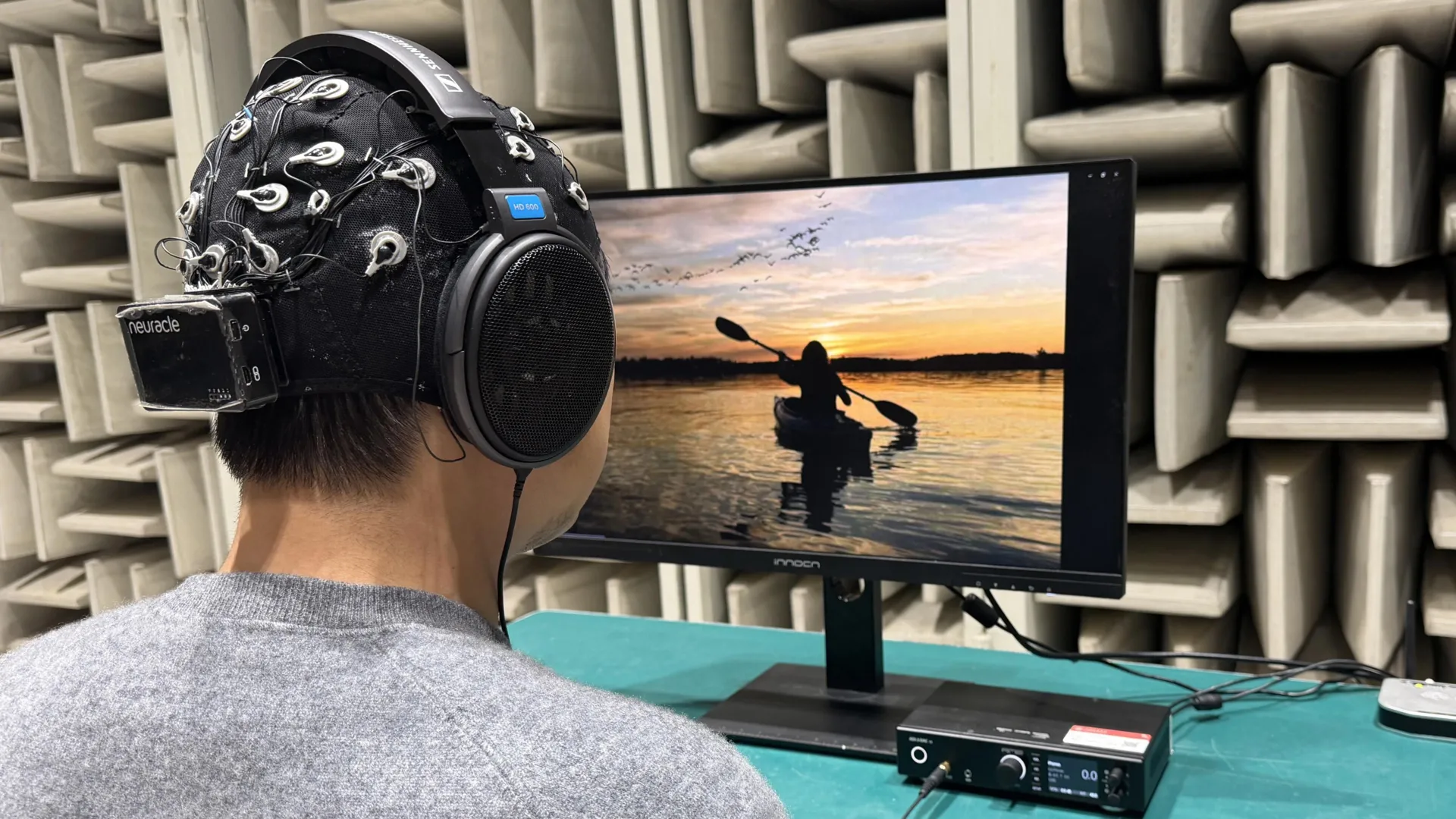
Study participants listened to a variety of sounds through headphones, with ambient noise playing at the same time. Their job was to adjust the volume until each note was barely audible above the noise.
The experiment included several visual conditions. First, participants completed the task with their eyes closed. They then repeated this with their eyes open while looking at a blank screen, then a still image associated with the sound, and finally a video that matched what they were hearing.
Closed eyes vs. visual cues
The results contradicted widely held assumptions. “Contrary to popular belief, we found that closing your eyes actually impairs your ability to detect these sounds,” said author Yu Huang. “On the other hand, viewing dynamic images in response to sound significantly improves hearing sensitivity.”
While closing the eyes was less helpful and made it harder to hear faint sounds in a noisy environment, adequate visual input provided clear benefits.
Brain activity and overfiltering
To understand why this happens, researchers used electroencephalography (EEG) to track brain activity during the test. They found that when you close your eyes, your brain enters a state known as a neurocritical state, increasing the intensity of its filtering of incoming information.
This enhanced filtering does more than just reduce background noise. You can also suppress the desired sound that participants are trying to hear.
“In noisy soundscapes, the brain has to actively separate the signal from the background,” Huang says. “We found that in this situation, the internal focus promoted by eye closure actually works negatively, leading to excessive filtering, while visual engagement helps anchor the auditory system to the outside world.”
When it works even if you close your eyes
The researchers noted that this effect was specific to noisy environments. In quiet situations, closing your eyes may improve your ability to detect subtle sounds.
However, daily life often includes loud background noise, so keeping your eyes open may be a more effective strategy in many situations.
Future research on vision and hearing
The research team plans to continue studying how vision and hearing interact. One important question is whether the benefit comes from just visual input or from seeing what matches the sound.
“Specifically, we want to test mismatched combinations. For example, what happens if you hear a drum but see a bird?” Huang said. “Does improved vision result from simply opening the eyes and processing more visual information, or does the brain require a perfect match between visual and auditory information? Understanding this distinction helps distinguish between the general effects of attention and the specific benefits of multisensory integration.”
