


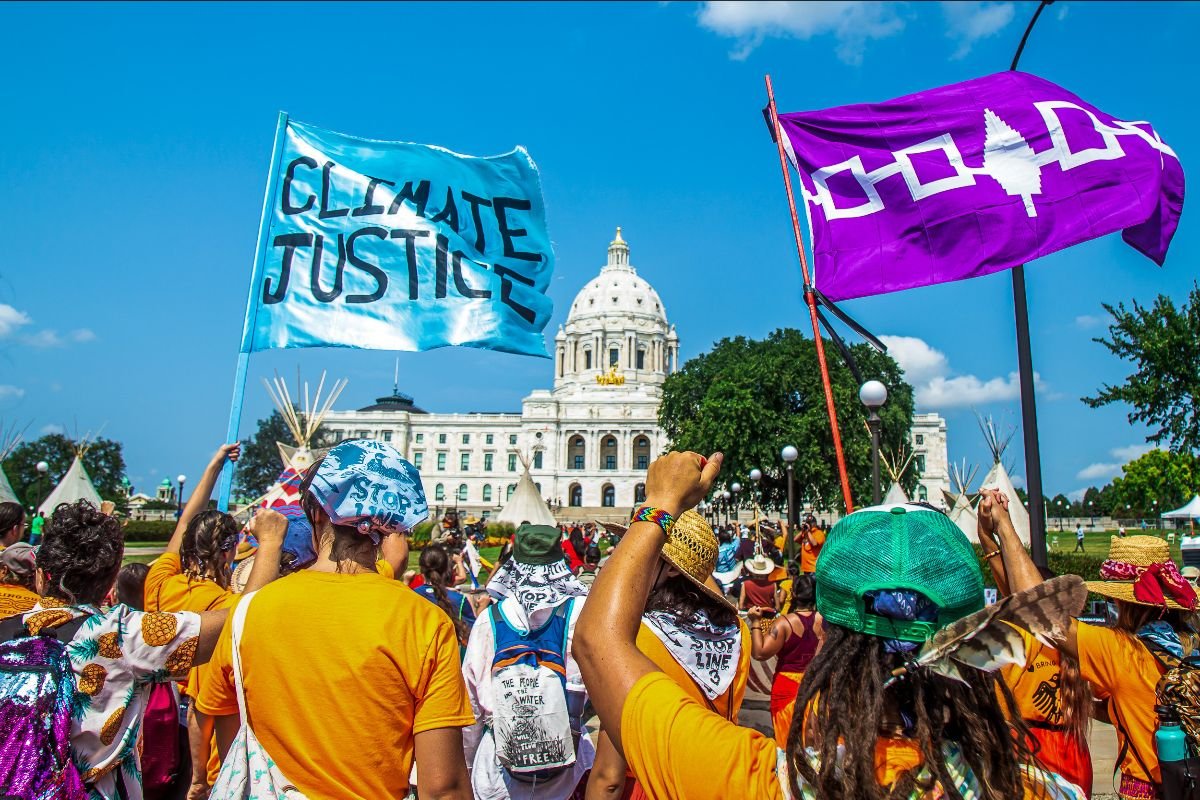
Look at last month’s “No Kings” protests. Millions of Americans are taking to the streets to protest the Trump administration’s reckless governing principles. Thousands of communities have expressed their solemn right to resist against clear and present danger.
At least for the time being. actually.
As the nation’s attention is diverted by the president’s daily diet of strategic and outrageous distractions, fossil fuel companies and their industrial allies are quietly pursuing new forms of corporate vigilance. They’re not as nasty as clubbing dissidents or trade union organizers, but they’re far more insidious. Louisiana, for example, is considering a bill that would allow protesters to be prosecuted under the state’s anti-terrorism law.
History buffs will recall that in the early 20th century, one of the major responsibilities of major industrial corporations was to ruthlessly suppress dissent. In California, large farmers supported by the state government hired club thugs to beat immigrant farm workers into submission. In Idaho, when silver and gold miners were unionizing and manning picket lines to demand higher wages, mine owners persuaded the state government to call in armed National Guard troops to break up bullet strikes. During the violent period of union organizing in Michigan in the 1930s, “security forces” hired by Ford and General Motors joined the police and used gunfire to break up strikes.
Today, major industrial companies, especially those in the fossil energy sector, do not pay armed organizations to do their dirty work. In return, they are buying influence in state legislatures and Congresses. The result is a new law that criminalizes the First Amendment’s guarantees of free speech and the right to peacefully assemble.
Five states have approved legislation that would define active protests as “riots”, subject to criminal law. Kentucky bans protests at the state capitol. Missouri has outlawed the right of public labor unions to staff picket lines, according to the International Center for Nonprofit Law (ICNL), a Washington-based research group that tracks U.S. laws that criminalize public protests.
In 2017, Louisiana passed the first law criminalizing protests and demonstrations against pipelines and other “critical infrastructure.” In 2024, it enacted four other anti-protest ordinances, including one that would subject people who participate in street protests that disrupt traffic to criminal charges under the Louisiana Racketeering Act. “These are laws that were originally developed and used to target the mafia,” said Ellie Page, senior legal counsel at ICNL.
Not to be outdone, Congress is currently considering eight proposals that would criminalize protesters who wear masks, block traffic, and disrupt pipeline construction. Criminal noncitizens may be deported. Nonprofit organizations that support protests could lose their tax-exempt status.
Attacks on environmental activists
No forum for public dissent is under more intense attack than the right to protest harm to water, land, and climate. Eighteen states, including three in the Great Lakes region, have passed laws criminalizing protests against oil and gas pipelines and other “critical infrastructure.”
Behind this wave of intimidation, almost entirely driven and enacted by conservative politicians, lies an irony of epic proportions. As you may recall, America was energized by public protest from its founding. The Boston Tea Party is a significant example of the power of civil disobedience and protest.
The same is true of contemporary American environmentalism. Public demonstrations are one of the effective tools available to advance the environmental movement. It’s been like this ever since the first Earth Day in April 1970, when 20 million Americans took part in public life.
So far, the various anti-protest laws have not led to many arrests, according to authorities tracking developments. There is also no evidence that they affected turnout in mass protests. “But that’s the point,” said David Armiak, research director and investigative journalist at the Center for Media and Democracy, a Wisconsin-based government and business watchdog group. “It creates a chilling effect. There are people who stay at home and do not participate in the democratic process for fear of being prosecuted, imprisoned or losing their jobs.”
dakota access genesis
In case you’re wondering, the source of all this repressive legislation is a loud and ultimately unsuccessful campaign a decade ago to halt construction of the 1,172-mile Dakota Access Pipeline from the Bakken oil fields in North Dakota to oil transport terminals in Illinois. Much of the route falls under the jurisdiction of state regulators, who issued construction permits. However, some of the 57 miles overseen by the U.S. Army Corps of Engineers were close to the border of the Standing Rock Sioux Reservation, crossing beneath a Missouri River reservoir.
The tribe, with support from state and national organizations, organized a campaign in April 2016 to stop the pipeline from crossing and prevent 1) leakage of oil into groundwater and surface waters and 2) greenhouse gas emissions from the 1.1 million barrels of oil it was scheduled to transport each day.
Through traditional means, the campaign achieved almost all of its goals. The crash in the cold North Dakota plains attracted national and international national and media attention. Energy Transfer Partners’ stock price fell 6%. When 2,000 veterans arrived in the fall of 2016 to show solidarity, the stock price fell another 5%.
The divestment campaign persuaded people to close 150,000 checking and savings accounts at 17 banks involved in the project, including Wells Fargo and Citigroup. Three banks, BNP Paribas, ING and DNB, also sold stakes in the project’s original $2.5 billion loan. A 2018 analysis by First Peoples Worldwide found that Energy Transfer Partners lost $8.2 billion due to construction delays due to civil unrest and legal proceedings.
The tribe’s resistance movement also garnered enough support that the U.S. Army Corps of Engineers denied Energy Transfer Partners a permit to cross the river in December 2016, pending completion of a full environmental impact statement.
Anti-protest law is born
However, this hard-fought victory did not last long. In January 2017, three days after taking office for the first time, President Trump rescinded the impact statement and issued a presidential memorandum urging the Army Corps to approve the crossing. Construction was completed in April and the pipeline began operations in June 2017.
In line with the president’s memo, Scott Biggs, a Republican state representative from Oklahoma, introduced legislation in January 2017 to address the North Dakota fight. The proposal calls for punishing pipeline protesters with prison terms and large fines for “deliberately damaging, destroying, vandalizing, defacing, or tampering with critical infrastructure equipment.”
Oklahoma’s proposal became the first so-called “critical infrastructure” bill in May 2017. The proposal was recast as a model bill distributed to states by the American Legislative Exchange Council (ALEC), a conservative activist group largely funded by fossil fuel companies. ALEC, notorious for enacting “stand your ground” laws that allow the use of deadly force if people feel threatened, expanded its infrastructure proposal to include tougher penalties for “obstructing or impeding” facility operations.
There is a second, equally pernicious aspect to the Dakota Access Pipeline protests. In the summer of 2017, Energy Transfer Partners filed a lawsuit in federal district court accusing three of its participants, Greenpeace USA, Earth First, and the international finance research group BankTrac, of extortion. The company said the co-conspirators “fabricated and disseminated materially false and misleading information” and “instigated, financed and facilitated criminal and terrorist acts in furtherance of these objectives.” Two years later, the case was dismissed when a federal judge ruled there was “insufficient” evidence needed to prove the group conspired to harm the company.
Energy Transport Partners quickly filed a second lawsuit in North Dakota’s Morton County District Court in 2019, accusing Greenpeace of aiding and abetting trespassing, arson, vandalism, and harassment and assault of construction workers.
On March 19, 2025, a Morton County jury handed down a stunning verdict that found Greenpeace liable for more than $660 million in damages. In February, a North Dakota judge reduced the damages to $345 million. Greenpeace is asking for a new trial to be held outside Morton County, where the Dakota Access Pipeline protests occurred, saying public opinion has tilted heavily toward the oil industry and President Trump’s “Make America Great Again” coalition.
If required to pay a financial judgment of this magnitude, Greenpeace USA and its Amsterdam-based parent company, Greenpeace International, could be shut down after 55 years of environmental work.
Take a close look at what’s going on. With the Greenpeace decision and anti-protest laws in place in nearly half of the states, the fossil fuel sector is turning its most important arenas of action—the streets and courts—against environmentalism. It is as alarming and threatening as anything else happening in these dark times of turmoil and danger.
