


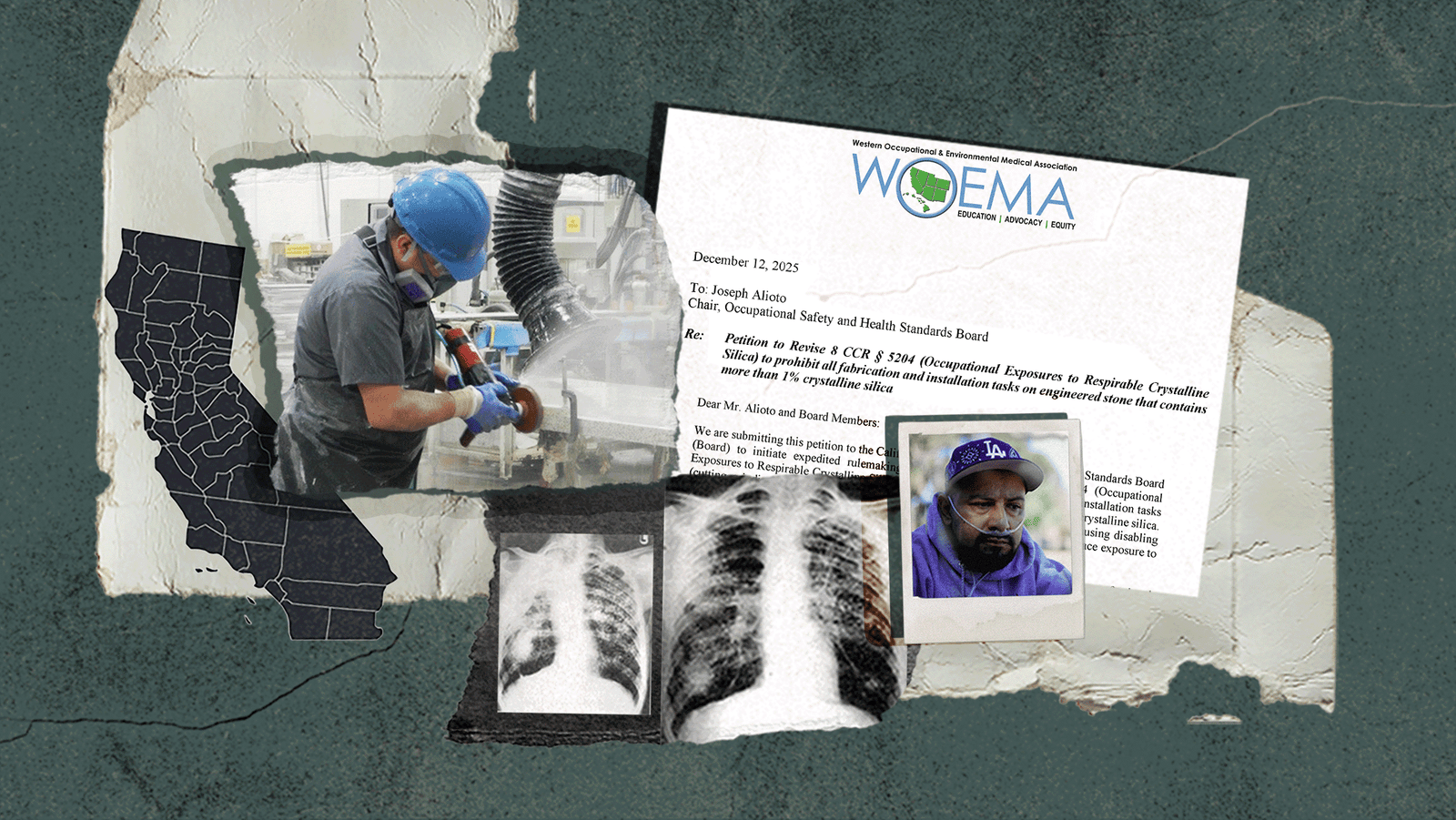
California is considering banning the manufacture and installation of engineered stone countertops, effectively banning the product, in response to an epidemic of silicosis, a deadly lung disease, among workers who cut, grind and polish countertop slabs before installing them in homes and businesses.
Silicosis is caused by inhalation of ground silica, one of the most common minerals on earth. Public Health Watch, LAist, and Univision first revealed a silicosis cluster among countertop manufacturing workers in Southern California in December 2022. A year later, the California Occupational Safety and Health Standards Board adopted an emergency interim standard requiring employers of such workers, most of them young immigrant men, to take protective measures such as water suppression of toxic silica dust. This standard became permanent in December 2024.
Five months after the initial report was published by Public Health Watch and its media partners, the California Department of Public Health has confirmed 69 cases of silicosis across the state. As of April 8, that number had increased to 542, of which 29 had died. More than half of these cases (279) were in Los Angeles County.
 credit: California Department of Public Health
Silica, which threatens manufacturers’ lungs, is derived from quartz, which is crushed and mixed with resins and pigments to create artificial stone, also known as engineered stone. It is a cheaper and more versatile alternative to natural stones such as granite and marble. It is a process that allows mass production of countertop slabs by pouring materials into molds.
When slabs are cut, ground, or polished in preparation for installation, harmful powders are released into the air and are inhaled into workers’ lungs, where they collect and cause slow suffocation. There is no cure for silicosis. The only procedure that can buy some victims time is a double lung transplant, which is expensive, cumbersome and rarely prolongs life beyond 10 years.
The Occupational Safety and Health Standards Board is scheduled to hear video testimony from manufacturing workers who have silicosis at a meeting Thursday in Santa Rosa. However, it is not expected to vote on the ban sooner than the May 21 meeting in Los Angeles.
California would become the first state to ban artificial stones if it chooses to do so. Australia banned the material in 2024 after experiencing a silicosis outbreak that killed an estimated 1,000 people.
The standards board must respond to a petition filed in December by the Western Association for Occupational and Environmental Medicine, a nonprofit group representing more than 600 physicians and other health professionals in seven states. In its petition, the association asked the board to “prohibit all manufacturing and installation operations of engineered stone that contain more than 1 percent crystalline silica. This action is necessary in light of the prevalence of silicosis, which is causing illness and death among manufacturing workers in California…” Engineered stone countertops typically contain more than 90 percent crystalline silica, the most common and dangerous form of the mineral. Another form, amorphous silica, is not thought to pose serious health risks.
Lawyers representing hundreds of sick workers and their families in lawsuits against countertop manufacturers say engineered stone cannot be safely handled.
“Synthetic stone is too toxic to manufacture safely,” said Rafael Metzger, a Long Beach practice who won the nation’s first $52.4 million jury verdict against 34 manufacturers in August 2024 with Gilbert Purcell of Sausalito and two other attorneys. “I meet with about half a dozen manufacturers every week, many of whom have silicosis.”
“The silicosis crisis is not a failure of rules, it’s a failure of products,” said James Nevin, based in Novato, California. The medical association’s “proposed ban is effective because it eliminates the risk at its source. Every jurisdiction that has reduced the disease has done so by eliminating crystalline silica artificial stone itself, not by pretending it is safe to use.”
Countertop manufacturers are not sitting idly by either. “While effective (workplace safety) standards already exist, there are non-compliant manufacturing plant owners who do not comply with the standards and put workers at risk,” Cosentino North America, part of Spain’s Cosentino Group, said in a March 27 letter to the standards commission. The company said, “If proper controls are in place, engineered stone can be produced safely.”
California’s silica regulations are enforced by the state’s Occupational Safety and Health Administration, known as Cal/OSHA. In a statement to Public Health Watch, a Cal/OSHA spokesperson said the agency has initiated more than 140 inspections of manufacturing plants since the emergency interim standard went into effect in December 2023. More than 580 violations were discovered during these inspections, the spokesperson said.
Eric Berg, Cal/OSHA’s deputy director for health, research and standards, said in a presentation at the standards board’s March meeting that the agency has imposed fines totaling $1.8 million against manufacturing plant operators who allegedly violated the silica rule. Berg said 26 businesses were ordered to cease operations because they were found to be dry-cutting artificial stone, a prohibited practice, or to use inadequate respiratory protection.
Last year, Cal/OSHA estimated there were 920 manufacturing plants in the state, employing about 4,600 workers.
It is unclear which direction the standards committee will take when the ban comes up for a vote. In a Feb. 27 letter, Commissioner Joseph M. Alioto Jr. urged district attorneys in the seven counties that account for nearly 95% of California’s silicosis cases to pursue criminal charges against violators.
“Don’t be fooled by the misdemeanor classification (of the silica violation),” Alioto wrote. “Science has shown us that these are not ordinary misdemeanor cases. Dry cutting alone will result in serious injury in the vast majority of cases. That means every successful misdemeanor you prosecute shuts down the violating employer and saves the lives of workers.”
But the medical association, whose board must rule on the petition, argued that “education and enforcement alone are not sufficient to curb the spread of the occupational health emergency caused by engineered stones.”
After Australia banned the material, alternatives with the same “quality, look and feel” and without crystalline silica were used in its place, the petition says. If the standards board follows Australia’s lead, it is “very likely that these safer products will immediately become available in the California market without significant economic impact to manufacturing industries and their employees.”
