


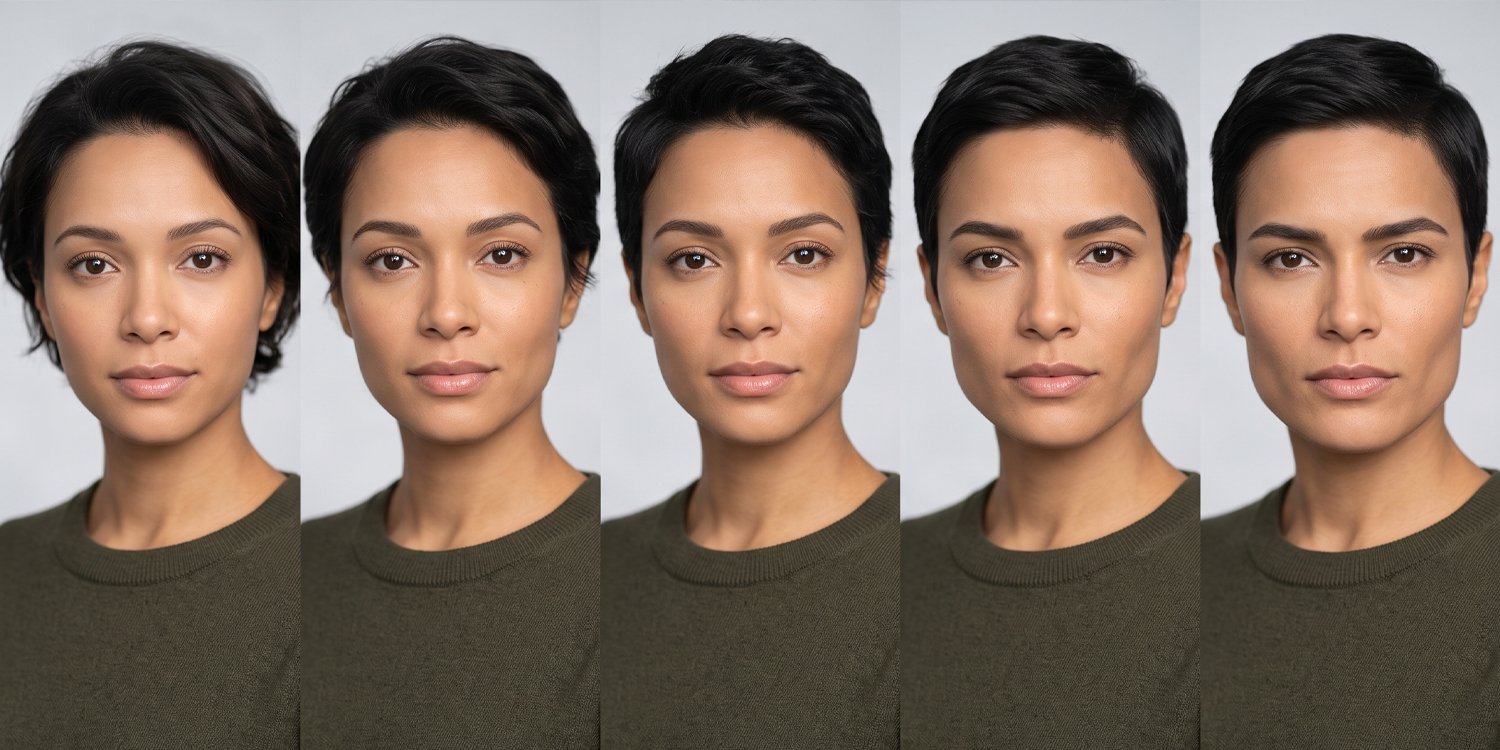
Larger men are less likely to easily recognize exaggerated masculine or feminine facial features when judging the gender of others. This dynamic suggests that an individual’s physical size can change how they perceive social cues in the faces around them. The results of this study were recently published in the journal Frontiers in Psychology.
What is sexual dimorphism? It refers to the physical differences between male and female bodies. In humans, these differences are most evident in facial structure. For example, a prominent jawline or thick eyebrow ridge are typically masculine facial features. At the other end of the spectrum, a soft jaw curve, large eyes, and a small chin are generally feminine facial features.
These physical differences are mainly caused by hormones during human growth. Elevated testosterone promotes bone growth on the lower side of the face. High estrogen levels make the skin softer and the fat distribution pattern different. As a result, the structural shape of the face transmits fundamental biological information about the individual to the world.
Evolutionary psychologists propose that early humans survived by quickly reading these biological signals. Detecting masculine traits helped our ancestors identify dominant, strong individuals who could pose a physical threat. Recognizing female characteristics has helped identify health conditions and genetic fitness that influence basic mate choice.
Because these evaluations are made in a fraction of a second, psychologists call them basic social judgments. We are constantly categorizing people around us. We scan crowds to identify friends, assess the approachability of strangers, and subconsciously judge the health of those we encounter.
However, not everyone perceives these social cues with exactly the same level of intensity. A person’s own health status affects how alert they are to potential threats in their environment. Psychologists often focus on a concept called formidability, which refers to an individual’s perceived fighting ability and physical strength.
Body size is the main indicator of formidable abilities. Large, strong men pose less physical risk in a fight than smaller men. Even if a strong man misjudges the strength of his competitor, he has the stamina to deal with the ensuing conflict, whereas a smaller man does not have that luxury.
Previous psychological research has shown that people who are shorter or less physically imposing are highly attentive to other men’s signals of dominance. They act defensively to protect themselves. They scan the environment with high precision for potential competitors and rivals.
Haoliang Zhu of Wenzhou University and Shitao Chen of Zhejiang University wanted to see whether this sensory phenomenon extended to basic gender classification. They designed the experiment in collaboration with a team of Chinese researchers. They set out to determine whether a man’s general body size modifies his sensitivity to subtle differences in masculine and feminine facial features.
The researchers recruited 112 young heterosexual men from a local university to participate in the study. Before testing began, researchers collected basic physical measurements from each participant, recording both height and weight. They used each of these numbers to calculate each participant’s body mass index (BMI).
To perform the experiment, the research team required a highly controlled series of visual stimuli. They started by photographing 50 men and 50 women under uniform lighting conditions. None of the subjects exhibited extreme emotional expression, and hair and clothing were digitally removed from the images to prevent unwanted visual clutter.
Using specialized computer software, the team blended these images together. They created a mathematical average of 50 female faces to generate a single female prototype face. They did exactly the same process for the man, creating a single male prototype face.
We also created androgynous-based faces by blending randomly selected male and female individual faces. These basic faces looked neither male nor female in nature. By using male and female prototypes, researchers were able to use software to modify these blank slates with high mathematical precision.
The team fine-tuned the structural shape of the neutral face along a sliding scale. Faces were gradually made more masculine or feminine in 15 percent increments, up to a maximum of 75 percent. The 15% altered images appeared very ambiguous, while the 75% altered images showed clear gender characteristics.
During the test, the young men sat quietly at a computer screen. The image flashed on the screen for 0.5 seconds. By limiting viewing time, the researchers prevented participants from overthinking their answers, forcing them to rely on first intuition and automatic cognitive processing. Participants then pressed a key to indicate whether they thought the face belonged to a man or a woman.
The researchers found consistent patterns across all three physical indicators. Participants’ body size negatively predicted their ability to accurately parse ambiguous faces. Taller men had a harder time correctly classifying faces than shorter men.
Exactly the same trend appeared for weight and BMI indicators. Heavier participants and those with more total body weight relative to height had lower sensitivity to facial manipulation. Larger men often incorrectly guessed their gender when the computer subtly widened their jawline or softened their chin ever so slightly.
Conversely, shorter, lighter men were able to detect subtle structural changes with greater accuracy. Their brains seemed to be more sensitive to the smallest visual hints of masculinity or femininity. This is consistent with the theory that physically vulnerable people need a finely tuned social radar to navigate their environments safely.
The researchers discovered a quadratic pattern when they built a statistical model to account for physical variation in body size. Participants generally indicated that they were more accurate when viewing masculinized faces than when viewing feminized faces. They noticed male traits more quickly than female traits.
The authors suggest that this dynamic is rooted in evolutionary selection pressures. In ancestral environments, men faced intense competition from other men for resources and social status. Failure to recognize a highly masculine and dominant rival can cause severe physical injury.
In contrast, failure to recognize subtle female characteristics primarily means missing out on potential mating opportunities. Reproduction is central to evolutionary success, but missed mating opportunities do not necessarily result in immediate physical danger. As a result, men’s brains may be wired to prioritize detecting male faces.
The study authors note several limitations to their study. The secondary findings regarding male and female faces were not statistically significant unless researchers actively controlled for participants’ physical dimensions in their calculations. This means that certain conclusions about facial sex require additional scientific validation.
Furthermore, this experiment only collected data from male participants. The psychological mechanisms that determine how women perceive facial gender cues may operate quite differently. Women face different evolutionary pressures, and their physical strength may not be reflected in social perceptions in the same way.
Future studies should recruit female participants to see if similar dynamics exist between different demographics. Scientists also want to investigate the precise neural pathways that shift small humans’ attention to social cues. So far, current research suggests that our physical bodies subtly shape our perceptions of the people we encounter every day.
The study, “Big bodies, blurred lines: The influence of male body size on sexually dimorphic facial features,” was authored by Haoliang Zhu, Shitao Chen, Xue Lei, Zhe Ni, and Chengyang Han.
