


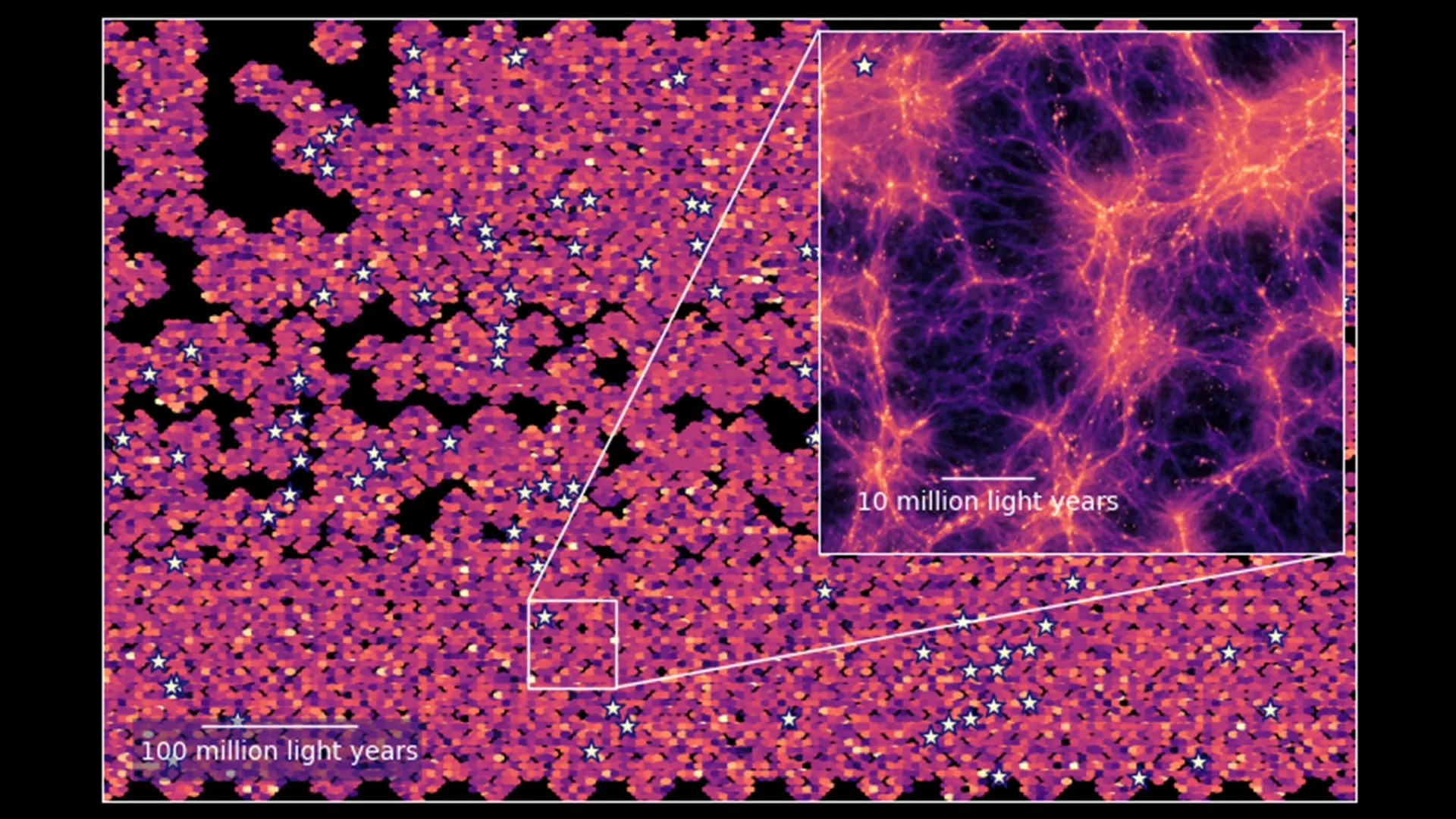
Astronomers collaborating with the Hobby-Eberly Telescope Dark Energy Experiment (HETDEX) have created the most detailed three-dimensional map to date of light produced by energized hydrogen in the early universe, dating back approximately 9 billion to 11 billion years. This type of radiation, known as Lyman-alpha light, is emitted in large quantities when hydrogen atoms absorb energy from nearby stars. This property makes it a powerful way to find bright galaxies during this distant period of intense star formation. But the locations of fainter galaxies and gas clouds that emit Lyman-alpha light remain largely hidden.
“By observing the early Universe, we can learn how galaxies evolved into their current form and what role intergalactic gas played in this process,” said Maya Lujan Niemeyer, a HETDEX scientist and recent graduate of the Max Planck Institute for Astrophysics who led the map’s development. “However, because of their distance, many objects from this era are dark and difficult to observe.”
To reveal these faint light sources, the research team used a method known as line intensity mapping. This approach allows us to detect the combined glow of many distant objects, helping scientists build a more complete picture of the young Universe. The findings were published on March 3rd. astrophysical journal.
How line intensity mapping reveals hidden galaxies
Light is broken down into its component wavelengths, producing what scientists call a spectrum. Astronomers study spectra (plural of “spectra”) looking for peaks and dips that indicate the presence of particular elements. Rather than identifying individual galaxies one at a time, line intensity mapping measures how strongly certain elements appear across regions of space.
“Imagine sitting in an airplane and looking down. The ‘traditional’ way of surveying galaxies is like mapping only the brightest cities. You can tell where the big population centers are, but you miss people who live in the suburbs and small towns,” explains HETDEX scientist Julian Muñoz, assistant professor at the University of Texas at Austin and co-author of the paper. “Intensity mapping is like looking at the same scene through a dirty airplane window. The image is blurred, but it captures all the light, not just the brightest spots.”
Although line intensity mapping has been used before, this is the first time Lyman alpha emission has been mapped with such a large dataset and high accuracy. McDonald Observatory’s Hobby-Eberly Telescope will collect vast amounts of information for HETDEX, which tracks the locations of more than 1 million bright galaxies to better understand dark energy. This study is notable not only for its scope but also for the amount of data it contains. The researchers collected more than 600 million spectra from an area of the sky equivalent to more than 2,000 full moons.
A vast ocean of untapped data
“But we only use a small portion of all the data we collect, about 5%,” explains Karl Gebhardt, principal investigator of HETDEX, chair of UT Austin’s astronomy department, and co-author of the paper. “There is great potential in using that remaining data for further research.”
“HETDEX observes all parts of the sky, but only a small amount of data related to galaxies is bright enough to be used in the project,” Lujan Niemeyer added. “But those galaxies are just the tip of the iceberg. In the seemingly empty space in between, there’s a whole ocean of light.”
Supercomputer reveals hidden structure of the universe
To build the new map, the researchers developed custom software and utilized supercomputers at the Texas Advanced Computing Center. These systems analyzed approximately 0.5 petabytes of HETDEX data. The team then used the known locations of bright galaxies already cataloged by HETDEX to estimate where nearby faint galaxies and glowing gas clouds were located. Bright galaxies often mark areas where other objects are likely to be found, as gravity forces matter to crowd together.
“We can therefore use the known positions of galaxies as guideposts to determine the distances to fainter objects,” said Eiichiro Komatsu, HETDEX scientist, scientific director of the Max Planck Institute for Astrophysics, and co-author of the paper. The completed map provides a sharper view around bright galaxies, while also revealing details in previously unexplored areas between them.
“There are computer simulations of this era,” Komatsu continued. “But they are just simulations, not the real universe. Now we have a foundation that allows us to know whether some of the astrophysics that underpins those simulations is correct.”
A new era of space mapping
The researchers plan to compare this map with other studies that have looked at the same region of space but focused on different elements. For example, line intensity maps of carbon monoxide (associated with the dense, cold clouds in which stars form) could help scientists better understand the environments surrounding young stars that produce Lyman-alpha radiation.
“This work is a first detection, which is exciting in itself, and opens the door to a new era of intensity mapping of the universe,” Muñoz said. “Hobby Everly is a pioneering telescope, and with new complementary instruments coming online, we are entering a golden age of mapping the universe.”
