

Close Menu

    Subscribe to Updates

    Get the latest creative news from FooBar about art, design and business.

    What's Hot

    A surprising new experiment in which quantum ghost imaging works using only sunlight

    May 18, 2026

    AI reveals the invisible magnetic chaos wasting energy inside electric motors

    May 18, 2026

    An ancient lost ocean may have built Central Asia’s dinosaur-era mountains

    May 18, 2026
    Facebook X (Twitter) Instagram
    Facebook X (Twitter) Instagram
    Health Magazine
    • Home
    • Environmental Health
    • Health Technology
    • Medical Research
    • Mental Health
    • Nutrition Science
    • Pharma
    • Public Health
    • Discover
      • Daily Health Tips
      • Financial Health & Stability
      • Holistic Health & Wellness
      • Mental Health
      • Nutrition & Dietary Trends
      • Professional & Personal Growth
    • Our Mission
    Health Magazine
    Home » News » AI reveals the invisible magnetic chaos wasting energy inside electric motors
    Nutrition Science

    AI reveals the invisible magnetic chaos wasting energy inside electric motors

    healthadminBy healthadminMay 18, 2026No Comments4 Mins Read
    AI reveals the invisible magnetic chaos wasting energy inside electric motors
    Share
    Facebook Twitter Reddit Telegram Pinterest Email


    The explosive growth of electric vehicles has intensified the search for ways to increase the energy efficiency of electric motors. One of the big challenges is iron loss, also known as magnetic hysteresis loss. Iron losses occur when the magnetic field inside the motor repeatedly reverses direction. This process wastes energy as heat inside the motor core, which is made of soft magnetic material. Since electric motors often operate at high temperatures, thermal effects can also partially demagnetize these materials, further complicating the energy loss issue.

    A key factor behind these effects is the behavior of magnetic domains, which are small magnetic regions within the material. The arrangement and structure of these domains strongly influences how magnetic materials respond to heat and how much energy is lost during operation.

    complex magnetic maze domain

    Some soft magnetic materials contain highly complex magnetic structures called maze domains, named for their zigzag, maze-like appearance. These labyrinth regions can change abruptly as the temperature increases or decreases, which can affect the loss of energy within the material. However, scientists have struggled to fully understand these structures because many interacting factors are involved, including material microstructure, thermal effects, and energy stability.

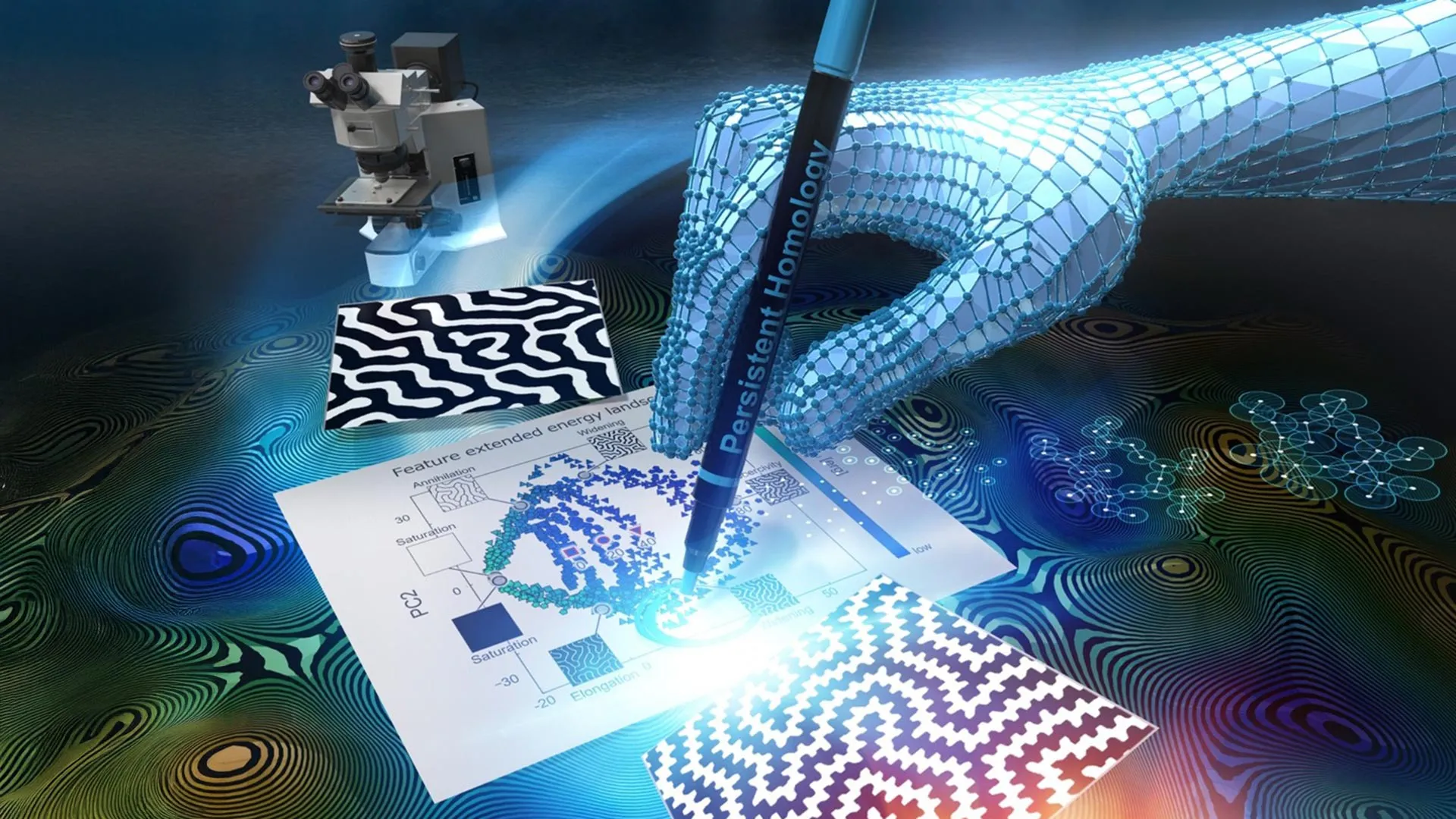
    To better understand this behavior, researchers led by Professor Masato Koji and Dr. Takeshi Masuzawa from the Department of Materials Science and Engineering at Tokyo University of Science (TUS), in collaboration with collaborators from the University of Tsukuba, Okayama University, and Kyoto University, developed a new model called the Entropy Extended Ginzburg-Landau (eX-GL) model. The research team used this approach to study the energy landscape of labyrinthine domains in rare earth iron garnet (RIG).

    “Traditional simulations oversimplify the actual materials, while experiments reveal complexity because there is no clear way to quantify cause and effect,” Professor Koji explains. “Our physics-based explainable artificial intelligence framework is designed to address these limitations and mechanistically explain the temperature-dependent magnetization reversal process.”

    Their findings were published in the magazine scientific report.

    AI and physics reveal hidden magnetic behavior

    To investigate how temperature affects the demagnetization of the labyrinth region, the researchers took microscopic images of magnetic domains in RIG samples at different temperatures. These images were analyzed using the eX-GL model.

    The first stage of the model uses persistent homology (PH), an advanced mathematical method that identifies topological features in the data. This enabled the research team to detect non-uniform structural characteristics in magnetic domain images. They then used machine learning-based pattern recognition to identify the most important features from the PH data, producing a digital free energy landscape that tracks how the magnetic microstructure evolves in response to changes in energy. Finally, mathematical analysis correlated these microscopic domain structures with larger magnetization reversal processes.

    Using this method, the researchers were able to identify a dominant feature known as PC1 and capture the magnetization reversal process. By linking PC1 with physical properties, the research team visualized four major energy barriers that strongly influence magnetization reversal dynamics.

    Hidden energy barriers within magnetic materials

    Detailed analysis of these barriers and associated microstructures reveals how different forms of energy influence magnetization reversal. The researchers measured energy transfer, including exchange interactions, demagnetization effects, and entropy.

    They also found that maze domains become more complex as the length of the domain walls increases. This increase in complexity is caused by the interaction between entropy and exchange forces. These results helped to elucidate the physical mechanism behind the maze area reversal behavior.

    “Our eX-GL approach effectively automates the interpretation of complex magnetization reversal processes and enables the identification of hidden mechanisms that are difficult to identify using traditional methods,” says Professor Koji. “Furthermore, since free energy is a universal thermodynamic metric, our model can be extended to other systems with similar properties.”

    Overall, this study not only sheds light on the workings of labyrinthine regions, but also introduces broader strategies for investigating complex energy landscapes in magnetic systems and other related physical materials.

    This research was supported by the Japan Society for the Promotion of Science (KAKENHI) Grant-in-Aid for Scientific Research (A) (21H04656). Additional support was provided by JST-CREST (grant number JPMJCR21O1). C. Mitsumata was supported by the Research Center for Energy and Materials Science (TREMS), University of Tsukuba.


    Source link

    Visited 1 times, 1 visit(s) today
    Share. Facebook Twitter Pinterest LinkedIn Telegram Reddit Email
    Previous ArticleAn ancient lost ocean may have built Central Asia’s dinosaur-era mountains
    Next Article A surprising new experiment in which quantum ghost imaging works using only sunlight
    healthadmin

    Related Posts

    A surprising new experiment in which quantum ghost imaging works using only sunlight

    May 18, 2026

    An ancient lost ocean may have built Central Asia’s dinosaur-era mountains

    May 18, 2026

    Scientists reveal surprising truths about coffee and blood pressure

    May 18, 2026

    Scientists reveal what changes 7-day fasting brings to the human body

    May 17, 2026

    Scientists discover surprising health benefits of watermelon

    May 17, 2026

    Scientists reverse Alzheimer’s disease in mice with breakthrough nanotechnology

    May 17, 2026
    Add A Comment
    Leave A Reply Cancel Reply

    Categories

    • Daily Health Tips
    • Discover
    • Environmental Health
    • Exercise & Fitness
    • Featured
    • Featured Videos
    • Financial Health & Stability
    • Fitness
    • Fitness Updates
    • Health
    • Health Technology
    • Healthy Aging
    • Healthy Living
    • Holistic Healing
    • Holistic Health & Wellness
    • Medical Research
    • Medical Research & Insights
    • Mental Health
    • Mental Wellness
    • Natural Remedies
    • New Workouts
    • Nutrition
    • Nutrition & Dietary Trends
    • Nutrition & Superfoods
    • Nutrition Science
    • Pharma
    • Preventive Healthcare
    • Professional & Personal Growth
    • Public Health
    • Public Health & Awareness
    • Selected
    • Sleep & Recovery
    • Top Programs
    • Weight Management
    • Workouts
    Popular Posts
    • 1773313737_bacteria_-_Sebastian_Kaulitzki_46826fb7971649bfaca04a9b4cef3309-620x480.jpgHow Sino Biological ProPure™ redefines ultra-low… March 12, 2026
    • the-pros-and-cons-of-paleo-dietsThe Pros and Cons of Paleo Diets: What Science Really Says April 16, 2025
    • pexels-david-bartus-442116The food industry needs to act now to cut greenhouse… January 2, 2022
    • 1773729862_TagImage-3347-458389964760995353448-620x480.jpgDespite safety concerns, parents underestimate the… March 17, 2026
    • 1773209206_futuristic_techno_design_on_background_of_supercomputer_data_center_-_Image_-_Timofeev_Vladimir_M1_4.jpegMulti-agent AI systems outperform single models… March 11, 2026
    • Improve Mental Health10 Science-Backed Practices to Improve Mental Health… March 11, 2025

    Demo
    Stay In Touch
    • Facebook
    • Twitter
    • Pinterest
    • Instagram
    • YouTube
    • Vimeo
    Don't Miss

    A surprising new experiment in which quantum ghost imaging works using only sunlight

    By healthadminMay 18, 2026

    Correlated and entangled photon pairs are essential tools in quantum optics. Scientists typically create these…

    AI reveals the invisible magnetic chaos wasting energy inside electric motors

    May 18, 2026

    An ancient lost ocean may have built Central Asia’s dinosaur-era mountains

    May 18, 2026

    Aging immune cells may cause memory decline by releasing proteins that age the brain

    May 18, 2026

    Subscribe to Updates

    Get the latest creative news from SmartMag about art & design.

    HealthxMagazine
    HealthxMagazine

    At HealthX Magazine, we are dedicated to empowering entrepreneurs, doctors, chiropractors, healthcare professionals, personal trainers, executives, thought leaders, and anyone striving for optimal health.

    Our Picks

    Aging immune cells may cause memory decline by releasing proteins that age the brain

    May 18, 2026

    Scientists reveal surprising truths about coffee and blood pressure

    May 18, 2026

    AI eye scan reveals who may be at higher risk of osteoporosis

    May 18, 2026
    New Comments
      Facebook X (Twitter) Instagram Pinterest
      • Home
      • Privacy Policy
      • Our Mission
      © 2026 ThemeSphere. Designed by ThemeSphere.

      Type above and press Enter to search. Press Esc to cancel.