


By stabilizing the enzyme’s starting point prior to evolution, researchers have opened new mutational routes to engineer highly specific proteases, including candidates targeting protein targets associated with disease.
Research: AI-engineered starting points and outcomes accelerate protein evolution. Image credit: Corona Borealis Studio / Shutterstock
In a recent study published in the journal natureresearchers established a practical workflow in a botulinum neurotoxin (BoNT) protease model. In this workflow, artificial intelligence (AI)-based protein sequence redesign improved the starting point and outcome of automated directed evolution while helping to alleviate stability-activity trade-offs that can constrain enzyme engineering.
In this study, we utilized a deep learning protein sequence design model called ‘ProteinMPNN’ and a computational protein stabilization method called ‘PROSS’ to generate stabilized starting mutants of botulinum neurotoxin (BoNT) protease before subjecting them to phage-assisted continuous evolution (PACE).
Remarkably, this study found that the redesigned starting point gave better results than the wild-type (WT) enzyme in the corresponding BoNT/E evolution campaign, adapted faster and was able to access a highly active mutation space that was found to be non-functional in the WT BoNT/E background.
Importantly, when evolved to cleave human ataxin-2, a protein implicated in neurodegeneration, the AI-redesigned protease mutant achieved >79-fold higher specificity for selected ataxin-2 substrates and exhibited 16% sequence divergence from the native protein framework compared to the top enzyme evolved by WT, highlighting the benefits of AI-assisted protein engineering and potential therapeutic enzyme development.
background
Since the advent of selective breeding thousands of years ago, humans have sought to shape the biosphere to suit their needs. Directed evolution of natural enzymes is an extension of this idea in the laboratory and is already helping to provide viable solutions for biomedical, therapeutic, and environmental applications.
However, as the search for new and more efficient enzymes continues, a growing body of research highlights that traditional evolutionary campaigns may face significant limitations. These campaigns are often based on screening wild-type proteins that may have marginal biophysical stability. Many mutations conferring new catalytic functions or unnatural substrate specificities can be thermodynamically unstable, so evolving proteins often lose structural integrity before reaching optimal activity. Therefore, there is a growing interest in using AI tools to support the engineering of therapeutic proteins.
Although computational tools like ProteinMPNN can generate protein sequences that are predicted to maintain the desired structure while changing much of the amino acid sequence, it remains to be established whether enzymes redesigned by AI will have greater evolvability across diverse selection pressures and complex fitness environments.
About research
This study aimed to address this knowledge gap by integrating AI sequence redesign with a high-throughput continuous evolution platform. First, this study utilized ProteinMPNN and PROSS tools to redesign BoNT/E, BoNT/F, and BoNT/X catalytic domains.
These redesigned catalytic domains were designed to incorporate structural distance constraints (10–18 Å from the substrate and catalytic zinc ions) and multiple sequence alignment (MSA) conservation thresholds (30–60%).
The evolutionary potential of these redesigned enzymes was evaluated using 44 parallel sequential evolution campaigns on the automated eVOLVER platform. Here, we challenged wild-type and redesigned BoNT/E proteases against a panel of increasingly difficult modified SNAP25 substrates, specifically substrates 415, 413, and 412.
Finally, we applied the workflow to reprogram the specificity of BoNT/E for human ataxin-2 (residues 1181-1201), a protein implicated in neurodegeneration, including ALS.
Research results
In this study, initial characterization of 74 ProteinMPNN BoNT/E designs revealed that 78% retained catalytic activity. In particular, the best-performing redesigned mutants (D1–D3) were observed to exhibit 1.7–2.8 times higher catalytic efficiency than the wild-type enzyme. Specifically, D2 achieved the highest catalytic efficiency (kcat/KM), up to 310 mM-¹s-¹ compared to 110 mM-¹s-¹ for WT BoNT/E.
The redesigned enzyme also exhibited very good thermal stability, with melting temperatures reaching up to 59.5°C. Remarkably, these numerical advantages were successfully translated into experimental practice. In this study, we showed that combining ProteinMPNN redesign with mutations from the PTEN-cleaving BoNT/E protease previously evolved with PACE increased expression in HEK293T cells more than 24-fold in D2 and D3, and increased PTEN cleavage products by 4.5- and 3.9-fold, respectively.
Furthermore, in parallel evolution campaigns that directly tested the effects of the redesigned and wild-type enzymes, the redesigned starting point consistently yielded superior results. Most importantly, reviewing the results of experiments performed on the most difficult substrate 412, we found that WT evolution failed in 50% of the lagoons, whereas all redesigned lagoons were successful.
The redesigned protease was also found to be resistant to destabilizing mutations (e.g., K225E) that confer high catalytic function but do not cause detectable activity when transplanted into a WT background.
Furthermore, a kinetically compromised redesign (D4; 20-fold slower initiation rate than WT) evolved a higher final activity than WT, supporting the view that starting site stability can expand evolutionary potential.
Finally, the ataxin 2 evolution campaign in this study revealed that even the top D3 evolved protease (D3(428)2) at the highest concentration tested (50 μM) showed no detectable cleavage of the natural substrate SNAP25 in the FRET assay.
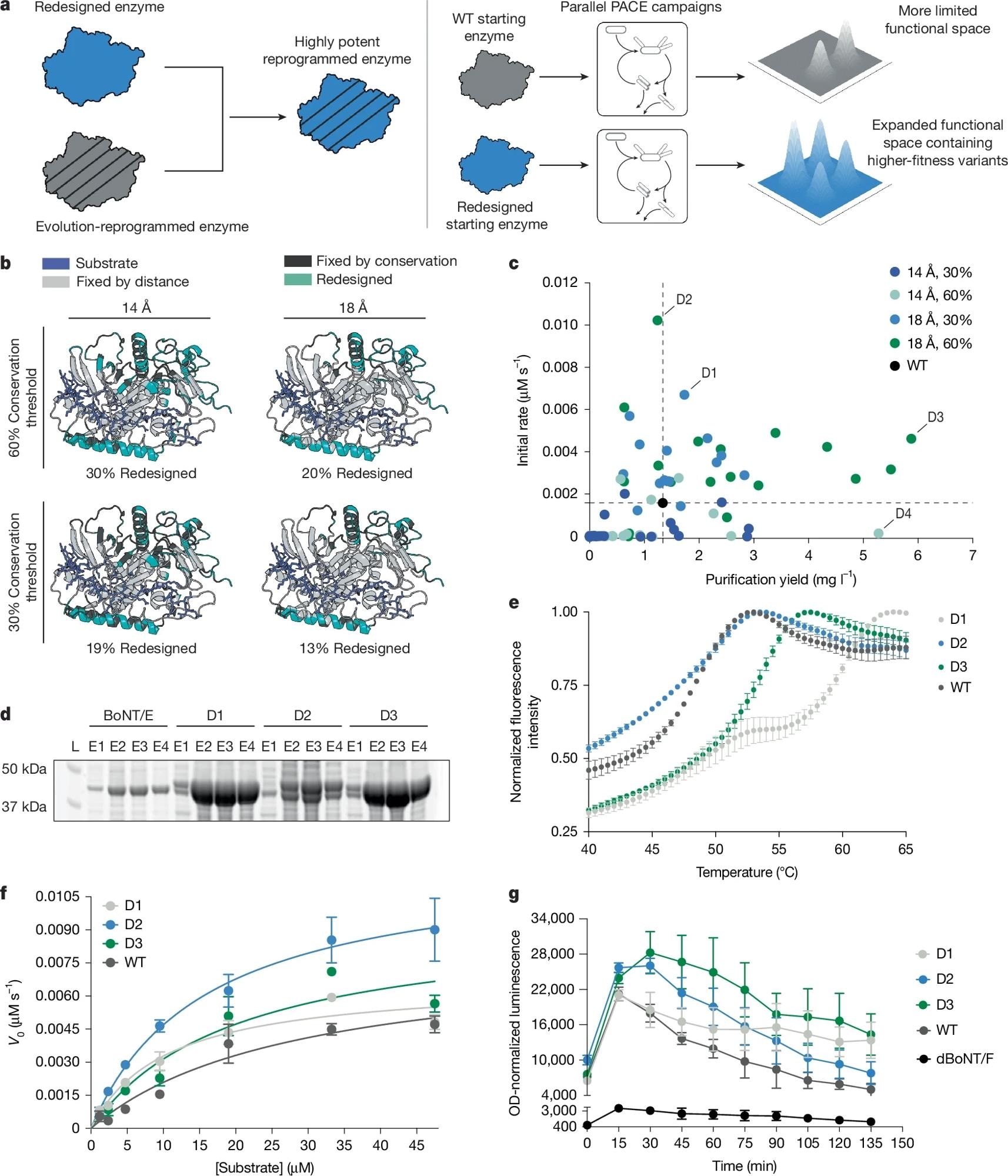
An overview for integrating computational protein sequence design and continuous evolution to redesign stabilized BoNT/E proteases. a, Left, Reengineering enzymes evolved in the lab results in highly potent enzymes with reprogrammed specificity. Yes, the redesigned protease is a good evolutionary starting point with an expanded and higher fitness mutation space. b, Residues constrained or allowed to change during redesign with BoNT/E protease. c, Catalytic rate and soluble yield of the assayed designs. Kinetic assays were performed using 2.5 nM protease and 4.75 μM SNAP25 FRET substrate. The dashed line indicates the value of WT protease. d, Abundance of the top redesigned proteases in purified elution fractions E1–E4 from the soluble fraction of E. coli expressing cells. 5 μl of the approximately 1 ml elution fraction was loaded into each lane. e, Thermal melting curve of proteins for measuring Tm. Thermal development was followed by SYPRO orange fluorescent dye. The Tm values calculated as the temperature at which the slope of the curve is maximum are shown in Supplementary Table 6. f, Michaelis-Menten plot of in vitro cleavage kinetics using SNAP25 FRET substrate. The resulting kinetic parameters of the BoNT/E protease mutants are shown in Supplementary Table 5. V0, initial velocity; g, Apparent protease activity in PACE protease cleavage selection circuit host cells as measured by luciferase signal. OD, optical density; Values and error bars represent the mean ± SD of three replicates (e–g).
conclusion
This study demonstrated that the combination of AI sequence redesign and automated continuous evolution can alleviate the classical trade-off between enzyme stability and acquisition of new catalytic functions in the BoNT protease model. By expanding the accessible mutational space, the redesigned starting point enabled the evolution of highly specific non-native catalytic activities.
Future studies should examine whether these benefits extend to unrelated enzyme families, which may facilitate a scalable framework for engineering customized therapeutic enzymes while establishing their delivery, efficacy, and safety in disease models.
