


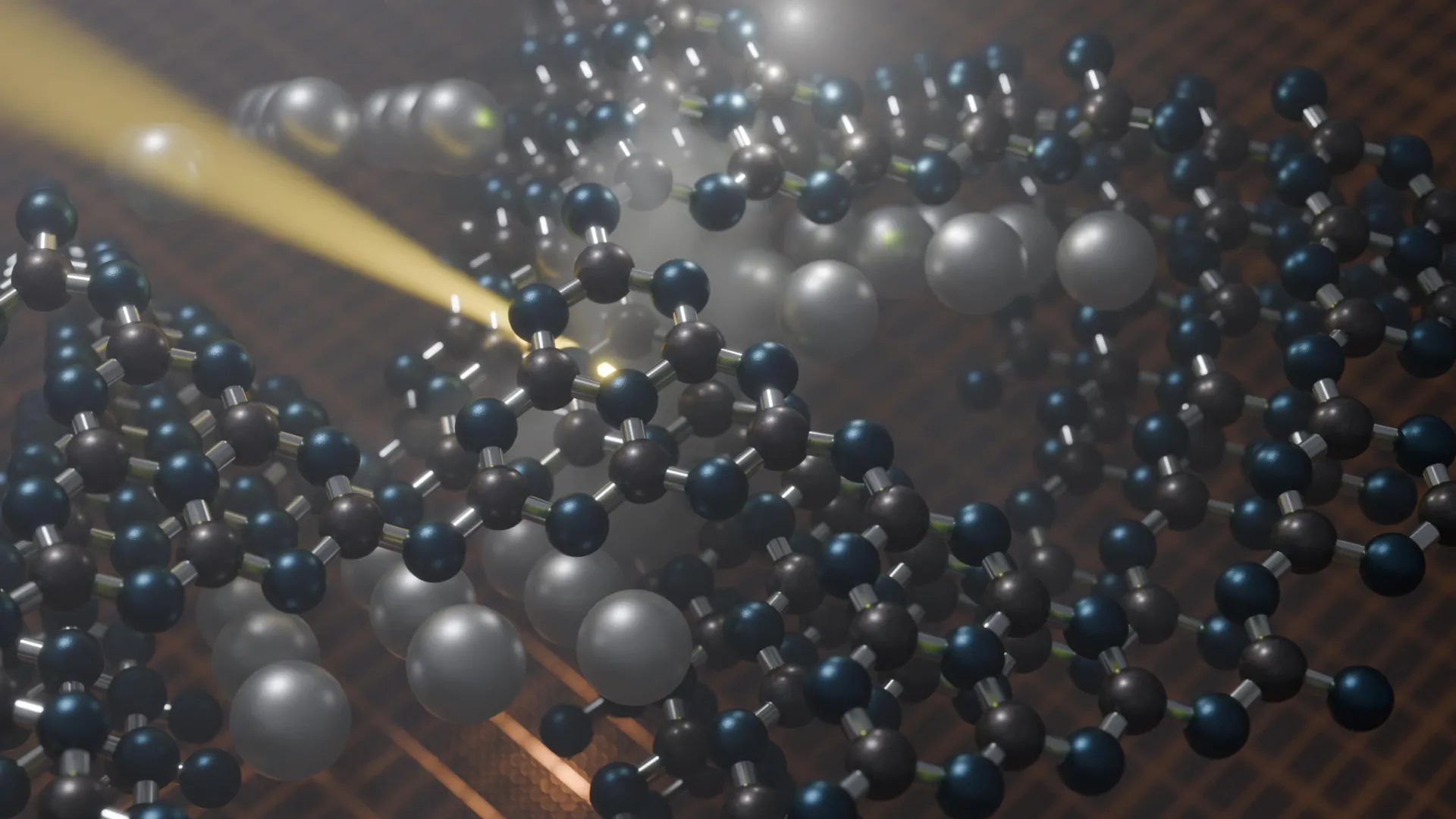
Photocatalysis offers a promising way to convert vast amounts of sunlight into useful chemical energy. In particular, polyheptazine imide, which has structural and functional characteristics that are effective for photocatalytic reactions, is attracting attention. Until recently, scientists had limited insight into how changes in its structure affect its electronic and optical behavior across the many possible materials in this family.
Researchers led by a team from the Center for Advanced System Understanding (CASUS) at Helmholtz Zentrum Dresden-Rossendorf (HZDR) have introduced a reliable and reproducible theoretical approach to tackle this problem. Their predictions were verified through measurements on actual material samples. The research team believes that this advance could significantly accelerate research into polyheptadine imides and spark rapid growth in the field.
Carbon nitride materials and visible light absorption
Polyheptadine imide belongs to the broader class of carbon nitrides. These materials consist of a layered structure similar to graphene, but built from nitrogen-rich ring-shaped molecular units.
Although graphene is known for its excellent electrical conductivity, it does not perform well as a photocatalyst. Polyheptadine imide differs in a crucial way. Its electronic bandgap allows it to absorb visible light, making it suitable for chemical reactions triggered by sunlight.
Carbon nitride materials also have some practical advantages. They are relatively cheap to produce, non-toxic, and thermally stable. However, early versions of these materials did not perform well as photocatalysts because their internal properties limited effective charge separation.
When a photon hits a material, an electron is excited and moves away from its original position, leaving behind a positively charged hole. When an electron quickly recombines with a hole, energy is released only as heat or light rather than causing a chemical reaction.
“Polyheptazine imide containing positively charged metal ions exhibits significantly improved charge separation. This feature makes polyheptazine imide highly suitable for practical applications,” said lead author Dr. Zahra Hajiamadi.
Computer modeling speeds the search for better catalysts
Improved materials are needed to unlock the economic potential of some photocatalytic processes. These include water splitting (to produce hydrogen as a fuel), carbon dioxide reduction (to produce basic carbohydrates as fuel or industrial chemicals), and hydrogen peroxide production (as a basic industrial chemical).
Designing a polyheptadine imide catalyst with superior performance for a particular reaction requires careful control of many aspects of its structure. It is impractical to create and test every possible material candidate in a laboratory. Therefore, computational methods play an important role in narrowing down the possibilities.
“The design space is huge,” explains Professor Thomas D. Kühne, CASUS director, head of the CASUS research team “Complex Systems Theory,” and senior author of the study. “For example, you can add functional groups to the surface or replace certain nitrogen or carbon atoms with oxygen or phosphorus atoms.”
Kuehne’s research group develops advanced numerical techniques designed to efficiently and accurately reproduce the chemical and physical behavior of complex materials.
Systematically tested for 53 metal ions
Polyheptadine imide is characterized by the presence of negatively charged pores within the material. Positively charged metal ions are present in these pores, which can significantly improve catalytic performance.
Hajiahmadi’s work represents the first comprehensive study of how different metal ions affect the optoelectronic properties of these materials. The study examined a total of 53 metal ions, classifying them according to where they exist in the structure (in-plane or between layers) and how they change the shape of the material (resulting in distortion or not).
“We used a reliable and reproducible computational framework that goes beyond traditional modeling techniques,” says Hajiamadi. “Standard computational studies of photocatalysis typically focus on ground-state properties and ignore excited-state effects, despite the fact that photocatalysis is essentially driven by photoexcited charge carriers. In particular, we employ techniques from many-body perturbation theory.”
These methods start with a simplified model system that does not include particle interactions. Interactions are then added as small corrections, allowing researchers to approximate how large numbers of particles affect each other. Although such calculations require considerable computational power and have little application in this field, new research shows their value. This framework explains exactly how these materials absorb light and how their electronic structures behave under illumination.
Experiments confirm theoretical predictions
The researchers used a computational approach to investigate how different metal ions change the structure of polyheptazinimide networks. Their analysis revealed that the introduction of ions can induce measurable structural changes, such as changes in interlayer spacing and changes in the local binding environment. These structural changes directly affect the electronic band structure and optical properties of the material, which in turn affects its efficiency in capturing light.
To test their predictions, the team synthesized eight different polyheptadine imide materials, each incorporating a different metal ion. The materials were then evaluated for their ability to catalyze the production of hydrogen peroxide.
“The results were clearly highly consistent with our predictions and outperformed competing computational methods,” Hajiamadi concluded.
Kuehne added, “If there was ever any doubt that polyheptazine imide is one of the most promising platforms for next-generation photocatalytic technology, I think this study puts that doubt to rest. The path towards the targeted design of efficient polyheptazine imide photocatalysts for sustainable reactions is now clearer, and I am confident that it will be implemented frequently and successfully.”
