


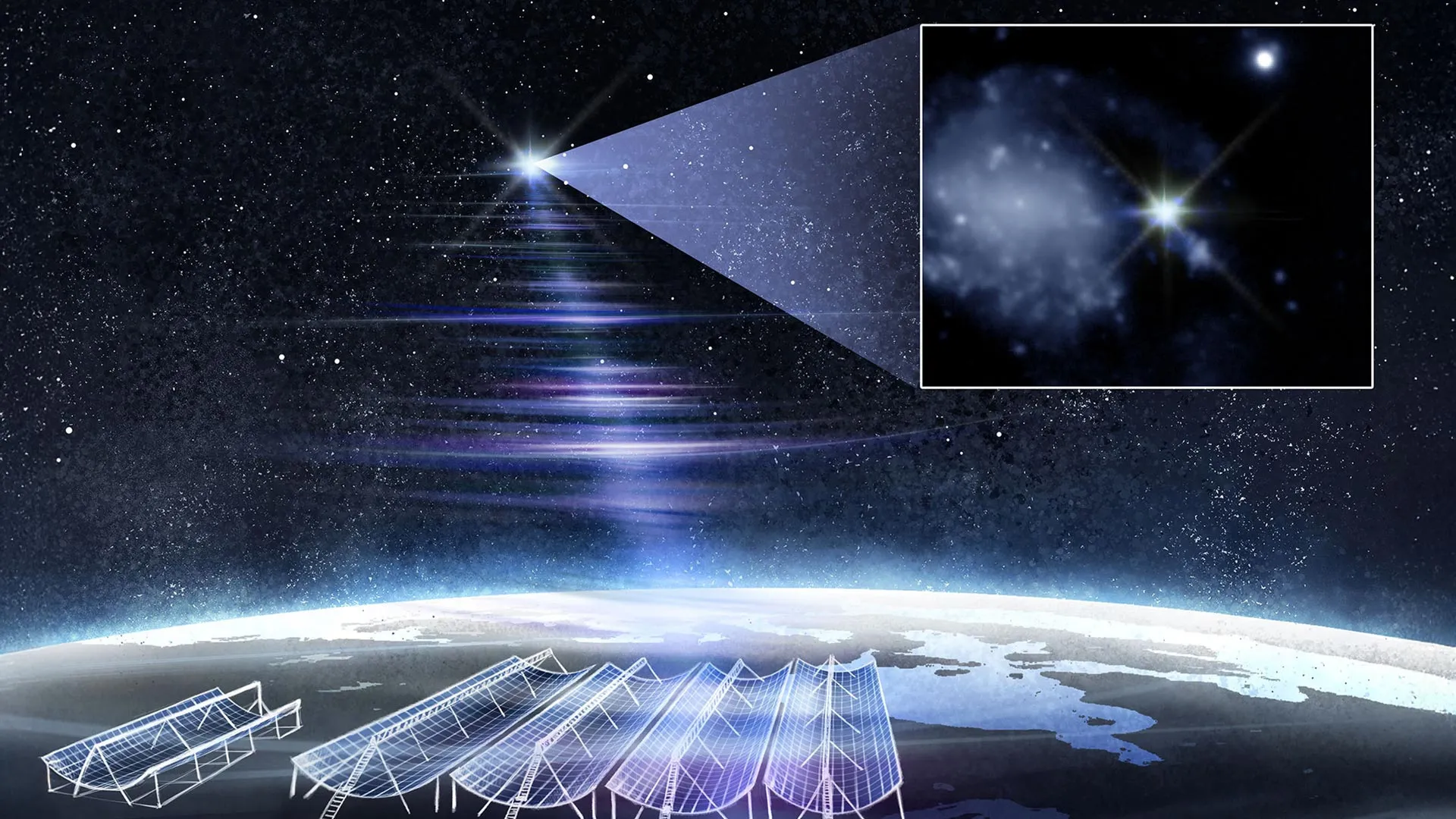
An international team of astronomers, including researchers from the University of Toronto, has identified the brightest fast radio burst (FRB) ever observed and, using a coordinated network of radio telescopes, traced its origin to a nearby galaxy. FRBs are one of the most mysterious phenomena in astronomy, but determining exactly where they come from could begin a new phase of research that could help scientists better understand the origins of our universe.
High-speed radio bursts are incredibly powerful flashes of radio energy that propagate long distances in space. Scientists believe they are produced by extreme astrophysical phenomena, but the exact cause remains unknown. Since 2018, the Canadian Hydrogen Intensity Mapping Experiment (CHIME) has detected thousands of such bursts. However, determining their exact location in the sky remains a major challenge.
CHIME outrigger array pinpoints bursts
The newly detected signal, designated FRB 20250316A and nicknamed RBFLOAT (“Brightest Radio Flash of All Time”), was located with remarkable accuracy using the CHIME/FRB outrigger array. These smaller versions of the CHIME equipment are installed in British Columbia, Northern California, and West Virginia. Together, they enable astronomers to use very long baseline interferometry (VLBI). VLBI is a technique that combines signals from widely spaced telescopes to determine the position of objects in the sky with very high accuracy.
“Ultimately, we were very lucky to be able to pinpoint the exact sky location of this rare event,” said University of Toronto doctoral student Mathias Razda, an author on both papers. “A few hours after discovering it, there was a power outage at one of the telescope sites that played a key role in knowing where the burst came from. If that event had happened later that day, we would have missed our chance completely.”
Powerful burst from a nearby galaxy
Fast radio bursts rank among the most powerful radio sources known, but only appear for a short time. Each burst typically lasts from a few milliseconds to a few seconds and temporarily shines brighter than all other radio signals within the host galaxy. RBFLOAT, detected on March 16, 2025, lasted approximately one-fifth of a second.
“Cosmically speaking, this fast radio burst is right in our neighborhood,” says Kiyoshi Masui, associate professor of physics at the Kavli Institute for Astrophysics and Space Studies at the Massachusetts Institute of Technology and a University of Texas alumnus. “This means we have the opportunity to study a very ordinary Fed in detail.”
The burst appeared very bright, partly because its source was relatively close to Earth. It occurred near the outer region of the galaxy NGC 4141 in the constellation Ursa Major, about 130 million light-years away. The researchers were able to narrow down the source of the signal to an area just 45 light years across, which is smaller than the typical size of a star cluster. Achieving this level of accuracy is comparable to finding a guitar pick from 1000 kilometers away.
“This discovery was very exciting because right after all three outriggers came online, we had the brightest event yet,” said Amanda Cook, a Bunting postdoctoral fellow at McGill University and a University of Utah alumnus who led the paper describing RBFLOAT. “Although it was a Sunday afternoon, a bunch of us immediately gathered in a Zoom room and began hacking away at the study in hopes of getting follow-up observations of the source as soon as possible.”
JWST observation reveals weak infrared signal
The precise location provided by the CHIME/FRB outrigger array allowed the team to conduct follow-up observations using the James Webb Space Telescope (JWST). During these observations, scientists detected a faint infrared signal in the same location where RBFLOAT occurred. This finding was unexpected, and researchers are still investigating what it represents. One possibility is that the signal is coming from a red giant star, and another idea is that it could be an echo of fading light associated with the burst itself.
“JWST’s high resolution allows us to resolve individual stars around FRBs for the first time. This opens the door to determining the types of stellar environments that can cause such powerful outbursts, especially when rare FRBs are imaged at this level of detail,” said Peter Blanchard, a postdoctoral fellow at Harvard University and lead author of a companion paper describing JWST’s observations.
Explosions that cast doubt on current theories
This phenomenon is the brightest FRB ever detected by CHIME, but astronomers have not observed repeated bursts from the same source. Scientists examined hundreds of hours of CHIME data covering the region over six years and found no additional signals.
“This burst does not appear to be repeatable, which is different from most well-studied Feds,” Cook said. “This challenges the main thinking in this area, repeated by all Feds, and opens the door for at least some Feds to reconsider its more ‘explosive’ origins.”
Two scientific papers describe this discovery. Astrophysics Journal Letter. One focuses on the original radio detection and precise localization of the burst, and the other reports JWST near-infrared observations of the same region. Together, these studies provide new insights into fast radio bursts and suggest that they may become valuable tools for studying the universe, rather than leaving it a mysterious oddity.
