


According to the Alzheimer’s Association, an estimated 7.2 million Americans over the age of 65 have Alzheimer’s disease. Current diagnostic tests typically measure the levels of two proteins in the blood or spinal fluid: amyloid beta (Aβ) and phosphorylated tau (p-tau). Although these biomarkers are widely used, they may not fully reflect the earliest biological changes that occur during disease progression.
Researchers at Scripps Research have now introduced a different type of blood test that focuses on how proteins are folded in the bloodstream, rather than how much is present. Their findings are: natural aging February 27, 2026 Researchers have shown that differences in the structure of three plasma proteins are strongly associated with Alzheimer’s disease status. These changes have allowed scientists to accurately distinguish between cognitively normal people and people with Alzheimer’s disease or mild cognitive impairment (MCI). This approach could ultimately allow diagnosis and treatment to begin earlier.
“Many neurodegenerative diseases are caused by changes in protein structure,” said lead author John Yates, a professor at the Scripps Research Institute. “The question was: Are there specific protein structural changes that could serve as predictive markers?”
Disruption of protein folding and proteostasis
For many years, Alzheimer’s disease has been closely associated with amyloid plaques and tau tangles that accumulate in the brain. However, scientists believe that the condition may involve a widespread failure of proteostasis, the system responsible for keeping proteins properly folded and removing damaged proteins.
As people age, this system becomes less effective. Therefore, proteins are more likely to be misfolded during production or maintenance. Based on this idea, the researchers proposed that when proteostasis is disrupted in the brain, similar structural changes may appear in proteins circulating in the blood.
Analyzing structural changes in blood proteins
To explore this possibility, the researchers tested plasma samples from 520 participants in three groups: cognitively normal adults, people with mild cognitive impairment, and patients diagnosed with Alzheimer’s disease.
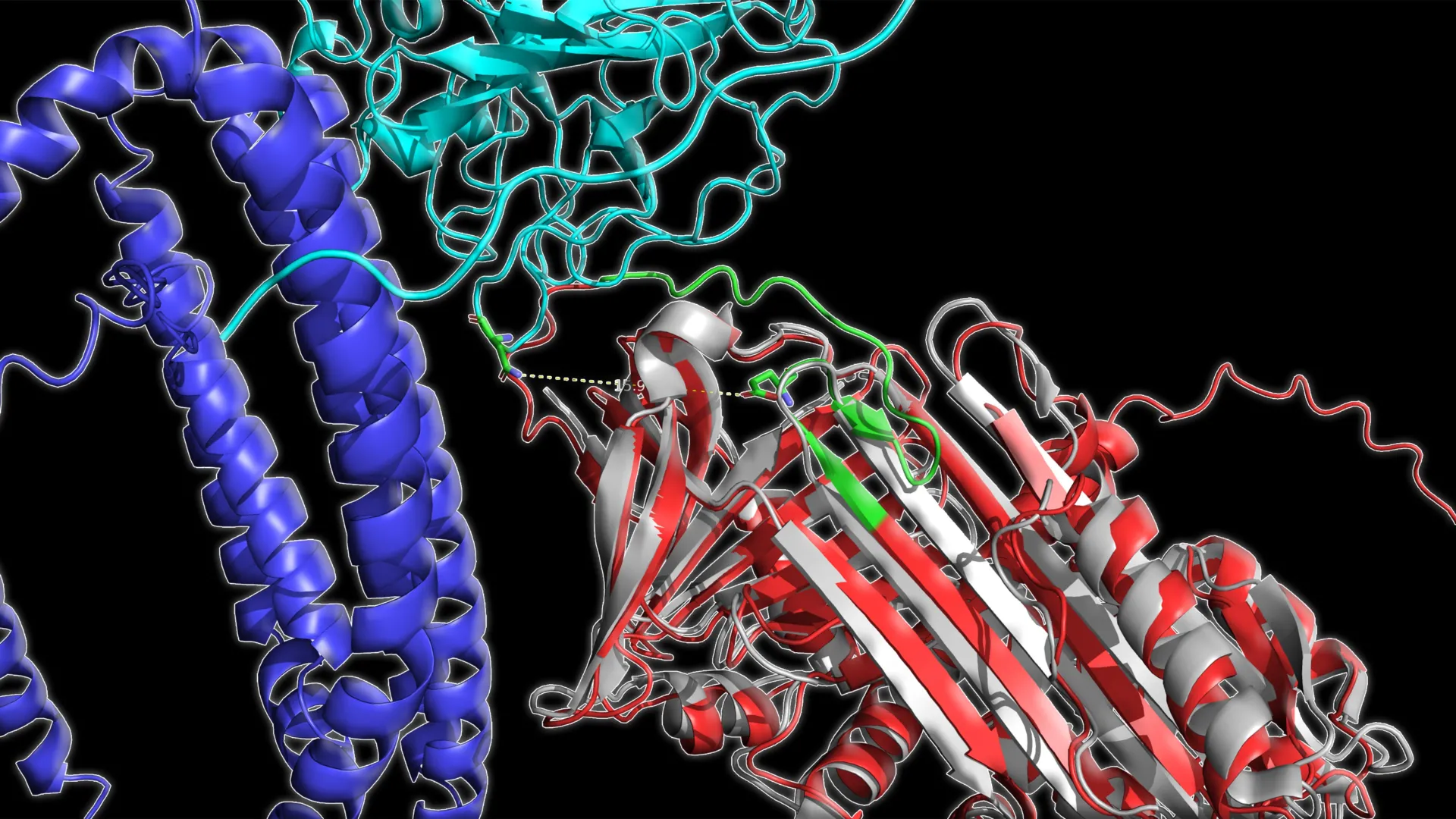
The scientists used mass spectrometry to determine how specific locations within the protein were exposed or buried, indicating changes in the protein’s structure. They then applied machine learning techniques to identify patterns associated with disease stage.
The results revealed clear patterns across all groups. As Alzheimer’s disease progresses, some blood proteins are no longer structurally “open.” These structural changes were found to be more informative in identifying disease stages than simply measuring protein concentrations.
Three proteins associated with Alzheimer’s disease progression
Among the many proteins analyzed, three proteins showed the strongest association with disease status. These were C1QA, which plays a role in immune signaling; Clusterin is involved in protein folding and amyloid removal. Apolipoprotein B is a protein that transports fat in the bloodstream and contributes to blood vessel health.
“The correlation was surprising,” said co-author Casimir Bamberger, a senior scientist at Scripps Research. “It was very surprising to find three lysine sites on three different proteins that correlated so highly with disease status.”
Changes at specific sites within these proteins allowed the researchers to classify participants as cognitively normal, MCI, or Alzheimer’s disease with about 83% overall accuracy. When directly comparing two groups, such as healthy people and MCI patients, accuracy rose to more than 93%.
Long-term tracking of Alzheimer’s disease
The three protein models remained reliable when tested on independent groups of participants and when researchers analyzed blood samples taken months later.
When tested repeatedly every few months, the panel identified disease status with about 86% accuracy and reflected changes in diagnosis over time. Structural scores also showed strong relationships with cognitive test results and a more modest relationship with MRI measures of brain shrinkage.
Taken together, these findings suggest that analysis of protein structures in blood could complement existing amyloid and tau tests. Because the method focuses on structural changes related to the underlying biology of the disease, it could help researchers identify disease stages, monitor progression, and assess how well treatments are working.
Future applications and next steps
“Early detection of markers of Alzheimer’s disease is absolutely critical to developing effective treatments,” Yates says. “If we can start treatment before significant damage occurs, we may be able to better preserve long-term memory.”
Before the blood test can be used in clinical practice, larger studies with longer follow-up periods will be needed to confirm the results. Researchers are also exploring whether the same structural profiling techniques can be applied to other diseases such as Parkinson’s disease and cancer.
In addition to Yates and Bamberger, the authors of the study, “Structural features of plasma proteins classify Alzheimer’s disease status,” include Ahrum Son, Hyunsoo Kim, and Jolene K. Diedrich of Scripps Research. Heather M. Wilkins, Jeffrey M. Burns, Jill K. Morris, and Russell H. Swerdlow of the University of Kansas Medical Center; Robert A. Risman of the University of California, San Diego;
Support for this research was provided by the National Institutes of Health (grants RF1AG061846-01, 5R01AG075862, P30AG072973 and P30-AG066530).
