


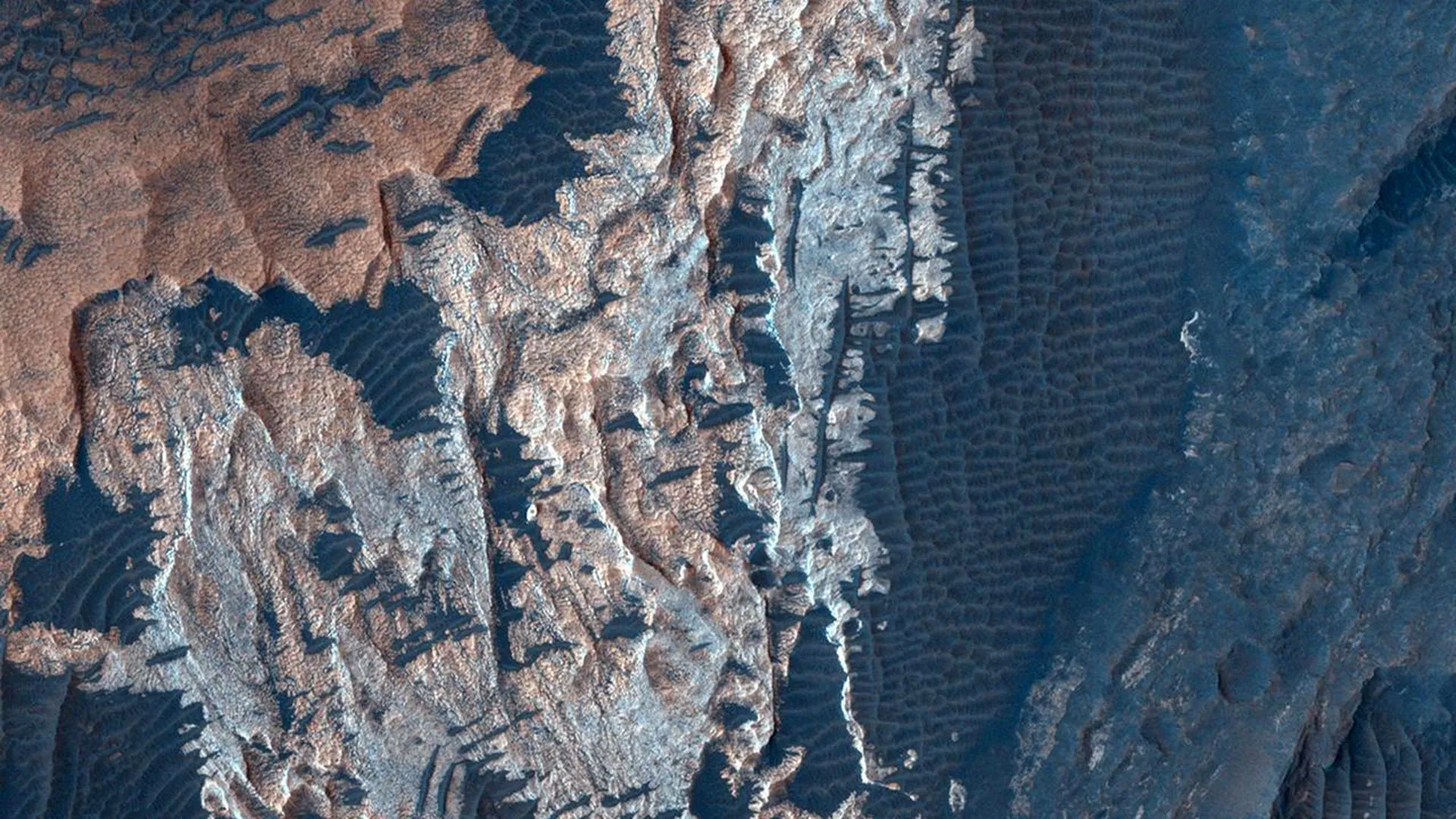
New research published in nature communications report that iron sulfate, a previously unknown mineral, may have been detected on Mars. Sulfur is abundant on Mars and usually combines with other elements to form sulfate minerals. On Earth, most sulfates dissolve easily in rainwater. However, because Mars is extremely dry, these minerals have persisted for billions of years, preserving evidence of ancient environmental conditions.
Each mineral has its own crystal structure and physical properties. Familiar examples include gypsum and hematite. Scientists will analyze data from orbiting spacecraft to identify minerals on Mars’ surface and reconstruct the environmental conditions that produced them. For nearly two decades, researchers have been puzzled by the layered iron sulfate on Mars, which exhibits an unusual spectral signal. A new study led by Dr. Janice Bishop, a senior scientist at the SETI Institute in California’s Silicon Valley and NASA’s Ames Research Center, has identified and characterized an unusual ferric hydroxysulfate phase. The research team combined laboratory experiments with observations of Mars’ orbit to better understand these materials. Their results provide new clues about the role of heat, water, and chemical reactions in shaping the Martian landscape.
“We investigated two sulfate-bearing sites near the vast Marineris Canyon system that contained mysterious spectral bands, layered sulfates, and interesting geology seen in orbital data,” Bishop said.
Research site near Marineris Valley
The study focused on two regions near Valles Marineris, one of the largest canyon systems in the solar system. One such location is Aram Chaos, located northeast of a system of canyons where ancient waters once flowed toward lower terrain to the north. The second site is located on a plateau above the Juventae Chasma, a 5 km deep canyon just north of the Valles Marineris.
Juventa Plateau (above Juventa Casma)
This area, near the cliffs of Valles Marineris, preserves traces of a wet past. Ancient waterways carved by flowing water crisscross the landscape. Scientists have found that sulfate minerals are concentrated in small, low-lying areas. This region likely formed when a pool of sulfate-rich water gradually evaporated. When the water disappeared, hydrated ferrous sulfate remained.
These minerals, including ferric hydroxysulfate, occur in a thin layer approximately 1 meter thick, both above and below the basaltic material. Their location suggests that they were first formed and then exposed to heat from lava or volcanic ash.
“By examining the morphology and stratigraphy of these four building blocks, we were able to determine the age and formation relationships between the different units,” said study co-author Dr. Katherine Weitz, a senior research scientist at the Planetary Science Institute.
Evidence from Aram Chaos
Sulfate minerals are widely distributed throughout the Valles Marineris region, especially in the rugged terrain known as the Chaos Terrain. Scientists believe these areas were formed in the distant past when massive floods reshaped the earth’s surface. As the water evaporates, it leaves behind layered deposits of iron and magnesium sulfates, evidence that Mars was wetter in the past.
Some chaotic terrains formed within ancient impact craters contain polyhydrated sulfates in their top layers. Below that is a layer of sulfuric acid monohydrate and ferric hydroxy sulfate.
How heat changed sulfate on Mars
Each of these sulfate types has unique spectral signatures and can be detected from orbit using CRISM instruments. Initially, it was difficult to explain the arrangement of these mineral layers. Laboratory experiments helped solve the puzzle. Researchers discovered that heating polyhydrate sulfate to 50°C transforms it into a monohydrate. When temperatures exceed 100°C, ferric hydroxysulfate is formed. These results indicate that the minerals may have been altered by geothermal heat after they were deposited.
Sulfate polyhydrate and sulfate monohydrate occur over a wide range of regions. Ferric hydroxy sulfate is extremely rare and only occurs in a few small locations. Scientists believe that a warm geothermal source may have once existed beneath these areas, creating the conditions necessary for the formation of this mineral. Additional sediment may remain buried beneath the sulfuric acid monohydrate layer.
Laboratory experiments reveal changes in minerals
Researchers at the SETI Institute and NASA Ames conducted laboratory experiments to track how these minerals evolve. The process starts with rosenite (Fe2+SO4·4H2O), which contains four water molecules in each unit cell. When heated, it transforms into zomolnocite (Fe2+SO4・H2O), which contains only one water molecule. Continued heating produces ferric hydroxysulfate, which replaces H2O in the mineral structure with OH.
“Our experiments suggest that this ferric hydroxy sulfate only forms when hydrated ferrous sulfate is heated in the presence of oxygen,” said NASA Ames postdoctoral researcher Dr. Johannes Muesberger. “Although the change in atomic structure is very small, this reaction dramatically changes the way these minerals absorb infrared light, making it possible to use CRISM to identify this new mineral on Mars.”
Oxygen and chemical reactions on Mars
This chemical reaction requires oxygen gas and produces water (Equation 1). Mars currently has a thin atmosphere dominated by CO2, but it still contains enough oxygen for this reaction to occur and to oxidize other forms of iron as well.
Formula 1: 4 Fe2+SO4・H2O + O2 → 4 Fe3+SO4OH + 2H2O
“These lab-formed materials are likely new minerals because of their unique crystal structure and thermal stability,” Bishop said. “But for scientists to formally recognize it as a new mineral, they need to discover it on Earth as well.”
Clues about geological activity on Mars
The newly identified ferric hydroxy sulfate has a crystal structure similar to zomolnocite, a ferrous sulfate monohydrate. However, it appears to form more easily from rosenite, which contains four water molecules.
The transformation of hydrated ferrous sulfate to hydroxyferric sulfate occurs only at temperatures above 100°C, which is much higher than typical Martian surface conditions. The ferric hydroxysulfate-containing sulfates observed at Alam Chaos and Juventai probably formed more recently than the surrounding terrain. Researchers suggest they may date from the Amazonian era (less than 3 billion years ago).
This discovery indicates that the volcanic heat of the Juventai Plateau and the underground geothermal energy of the Alam Chaos could convert common hydrated sulfates to ferric hydroxysulfates. The discovery suggests that parts of Mars have remained chemically and thermally active more recently than previously thought, providing new insights into the evolving surface of Mars and its potential to support life.
The paper “Characteristics of ferric hydroxysulfate on Mars and the influence of the geochemical environment supporting its formation” nature communications.
