


Gravity often feels reliable and unchanging. It seems stable enough that we hardly question it. But the reality is even more surprising.
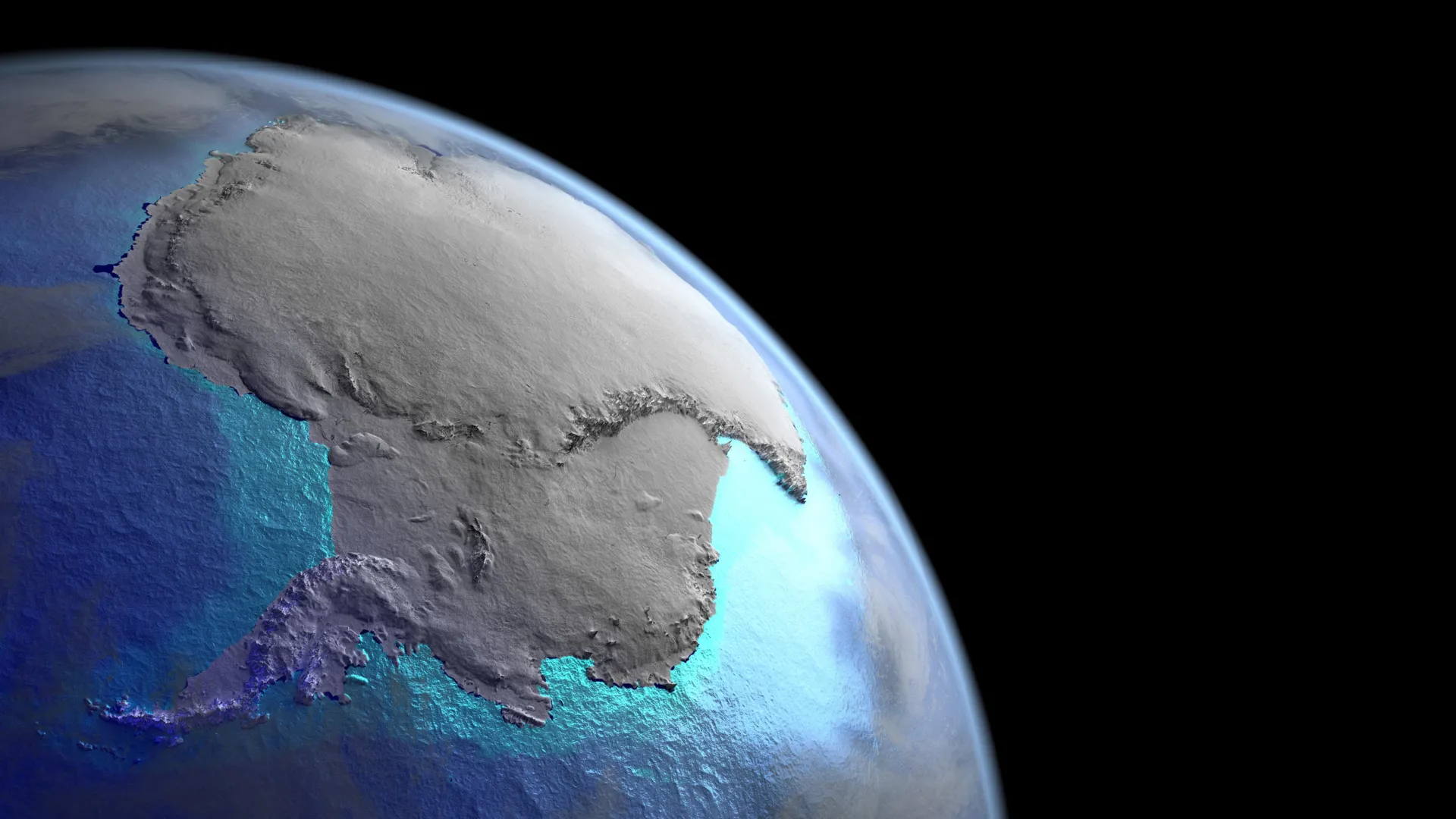
In reality, gravity is not exactly the same strength everywhere on Earth. Its gravitational pull varies slightly across the planet’s surface. Considering the effects of the Earth’s rotation, we find that gravity is weakest underground in Antarctica.
Movement deep in the Earth created a gravitational hole in the South Pole
A new study has shown that the very slow movement of rocks deep within the planet contributed to the development of gravitational anomalies beneath Antarctica. These movements occurred over tens of millions of years, gradually forming what scientists call the Antarctic Gravitational Hole. The study also notes that this change in lower gravity occurred at the same time as a major change in Antarctica’s climate. Future research may reveal whether these gravitational changes helped fuel the development of the continent’s vast ice sheets.
“Better understanding of how the Earth’s interior shapes gravity and sea level will provide insight into the factors important to the growth and stability of large ice sheets,” said Dr. Alessandro Forte, professor of geophysics at the University of Florida and co-author of a new study that recreates the past of the Antarctic Gravity Hole.
Differences in gravity are caused by changes in the density of rocks far below Earth’s surface. Although changes in gravity are small, they can have a noticeable effect on the ocean. In areas where gravity is weak, seawater tends to flow toward areas where the gravitational pull is strong. As a result, sea levels in these weaker gravity zones are slightly lower relative to the center of the Earth. Because of the gravity hole beneath Antarctica, the sea level around Antarctica is much lower than it would be otherwise.
Creating a map of the Earth’s interior using earthquakes
Recently published research results are scientific reportconducted by Forte and Dr. Petar Grišovic of the Paris Institute of Geophysics. Scientists have mapped Antarctica’s gravity hole and reconstructed how it evolved over millions of years. Their research relied on a global scientific effort that combined seismic records from around the world with physically-based computer models. By combining these tools, we were able to uncover the hidden three-dimensional structure of the Earth’s interior.
“Imagine doing a CT scan of the entire Earth, but we don’t have X-rays like you do in a doctor’s office. We do have earthquakes. Seismic waves provide the ‘light’ that illuminates the Earth’s interior,” Forte said.
The researchers created a detailed gravity map of Earth by analyzing how seismic waves traveled through the planet and combining that data with physically-based modeling. This result closely matched very accurate satellite measurements of Earth’s gravitational field. This agreement helped ensure that their model realistically captured the planet’s internal structure.
Rewinding Earth’s geological history
The next step involved going back in time to understand how gravitational holes developed. Scientists used advanced computer simulations to reverse the slow movement of rocks inside the planet. Their model traced these changes back to the time of the dinosaurs, about 70 million years ago.
These reconstructed snapshots showed that the Antarctic gravity hole was initially weak. However, from about 50 million years ago to 30 million years ago, the anomalous phenomena began to become more intense. This period coincides with major changes in Antarctica’s climate system, including the beginning of a widespread ice age.
Looking to the future, Forte wants to investigate whether strengthening gravitational anomalies played a role in the formation of the Antarctic ice sheet. Future models will investigate how changes in gravity, sea level, and continental elevation interact.
Ultimately, the researchers hope to answer bigger questions about Earth’s systems. As Forte explained, the goal is to understand “how does our climate relate to what’s happening inside the Earth?”
