


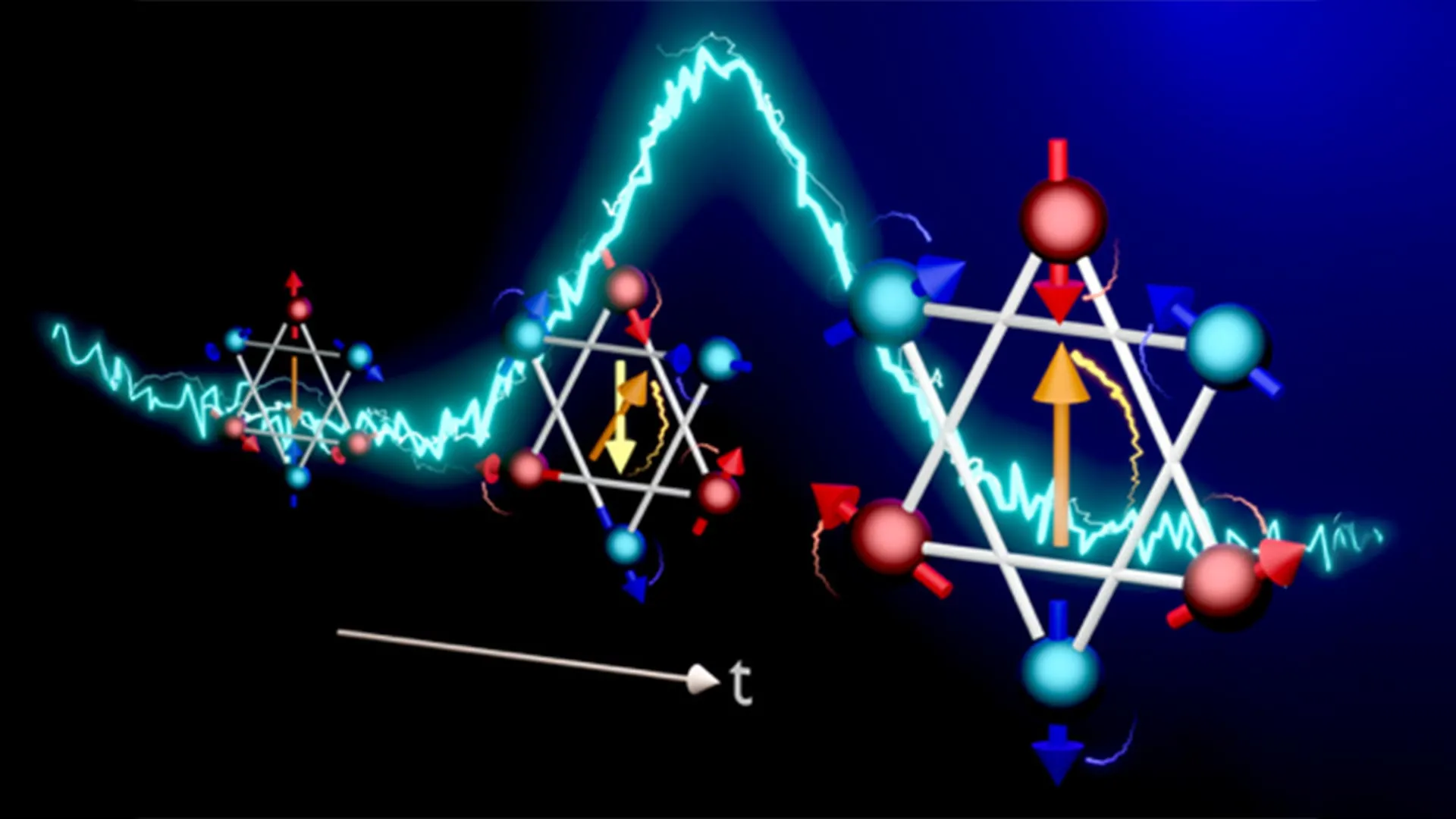
A team led by Ryo Shimano at the University of Tokyo directly observed how electron spins reverse inside antiferromagnets (materials in which opposite spins cancel each other out). By capturing the behavior of this process, the researchers identified two different switching mechanisms. One of them outlines a practical path toward ultrafast, nonvolatile magnetic memory and logic devices that have the potential to outperform today’s technology. The result is natural materials.
From punched paper cards and metal rods to vacuum tubes and transistors, modern computing has always relied on physical systems that represent zeros and ones. As demand for processing power continues to rise, researchers are seeking faster and more efficient alternatives. Antiferromagnets offer a promising option. Although it appears magnetically neutral due to its spin balance, its internal magnetic structure can be used to store digital information in new ways.
“Scientists have believed for many years that antiferromagnets like MnSn (manganese tritin) can switch their magnetization very quickly, but it was unclear whether this non-volatile switching was completed within a few to tens of picoseconds, or how the magnetization actually changed during the switching process,” Shimano says.
Heat or current? Solving the mystery of switching
The central question was: What actually causes spin reversal? Does the current directly reverse the spin, or does the heat generated by the current cause the change?
To find out, the team designed an experiment to watch the process unfold in real time. They created a thin film of Mn3Sn and sent short electrical pulses through it. At the same time, they irradiated the sample with a precisely timed ultrafast flash of light and adjusted the delay between the current pulse and the light pulse. This approach allowed us to assemble time-resolved sequences that show how the magnetization changes from moment to moment.
“The most difficult part of the project was measuring the tiny changes in the magneto-optical signal,” recalls Shimano. “But once we had the right method in place, we were surprised to find that we could finally observe the switching process very clearly.”
Two different spin-switching mechanisms revealed
The experiment produced an unprecedented frame-by-frame display of changes in the magnetic pattern during switching. The images showed that its behavior depends on the strength of the applied current.
When the current was strong, switching was driven by heating effects. However, under weaker current conditions, the spins reversed with little or no heating. This second pathway is particularly important because it suggests a way to quickly and efficiently control magnetic states without wasting energy as heat.
This heat-free switching mechanism could serve as the basis for next-generation spintronic devices used in computing, communications, and advanced electronics. For Shimano, the findings represent a new area of science that is still waiting to be explored.
Pushing the limits of picosecond switching
“The current fastest time-resolved observation of electrical switching in Mn₃Sn is 140 ps, limited primarily by how short current pulses can be generated in the device settings. However, our findings suggest that under the right conditions the material itself can switch even faster. In the future, we aim to explore these ultimate limits by creating even shorter current pulses and optimizing the device structure.”
Current measurements have an upper limit of 140 picoseconds, but the material’s actual speed limit may be even lower. By improving experimental tools and device design, the researchers hope to discover just how fast antiferromagnetic spin switching can ultimately be achieved.
