


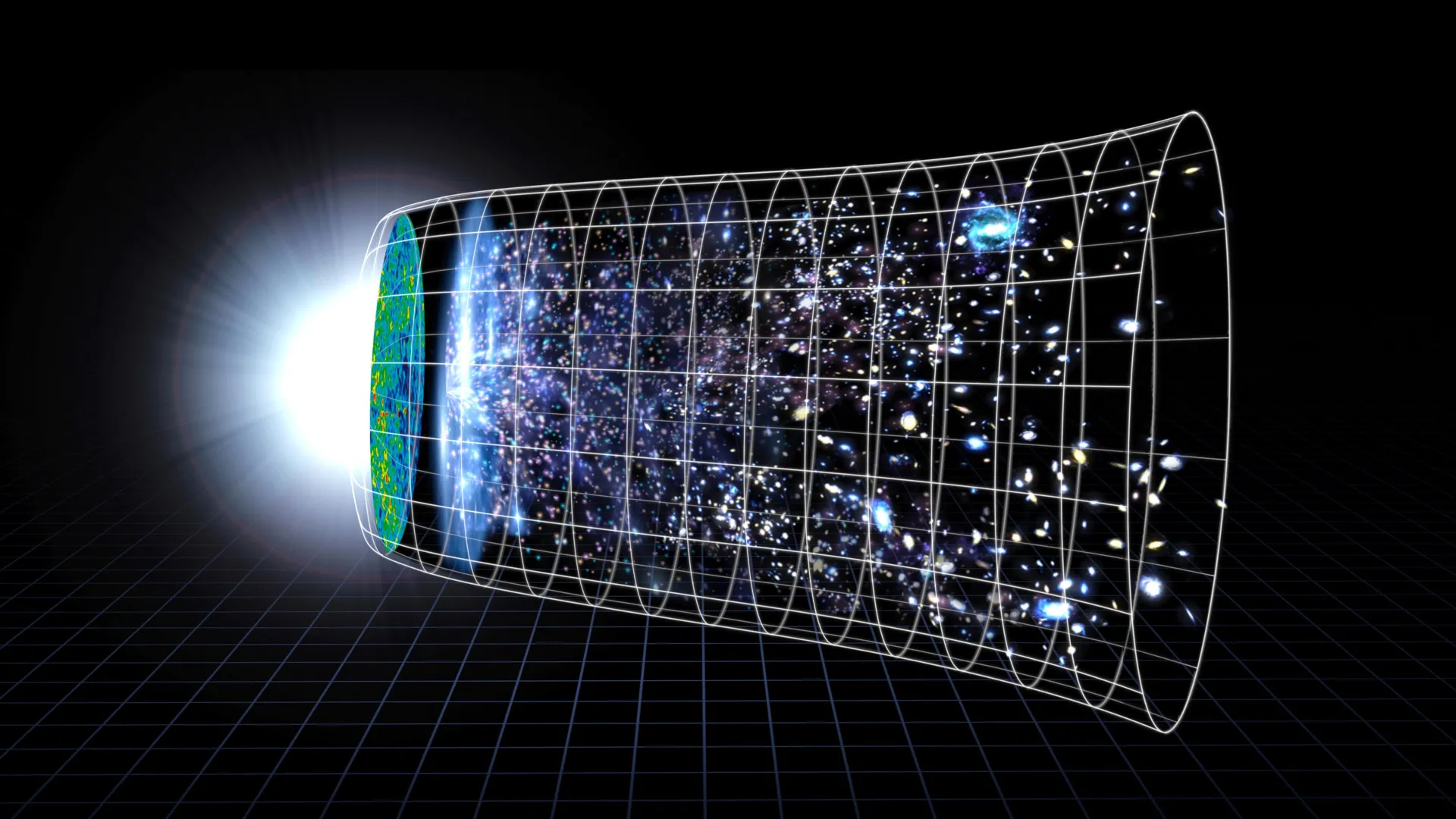
In an expanding universe, measuring distance becomes more complicated because space is not fixed while light travels through it. Galaxies continue to emit light, but that light can take billions of years to traverse the universe before reaching us. During that journey, the universe continues to expand, increasing the average distance between galaxies (yes, I know galaxies sometimes collide, but we’re talking on average, large scales here).
This means that even though the telescope captures light from a distant galaxy, the images do not reveal where that galaxy is currently located. It shows the galaxy that appeared when light began its journey. To estimate current distances, astronomers must use cosmological models that explain how the universe has expanded over time.
The main model currently in use is called LCDM. Contains Dark Matter (separate episode) and Dark Energy (separate episode). The strengths and limitations of LCDM are worth discussing separately (in a separate episode), but alternative models do not significantly change the overall picture presented here.
the edge of the observable universe
The universe is about 13.77 billion years old, but the furthest region we can observe is currently about 45 billion light years away. Space expanded as their light traveled towards us.
This boundary is known as the particle horizon, the cosmological horizon, or the co-moving horizon, depending on the mood of the moment. It defines the outer edge of the bubble that we can observe and marks the maximum distance that we can see today.
At first, the numbers seem contradictory. How did the observable universe grow by 45 billion light years when the universe was only 13.77 billion years old? The answer is that the universe could be expanding faster than light.
Why is expansion faster than light allowed?
This does not violate the laws of physics. The speed of light limits the speed at which an object can move through a local area of space. Observers will never see a nearby rocket ship passing faster than light.
The expansion of the universe is different. Distant galaxies are not necessarily speeding through space in the usual sense. Instead, the space between us and those galaxies is expanding. Special relativity does not impose the same restrictions on how fast distances across the universe increase.
By measuring a galaxy’s redshift, astronomers can estimate how quickly it is receding. As a galaxy moves away, its light is stretched toward redder wavelengths in the electromagnetic spectrum. Edwin Hubble used this effect to uncover evidence that the universe is expanding.
In an expanding universe, galaxies that are more distant generally move away from us faster because there is more space between them. The more space you have, the more distance you can expand.
The point at which a galaxy begins to recede faster than light is called the Hubble distance. It is located approximately 13.77 billion light years away.
Why can we see galaxies moving faster?
We can observe galaxies beyond the Hubble distance because the light that reaches us today was emitted long ago when those galaxies were much closer together. Also, if light starts traveling toward us as a galaxy approaches, we may end up receiving light from some galaxies that are further away.
However, there is an ultimate limit called the cosmological event horizon (which is slightly different from the event horizon of a black hole). It is currently about 17 billion light years away.
The light that is emitted now beyond that boundary will never reach us no matter how long we wait. As space expands, it becomes impossible to overcome the distance it grows.
Dark energy and the disappearing universe
Accelerated expansion due to dark energy makes this separation even more extreme. The cosmic event horizon will continue to expand, but will eventually approach its maximum distance of about 60 billion light years.
Still, the observer cannot see everything within that distance. Light from the most distant galaxies is stretched to wavelengths so huge that they virtually disappear from view.
In about 100 billion years, all galaxies beyond the Local Group will disappear from view forever. Future observers will live in a universe that appears much smaller and empty than the one we can see today.
