


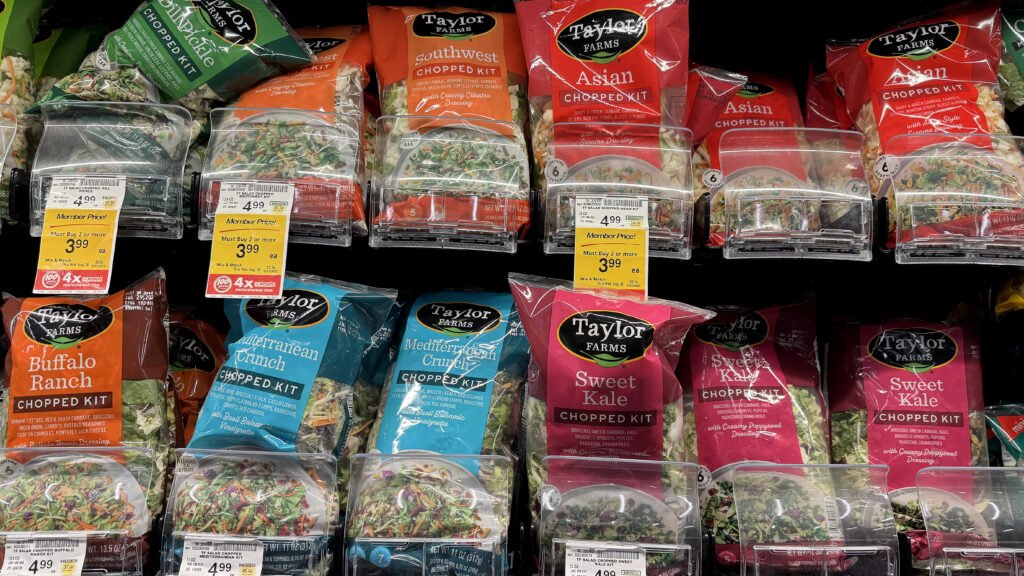
WASHINGTON – Federal health officials said Monday they continue to focus on Taylor Farms lettuce as the source of a diarrhea-causing parasite in multiple states, despite inaccurate test results the government briefly released over the weekend.
Food and Drug Administration officials announced Monday that laboratory testing incorrectly identified a positive result for Cyclospora on lettuce samples taken from Taylor Farms. The FDA posted the findings on its website on Saturday, but announced on Sunday that the results were false positives.
Federal and state authorities are investigating the increasing number of cases of the parasite, and outbreaks in five states were initially linked to lettuce served at Taco Bell stores. Taylor Farms announced Saturday that it is recalling 25 types of shredded lettuce and salad mix products that were sold under eight different brand codes. This product is used by many food chains and suppliers in the United States.
“FDA’s tracking and outbreak data continues to focus on shredded iceberg lettuce from the Taylor Farms site in central Mexico,” Donald Prater, acting director of the FDA’s food division, told reporters on Monday.
In addition to tracing the lettuce supply chain, FDA staff have begun testing samples of produce arriving across the U.S. border.

Why we still don’t know what foods are the source of Cyclospora
FDA officials said Monday that the false-positive result was due to a rapid test used to screen for traces of aerospores. The first sample that appeared to test positive for the parasite was obtained from Taylor Farms, but was not included in the company’s lettuce recall. FDA officials said they felt they had to alert the public about the discovery.
However, subsequent quality control testing revealed the positive result to be false. FDA officials notified Taylor Farms on Sunday.
The company promoted the latest test results on social media and claimed that “FDA has apologized to us.” Government officials said there was no formal apology.
Cyclospora is a microscopic parasite that infects food that comes into contact with human feces, most commonly when produce is irrigated or washed with contaminated water. Ingesting the parasite causes an intestinal disease characterized by “frequent and sometimes explosive bowel movements,” according to the CDC.
According to the FDA and CDC, Cyclospora will sicken at least 1,645 people and result in 141 hospitalizations in the United States in 2026. Government officials are investigating five separate outbreaks, including one originating from Taylor Farms.
Acting FDA Commissioner Kyle Diamantas said health officials continue to identify new cases related to the latest outbreak, including one that started last week.
“This means we need to take steps to ensure that contaminated products do not reach the market,” Diamantas explained.
As of Friday, foot traffic at many restaurant chains was down compared to the daily average from January 1 to July 6, according to Placer.ai, which tracks people’s movements based on cell phone usage.


Sign up for daily summary
Get all the health and medical news you need today in one email
Taco Bell suffered the biggest decline, an 18.9% drop, after federal health officials named the chain in an investigation into a cross-polyosis outbreak. According to Placer.ai, pedestrian traffic in Chopt has decreased by 14.3%. Chipotle and Panera Bread both saw traffic declines of nearly 7%, while Cava’s decline was smaller at 4.2%, according to the company.
Food safety investigators are often unable to draw a direct biological link between recalled produce and foodborne illness outbreaks. Some common tests used to test for food poisoning are not designed to detect Cyclospora. Technologists cannot grow the parasites in the lab, making it difficult to extract evidence from contaminated produce.
Instead, investigators draw conclusions based on what people ate, the proximity and timing of incidents, and other pattern descriptions.
— Matthew Perrone
AP Business Writer Anne D’Innocenzio contributed from New York.
