


Some breakthroughs in physics come from completely new inventions. Some people start with a new theory. But many advances occur when researchers combine familiar technologies in unexpected ways to create something more powerful than its individual parts.
This strategy could be particularly valuable in the search for weakly interacting particles, including neutrinos and certain dark matter candidates. These particles are notoriously difficult to detect because they rarely interact with normal matter. Building larger detectors and increasing their spatial resolution increases the probability of observing the weak signals they produce, but doing so often makes the equipment more complex and expensive.
Similar requirements apply to calorimeters. A calorimeter is a device used in collider experiments to measure the energy carried by particles.
Why particle detectors are so complex
Most particle physics experiments require reconstructing the three-dimensional (3D) paths that elementary particles take as they move through large amounts of dense matter.
One common detector material is scintillator. When a charged particle passes through a scintillator, the material emits a small flash of visible light. Scientists use these flashes to determine where the particles traveled and how they interacted with the detector.
To precisely localize particles, scintillators are usually divided into a huge number of small active sections. The optical fiber collects the photons produced in each section and carries the light to a photomultiplier tube or silicon photomultiplier tube, where the photons are counted.
This approach is very accurate, but difficult to scale.
For example, Japan’s T2K neutrino oscillation experiment uses a detector with about 2 tons of sensitive material made of about 2 million cubes and 60,000 fibers. At CERN and the Paul Scherrer Institute, the LHCb and Mu3e experiments use millions of thin scintillating optical fibers to reach submillimeter spatial resolution.
Although these systems demonstrate what segmented detectors can accomplish, they also reveal growing problems. As detectors grow larger, manufacturing, assembling, and reading millions of individual components can become a major technical and financial bottleneck.
A radical new approach to particle tracking
Researchers from ETH Zurich and EPFL are now proposing a completely different strategy.
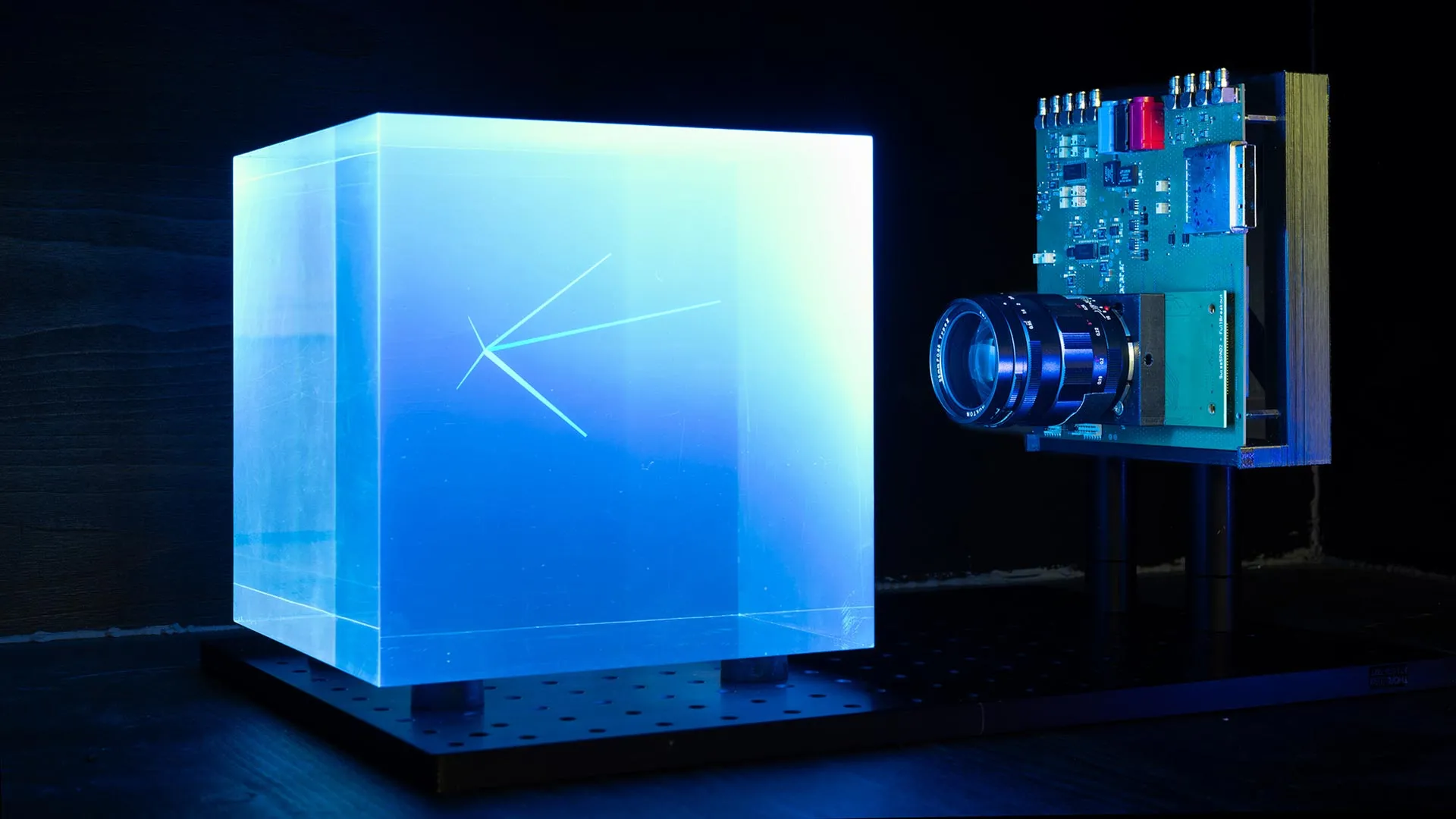
PhD student Till Dieminger, senior scientist Dr. Saul Alonso Monsalve, Professor Davide Sgaraverna and colleagues from their group, together with members of EPFL’s Advanced Quantum Architecture Laboratory in Lausanne, led by Professor Eduardo Charbon, developed and tested the first prototype of a detector designed to perform ultrafast, high-resolution 3D particle imaging in large blocks of unsegmented scintillator material.
Rather than splitting the detector into millions of tiny units, the system uses advanced camera technology to reconstruct where the light originates.
For a prototype demonstration and an extensive series of simulations, please see the recent nature communications.
Turn light field photography into physical tools
This detector is inspired by plenoptic cameras, also known as light field cameras.
Unlike regular cameras, which primarily record the intensity of incoming light, light field cameras also capture information about the direction from which the light is coming. This allows you to recover depth and reconstruct the scene in three dimensions.
This technology relies on a microlens array (MLA) placed between the camera’s main lens and the image sensor. Each microscope lens acts like a tiny camera, recording the same scene from a slightly different angle. Combining information from all these lenses allows the system to reconstruct a light field that describes the intensity, location, and direction of the incoming light.
For particle detection, this feature is especially useful because the light in the scintillator is very weak.
Plenoptic cameras combined with single-photon avalanche diode (SPAD) array sensors have the potential to detect individual photons and reconstruct particle trajectories even when very little light is available. Despite their promise, light-field cameras have not been previously explored for particle tracking.
Inside the PLATON prototype
This new system was developed through the PLATON project, which is funded by the Swiss National Science Foundation.
The ETHZ-EPFL team built a proof-of-concept detector that combines a micro-lens array with a SPAD image sensor. The sensor, known as SwissSPAD2, was developed by the EPFL team. Raytrix GmbH designed the MLA and attached it directly to the sensor, creating a complete plenoptic imaging system.
SwissSPAD2 also provides gated photon detection. This means that the sensor only records photons within a defined time frame.
This timing control allows researchers to focus on the periods when genuine scintillation light is most likely to be present, while eliminating random background signals and other spurious counts.
Test the detector with just a few photons
The researchers tested PLATON’s spatial resolution in laboratory experiments using light levels ranging from hundreds of detected photons to just five photons.
They also evaluated whether the prototype could detect electrons and reconstruct their positions within blocks of plastic scintillator. Electrons were generated using a strontium-90 source.
Across a variety of test conditions, the simulations closely matched laboratory measurements, giving the researchers confidence that their model accurately described the detector’s performance.
The results of the first demonstrator were already shaping the team’s plans for the next version of PLATON.
Faster timing and better sensitivity
Researchers are developing a new SPAD array sensor designed to improve photon detection efficiency and provide subnanosecond timing to individual photons.
In current systems, photons are assigned to fixed time windows. In the upgraded version, each detected photon receives its own precise timestamp.
The added timing information helps the system more accurately determine where each photon came from and improves reconstruction of particle tracking.
The researchers also optimized the plenoptic camera to expand its field of view and collect more light. The simulations presented in the paper suggest that these changes should further improve the spatial resolution of PLATON.
AI reconstructs hidden particle interactions
The research team also used simulations to estimate how the upgraded PLATON system would perform in detecting neutrinos.
The simulation incorporates a new image processing method based on neural networks (NN). The system uses the Transformer architecture, which is an adaptation of types commonly used in large-scale language models.
However, rather than analyzing words, this transformer looks at the patterns of scintillation photons recorded by the detector. It is designed to determine the correlation between when and where photons appear, allowing us to reconstruct the original particle interactions.
Simulations show that a non-segmented PLATON detector with a volume of (10x10x10)cm3 can realistically achieve sub-1mm spatial resolution.
They also suggest that the system may be able to identify neutrino interactions that produce final-state, low-momentum protons with high purity and efficiency. In other words, the detector may be able to select events of interest while rejecting many irrelevant signals.
Scale up to cubic meters
The researchers also considered how the technique would work with larger detectors.
Due to limited computing resources, it was not possible to perform a complete neutrino simulation on a 1 cubic meter block of unsegmented scintillator. Instead, they modeled a simplified point-like photon source.
Simulations suggest that a detector of this size can achieve spatial resolution of several millimeters and is comparable to state-of-the-art plastic scintillator detectors.
This result is particularly noteworthy because PLATON is able to achieve this performance without breaking the scintillator into millions of individual parts.
The authors believe that further improvements in the optical design and other parts of the system could eventually enable submillimeter resolution in PLATON-type detectors with volumes greater than 1 m3.
Potential applications beyond particle physics
Researchers at ETH Zurich believe this technology could eventually be useful far beyond neutrino experiments and particle colliders.
PLATON is designed to reconstruct the location of weak optical signals in three dimensions, potentially improving a wide range of imaging systems.
Dieminger, Alonso-Monsalve and Sgalaberna have already filed three patents for the use of PLATON technology in positron emission tomography (PET). PET is a medical imaging method that tracks radioactive tracers in the body to reveal the activity of organs and tissues.
The patent covers both the scanner design and image processing technology, including the NN developed by Alonso Monsalve.
Particle physics has a long history of creating techniques that are later used in a wider range of applications. The World Wide Web was created at CERN, and proton therapy was developed through advances in particle accelerators and radiation physics.
PLATON could be another example of a physics experiment that could lead to major scientific and medical applications.
