


NEW YORK — Infections caused by the diarrhea-causing parasite Cyclospora are soaring, with 2026 already the worst year ever reported in the country, according to state-level data.
More than 30 states have reported infections this year, with the number of infections exceeding the U.S. record of about 4,700 set in 2019, according to the latest data. The disease is usually not life-threatening and is usually treated with antibiotics.
Health authorities have not yet clearly identified the cause of the infection. Federal health officials on Tuesday said they believe the cases in at least four states – Michigan, Ohio, Kentucky and West Virginia – are related, but that transmission patterns may vary by location.
Michigan officials condemn lettuce
In Michigan, where more than 3,300 cases have been reported, officials say early information suggests lettuce and salad greens may be the culprit.
After conducting more than 1,000 interviews with patients, “early information indicates lettuce is a common product that comes up regularly during investigations,” said Natasha Baghdasarian, medical director for the Michigan Department of Health.

American food safety could be headed for collapse
Because of this commonality, and because agricultural products have been behind past cyclospora outbreaks, Michigan officials advised consumers to buy lettuce whole, discard the outer layer, and thoroughly wash leftovers. They also suggested people avoid bagged lettuce and premix salad kits.
Taco Bell restaurant chain released a statement on Tuesday saying, “As a precautionary measure, we have voluntarily and temporarily removed limited food from some of our restaurants. We will continue to closely monitor the situation and follow the guidance of public health officials.”
Federal health officials did not directly answer questions on a call with reporters Tuesday about whether they were considering Taco Bell or any specific food vendors or distributors.
“FDA is certainly continuing to follow up on multiple agricultural products, including those where cases were reported before they became ill,” Donald Prater, acting deputy commissioner for food at the U.S. Food and Drug Administration, said in response.
Cyclospora causes ‘explosive’ diarrhea
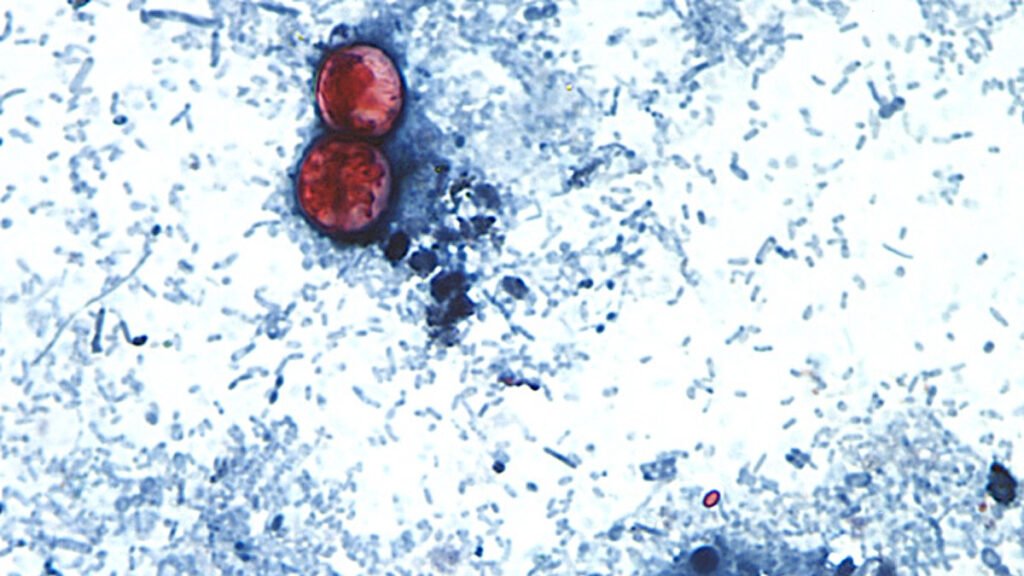
Cyclospora is a microscopic, spherical parasite that typically causes watery diarrhea “with frequent, sometimes explosive defecation,” according to the Centers for Disease Control and Prevention. Outbreaks tend to occur most often in late spring and summer.
This heat-loving parasite infects the intestines and spreads through feces. In the past, some people have been infected by consuming fruits and vegetables that have been exposed to irrigation water contaminated with feces.


Sign up for daily summary
Get all the health and medical news you need today in one email
This disease, called cyclosporiasis, is less common than food poisoning caused by other bacteria such as salmonella and E. coli. Many cases were not linked to specific foods or other sources, and for many years very few outbreaks of Cyclospora were reported in the United States. But that number started increasing about a decade ago, with particularly notable spikes in 2018 and 2019.
Experts say cases of cyclospora have likely been underreported historically, in part because some common tests used to check for food poisoning are not suitable for detecting the disease. They attribute the upward trend in cases to climate change and improved detection.
2019 was the worst year for infectious diseases
The worst year for infections in the U.S. was 2019, when about 4,700 cases of the disease were reported, according to federal data.
The Centers for Disease Control and Prevention keeps these numbers, but they lag behind those published by individual city and state health departments, which are dealing with local outbreaks in real time. On Tuesday, CDC officials issued a health alert saying that since May 1, the agency knows of 1,645 confirmed cases in the country and more than 5,100 cases that require further analysis to determine whether they were infected in the United States. Reports have come from 34 states, and no deaths have been reported, the CDC said.
Gwen Biggerstaff, deputy director of the CDC’s Division of Foodborne, Waterborne, and Environmental Diseases, said in a call with reporters that the actual number of cases is likely higher than what has been reported so far because some people may have mild illness without seeking treatment.
It may take days to weeks for a person exposed to the parasite to develop symptoms. It is not clear how infected people are now or whether many infections occurred earlier. But Biggerstaff said officials expect the number of cases to continue rising through August.
The CDC also posted information about its investigation into the outbreak, which has affected four states.
The federal alert does not provide details on the number of cases reported by each state. But Michigan officials reported more than 3,300 confirmed cases, officials in northwestern Ohio confirmed more than 1,100, New York City officials reported more than 400 and Illinois reported more than 200.
Officials do not believe everything can be tied to a common source. Illinois, for example, said more than half of those infected had a history of travel outside the United States, suggesting at least some may have been infected outside the United States.
But Michigan officials believe a large portion of the total number of cases is likely due to related domestic transmission. CDC officials did not elaborate on why they currently believe cases in Michigan, Ohio, Kentucky and West Virginia are part of the same outbreak.
— Mike Stobbe
Associated Press writer DeAnn Durbin in Detroit contributed to this report.
