


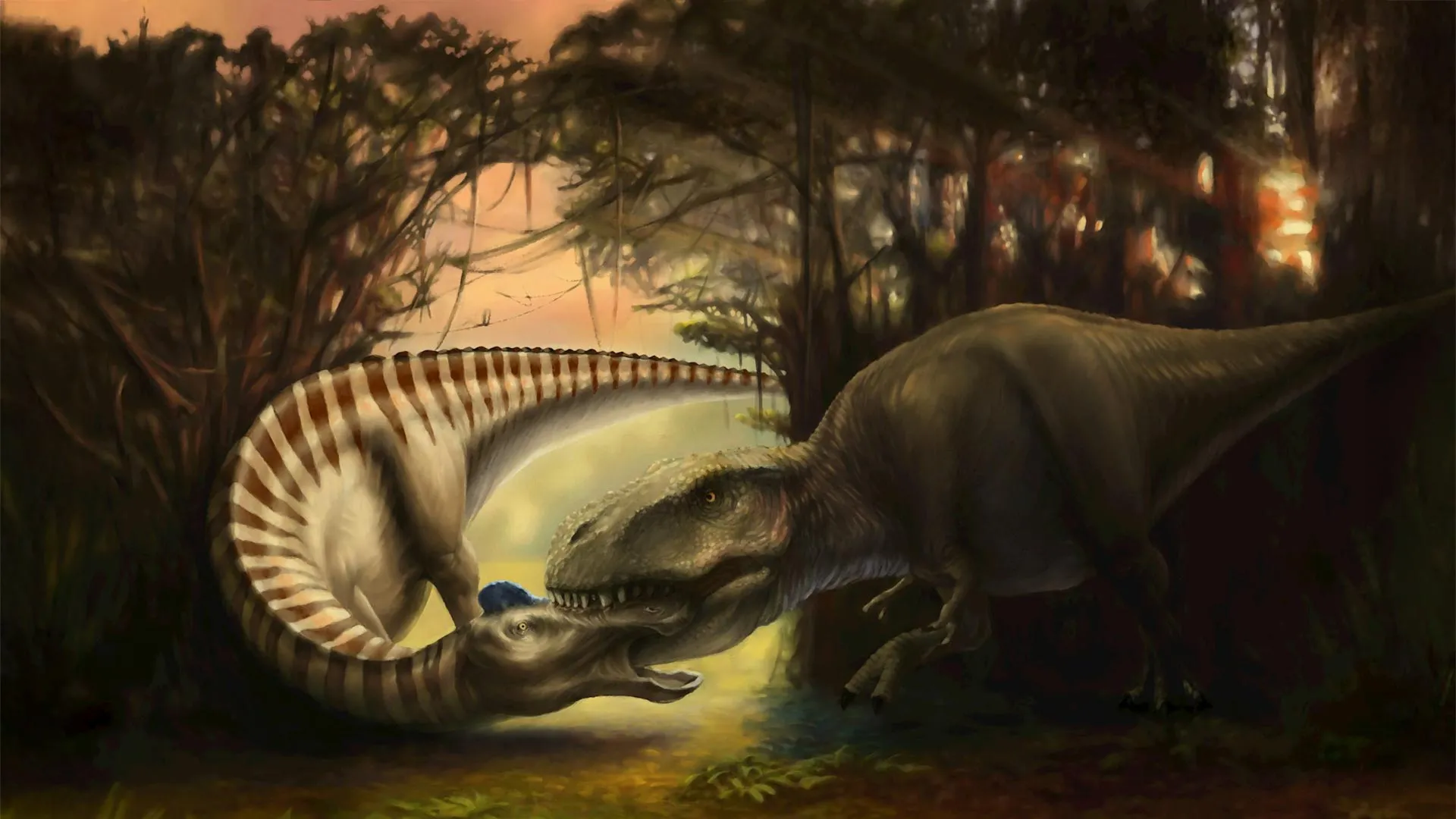
A remarkable fossil at the Montana State University Museum of the Rocky Mountains is offering scientists an unusually detailed glimpse into how Tyrannosaurus rex attacked its prey. The specimen, which contains a Tyrannosaurus tooth still embedded in the skull of another dinosaur, is the focus of a new study by researchers at Canada’s Montana State University and the University of Alberta.
About 66 million years ago, near the end of the dinosaur era, Tyrannosaurus rex ruled what is now Montana. This giant predator shared its environment with other giants, including the horned Triceratops and the duck-billed herbivore Edmontosaurus.
Embedded Tyrannosaurus teeth tell an ancient story
In 2005, researchers discovered a nearly complete Edmontosaurus skull in the Hell Creek Formation on land managed by the Bureau of Land Management in eastern Montana. The fossil is now part of the Museum of the Rockies’ paleontology collection, and what immediately stands out is that a broken Tyrannosaurus tooth remains stuck in the animal’s face.
The skull, now on display in the museum’s Hall of Horns and Teeth, was the centerpiece of a joint expedition led by University of Alberta doctoral student Taia Weinberg-Henzler and Museum of the Rockies curator of paleontology John Scannella. Their findings were published in the scientific journal PeerJ.
“Bite marks on bones are relatively common, but finding embedded teeth is very rare,” Weinberg-Henzler said. “The great thing about the teeth, especially those embedded in the skull, is that we can identify not only who was bitten, but also who did the biting. This allowed us, like a Cretaceous crime scene investigator, to paint a picture of what happened to this Edmontosaurus.”
CT scan helps reconstruct attack
To identify the predator, the researchers compared the implanted teeth to the teeth of all known carnivorous dinosaurs from the Hell Creek Formation. The winner was Tyrannosaurus. A CT scan performed at Bozeman Health Deaconess Hospital’s Advanced Medical Imaging Facility provided further details about how the tooth became trapped in the skull.
“Fossils like this are particularly interesting because they capture the behavior of a Tyrannosaurus rex biting this platypus in the face,” Scannella said. “The skull shows no signs of healing around the Tyrannosaurus teeth, so it may have been dead at the time of the bite or died from the bite.”
Rare fossils provide new clues about Tyrannosaurus behavior
According to Weinberg-Henzler, tooth position provides important clues about predator-prey encounters.
“Seeing the teeth embedded in Edmontosaurus’ snout suggests that it met its attacker face-to-face, which typically happens to animals killed by predators,” Weinberg-Henzler said. “The amount of force required to break the teeth within the bone indicates the use of lethal force. To me, this is a horrifying depiction of the final moments of this Edmontosaurus.”
Scientists have debated the feeding habits and hunting behavior of tyrannosaurs for decades. As one of the largest carnivores to ever walk the Earth, it has long been the focus of paleontological research. This rare fossil, with embedded teeth preserved for millions of years, provides another piece of valuable evidence of how the iconic predator hunted and subdued its prey.
