


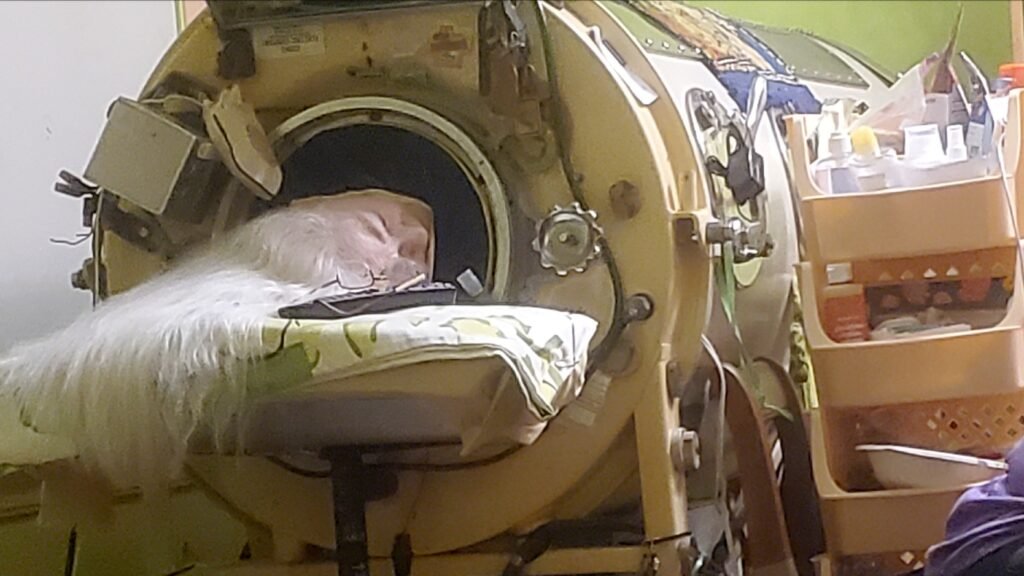
Martha Lillard was diagnosed with polio when she was just 5 years old and relied on an iron lung to survive. She was the last American polio patient to use the device, and died on June 26 in Oklahoma, according to her sister. She was 78 years old.
“They told her she shouldn’t live past 20,” Lillard’s sister, Cindy McVeigh, told The Associated Press on Friday. “She had a passion and drive to continue living and make the most of life.”
McVeigh believes her sister’s death was due to the long-term effects of COVID-19. The death certificate listed chronic lung failure and post-polio syndrome as causes, McVeigh said.
Lillard slept in a steel lung cylinder that covered her body, allowing air to move in and out of her lungs depending on the air pressure in the room. As a child, she attended elementary school for two hours a day and was tutored the rest of the time. She attended Shawnee High School using a phone system that allowed her to communicate with teachers and classmates through the classroom intercom.
Her family took a road trip to Missouri thanks to a custom trailer, and her father called the hotel to see if the door was wide enough to accommodate the car Lillard was sleeping in. Lillard was even able to drive a car at one point.

Vaccine development giant sees gains in his field eroded
“For me, it was just a normal thing,” McVeigh, 75, recalls.
Polio was once one of the most feared diseases in the country, paralyzing thousands of people each year. This disease primarily affects children.
A vaccine became available in 1955. National vaccination campaigns reduced the number of annual infections in the United States to less than 100 in the 1960s and less than 10 in the 1970s, according to the federal Centers for Disease Control and Prevention. In 1979, polio was declared eradicated in the United States. This means that polio is no longer a routine epidemic.
Then, thanks to the internet, Lillard was able to stay informed and learn about all kinds of topics, including the disease that left him paralyzed from the neck down.
Treatment allowed her to regain partial use of her left arm and use of her legs. However, she could only move her left arm from side to side at her waist. Unable to help, she lived alone for many years and prepared her own meals.
Thanks to the Internet, Lillard was able to meet her future husband. After the September 11, 2001 terrorist attacks, Lillard wanted to better understand what happened. McVeigh said she met an Egyptian man in a chat room and they had been communicating online for more than 20 years.
Lillard married Baha Sarr in February after finally being able to obtain a travel visa to Oklahoma.
“They really were soul mates,” McVeigh said. “He’s very heartbroken.”


Sign up for daily summary
Get all the health and medical news you need today in one email
During the coronavirus pandemic, Lillard contracted COVID-19 twice. Before contracting COVID-19, her lung capacity was less than 25%. For the last five years of her life, she had difficulty breathing and was unable to leave the house. For the past two years, she has been in an iron lung nearly 24 hours a day, McVeigh said.
McVeigh described her sister as artistic and creative. She wrote poems and composed songs. She wrote her own obituary, which is now posted online by the funeral home. She explained that she is a volunteer with the Humane Society. “She was an avid beagle fan and a Facebook cross-poster who helped with animal rescue efforts,” Lillard wrote.
She later updated her obituary to say she “passed away from a prolonged COVID-19 infection,” but McVeigh also added the date of her death.
In recent years, McVay and Lillard were desperately looking for someone to fix her iron lung, one of several she had in her life.
“But we don’t have to do that anymore because she’s the last one,” McVeigh said through tears.
— Jennifer Cinco Kelleher
