

Close Menu

    Subscribe to Updates

    Get the latest creative news from FooBar about art, design and business.

    What's Hot

    How controlling an AI’s personality changes the way it interacts with other AIs

    July 13, 2026

    A 200-year-old physics experiment could help build future computers

    July 13, 2026

    Losing just 80 minutes of sleep can lead to weight gain

    July 13, 2026
    Facebook X (Twitter) Instagram
    Facebook X (Twitter) Instagram
    Health Magazine
    • Home
    • Environmental Health
    • Health Technology
    • Medical Research
    • Mental Health
    • Nutrition Science
    • Pharma
    • Public Health
    • Discover
      • Daily Health Tips
      • Financial Health & Stability
      • Holistic Health & Wellness
      • Mental Health
      • Nutrition & Dietary Trends
      • Professional & Personal Growth
    • Our Mission
    Health Magazine
    Home » News » Stephen Hawking’s black hole law has received a major upgrade
    Nutrition Science

    Stephen Hawking’s black hole law has received a major upgrade

    healthadminBy healthadminJuly 13, 2026No Comments5 Mins Read
    Stephen Hawking’s black hole law has received a major upgrade
    Share
    Facebook Twitter Reddit Telegram Pinterest Email


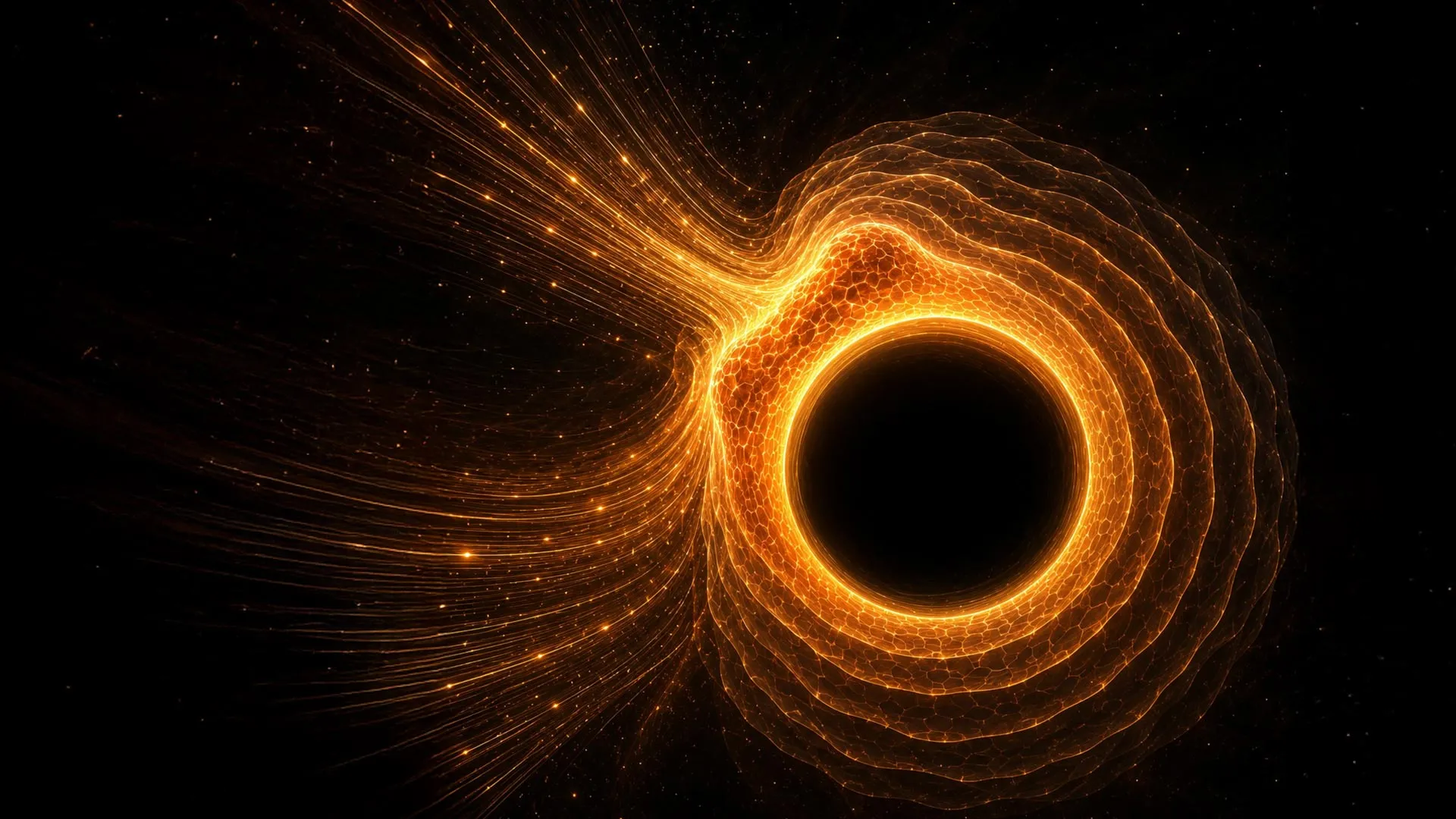
    Scientists have proposed a new way to describe black holes that could overcome major limitations in one of Stephen Hawking’s most influential ideas. The study introduces a modern approach to black hole thermodynamics that works even when black holes are changing over time, and could yield new insights into how black holes form, coalesce, and slowly evaporate.

    Black holes are one of the most extreme objects in the known universe. It forces enormous amounts of mass into an incredibly small area, creating a gravitational force so strong that not even light can escape. To understand these cosmic objects, physicists rely on Einstein’s theory of general relativity and quantum mechanics.

    In the early 1970s, Stephen Hawking and other researchers discovered a surprising connection between the behavior of black holes and the laws of thermodynamics that explain familiar processes such as heating water in a stove.

    “While Hawking’s laws of black hole mechanics provide a satisfying connection between extreme and ordinary physics and have been the paradigm for 50 years, they have important limitations,” said Abhay Ashtekar, Atherton University professor, Evan Pugh Professor Emeritus of Physics at Penn State’s Eberly College of Science, and leader of the research team. “They were formulated for black holes in equilibrium, that is, black holes that do not change over time, but black holes are constantly changing, forming, merging, and eventually evaporating. We wanted to find a way to overcome this limitation and extend the laws to black holes that are out of equilibrium.”

    Ashtekar and his colleagues have now proposed a new method for determining the entropy of black holes. Entropy is a measure of disorder, and according to the second law of thermodynamics, it never decreases. Their findings were; physical review letter Selected as a suggestion by the editors, we introduced a measure of entropy that is more closely related to the spin and energy of black holes. The researchers say this could improve scientists’ understanding of dynamic phenomena such as black hole mergers and evaporation.

    Why we need to update Hawking’s framework

    “The laws of black hole mechanics come directly from Einstein’s equations,” said Daniel E. Paraizo, a physics graduate student at Penn State and an author on the paper. “Since we can’t see inside a black hole, it seemed that there were an infinite number of ways to create a black hole, and its entropy would be infinite. Also, it was thought that black holes could only absorb energy, not radiate it, so their temperature was zero.”

    Initially, these ideas seemed to contradict the well-known laws of thermodynamics, as black holes did not appear to have infinite entropy and temperature. Hawking later changed that by using quantum mechanics to demonstrate that black holes can emit particles and energy.

    “This changes the way we think about the thermodynamic properties of black holes, from a kind of mathematical concept described in equations to something more akin to physical reality,” Paraizo said. “This opens the door to discovering the black hole analogy between entropy and temperature used in thermodynamics.”

    Hawking proposed that the size of a black hole’s event horizon, the boundary from which not even light can escape, is proportional to its entropy. He also showed that the temperature of a black hole depends on the combination of its mass and spin.

    A better measure of dynamic black holes

    The problem, the researchers say, is that Hawking’s approach only works if the black hole is in equilibrium.

    “But there’s a problem,” says Jonathan Schuh, a physics graduate student at Penn State and an author on the paper. “These analogies only really work for black holes in equilibrium. In dynamic situations, an event horizon can form and grow in a so-called flat region of spacetime where nothing is happening. This makes the event horizon teleological; its properties cannot be determined solely by the local physics of the black hole. Therefore, the area of the event horizon is not a measure of the physical entropy of a dynamic black hole as it grows, evaporates, and merges.”

    The researchers’ solution replaces the traditional event horizon with what physicists call a “dynamic horizon.” This concept is already widely used in computer simulations of black holes. Unlike event horizons, dynamic horizons are defined by the properties of a black hole at a particular moment in time, avoiding the complications introduced by relying on future events.

    “This allows us to extend the first and second laws of thermodynamics to non-equilibrium black holes, overcoming the limitations of a paradigm that has been in use for more than half a century,” Ashtekar said. “Applying these generalized laws allows us to better understand evaporating black holes and black hole mergers in quantum theory, such as those detected by the LIGO-Virgo-KAGRA collaboration using gravitational waves.”

    This research was supported by the Penn State Atherton Professorship Program and the Penn State Eberly College of Science.


    Source link

    Visited 2 times, 2 visit(s) today
    Share. Facebook Twitter Pinterest LinkedIn Telegram Reddit Email
    Previous ArticleWealth and air pollution emerge as the biggest predictors of state autism rates
    Next Article Last polio patient in the US who used an iron lung died at age 78
    healthadmin

    Related Posts

    A 200-year-old physics experiment could help build future computers

    July 13, 2026

    Losing just 80 minutes of sleep can lead to weight gain

    July 13, 2026

    Why do young healthy non-smokers develop lung cancer?

    July 13, 2026

    Scientists have discovered that the brain doesn’t make decisions the way we think it does

    July 13, 2026

    Large-scale study finds that where you live may affect your risk of dementia

    July 13, 2026

    Quantum mechanics may not need imaginary numbers after all, physicists say

    July 13, 2026
    Add A Comment
    Leave A Reply Cancel Reply

    Categories

    • Daily Health Tips
    • Discover
    • Environmental Health
    • Exercise & Fitness
    • Featured
    • Featured Videos
    • Financial Health & Stability
    • Fitness
    • Fitness Updates
    • Health
    • Health Technology
    • Healthy Aging
    • Healthy Living
    • Holistic Healing
    • Holistic Health & Wellness
    • Medical Research
    • Medical Research & Insights
    • Mental Health
    • Mental Wellness
    • Natural Remedies
    • New Workouts
    • Nutrition
    • Nutrition & Dietary Trends
    • Nutrition & Superfoods
    • Nutrition Science
    • Pharma
    • Preventive Healthcare
    • Professional & Personal Growth
    • Public Health
    • Public Health & Awareness
    • Selected
    • Sleep & Recovery
    • Top Programs
    • Weight Management
    • Workouts
    Popular Posts
    • 1773313737_bacteria_-_Sebastian_Kaulitzki_46826fb7971649bfaca04a9b4cef3309-620x480.jpgHow Sino Biological ProPure™ redefines ultra-low… March 12, 2026
    • pexels-david-bartus-442116The food industry needs to act now to cut greenhouse… January 2, 2022
    • 1773729862_TagImage-3347-458389964760995353448-620x480.jpgDespite safety concerns, parents underestimate the… March 17, 2026
    • 1773209206_futuristic_techno_design_on_background_of_supercomputer_data_center_-_Image_-_Timofeev_Vladimir_M1_4.jpegMulti-agent AI systems outperform single models… March 11, 2026
    • 1774403998_image_28620e4b6b0047f7ab9154b41d739db1-620x480.jpgGait pattern helps distinguish between Lewy body… March 24, 2026
    • Leukemia-620x480.jpgBiomimetic platform powers CAR T therapy for… March 9, 2026

    Demo
    Stay In Touch
    • Facebook
    • Twitter
    • Pinterest
    • Instagram
    • YouTube
    • Vimeo
    Don't Miss

    How controlling an AI’s personality changes the way it interacts with other AIs

    By healthadminJuly 13, 2026

    A study examining the personality traits of three major language models and their relationship to…

    A 200-year-old physics experiment could help build future computers

    July 13, 2026

    Losing just 80 minutes of sleep can lead to weight gain

    July 13, 2026

    Dementia research sees promising data after risk reduction strategies

    July 13, 2026

    Subscribe to Updates

    Get the latest creative news from SmartMag about art & design.

    HealthxMagazine
    HealthxMagazine

    At HealthX Magazine, we are dedicated to empowering entrepreneurs, doctors, chiropractors, healthcare professionals, personal trainers, executives, thought leaders, and anyone striving for optimal health.

    Our Picks

    Dementia research sees promising data after risk reduction strategies

    July 13, 2026

    How AI will reshape digital health funding in 2026

    July 13, 2026

    The evolutionary reasons for who we choose as friends

    July 13, 2026
    New Comments
      Facebook X (Twitter) Instagram Pinterest
      • Home
      • Privacy Policy
      • Our Mission
      © 2026 ThemeSphere. Designed by ThemeSphere.

      Type above and press Enter to search. Press Esc to cancel.